Chemistry handbook, tables, and simulator guides
Short answers to school chemistry questions, ready-to-use tables, and experiments you can try yourself.
Tables and reference
 First 20 Elements
The total number of elements, plus the names, symbols, and atomic masses of the first 40 elements in one table.
2 min read Atomic mass table
Type your formula and get its molar mass instantly. Includes a table of all 118 elements.
2 min read Metals and nonmetals
Position on the periodic table, differences in properties, and metalloids.
2 min readChoosing an app

Simulator guides: Atoms & bonding
 Atomic interactions
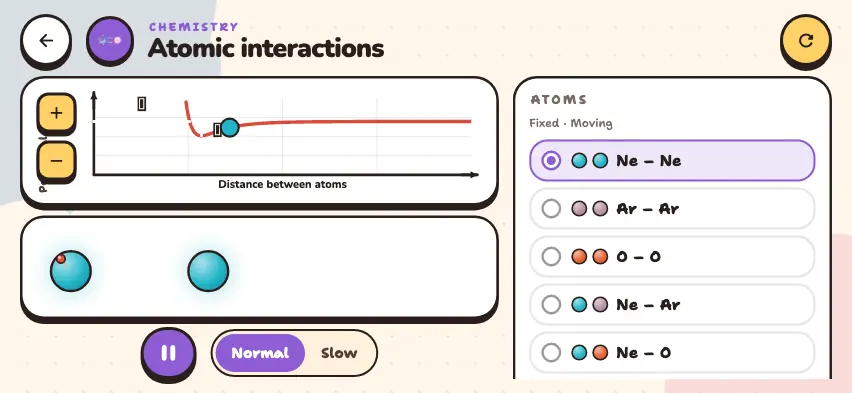
Attraction and repulsion between atoms, the potential energy curve, σ and ε, and a simulator guide.
4 min read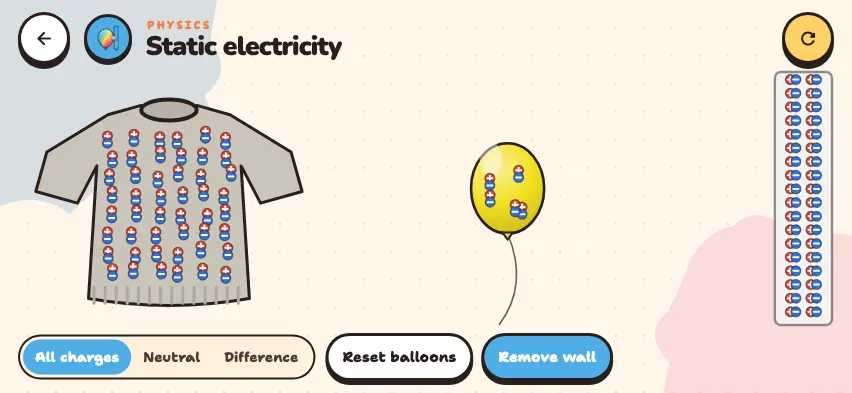 Static electricity
How rubbing moves electrons, why a charged balloon attracts a neutral wall, and a simulator guide.
3 min read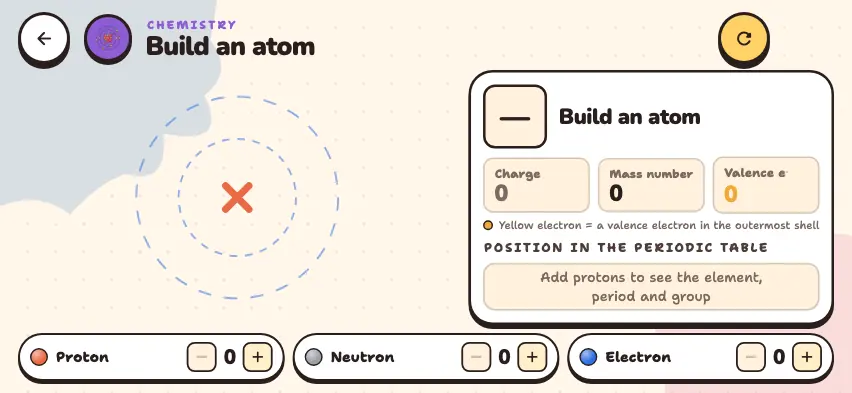 Atomic structure
The three particles of an atom, mass number, charge, ions, valence electrons, and a guide to building an atom.
3 min read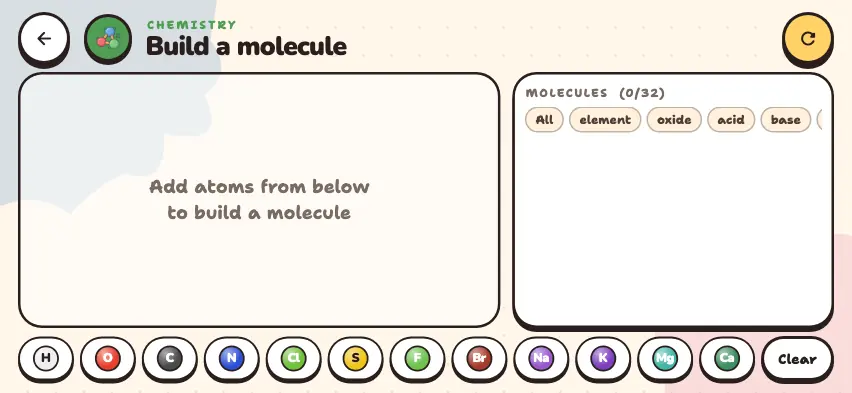 Molecular structure
Molecules vs. ionic compounds, bond length and energy, and a guide to building 32 compounds.
3 min read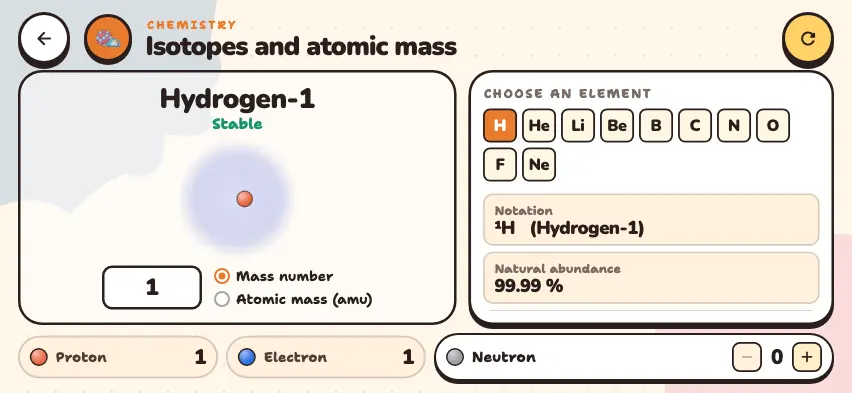 Isotopes and atomic mass
The definition of an isotope, mass number, natural abundance, and an average atomic mass problem.
3 min read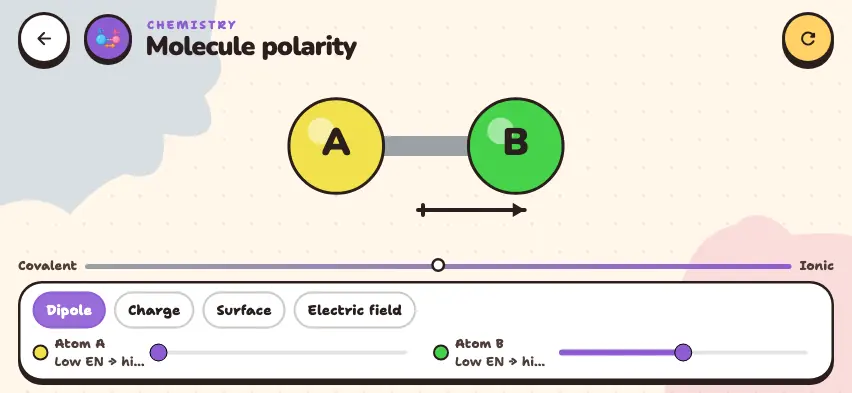 Molecule polarity
Electronegativity differences, δ+ and δ− charges, dipoles, and polar and nonpolar bonds.
3 min read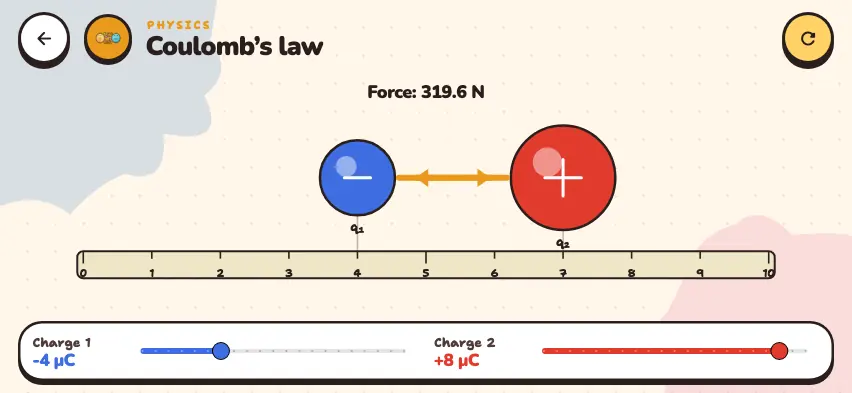 Coulomb's law
The Coulomb's law formula, a worked example, the link to ionic bonds, and a simulator guide.
3 min read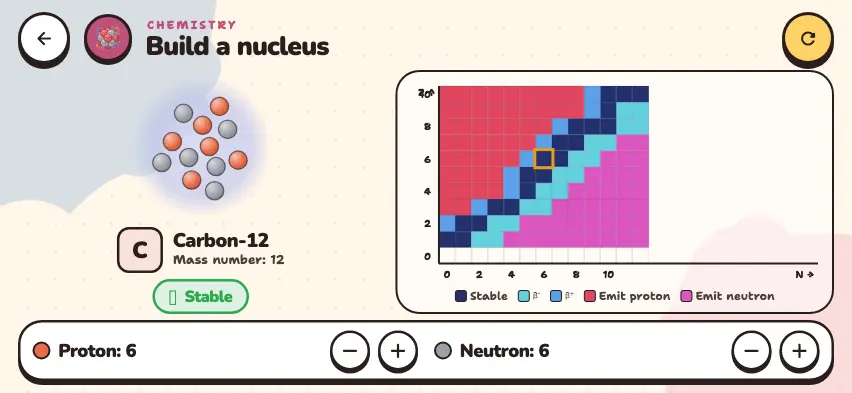 Atomic nucleus
Nuclear stability, the chart of nuclides, β⁻ and β⁺ decay, and a guide to building a nucleus.
3 min read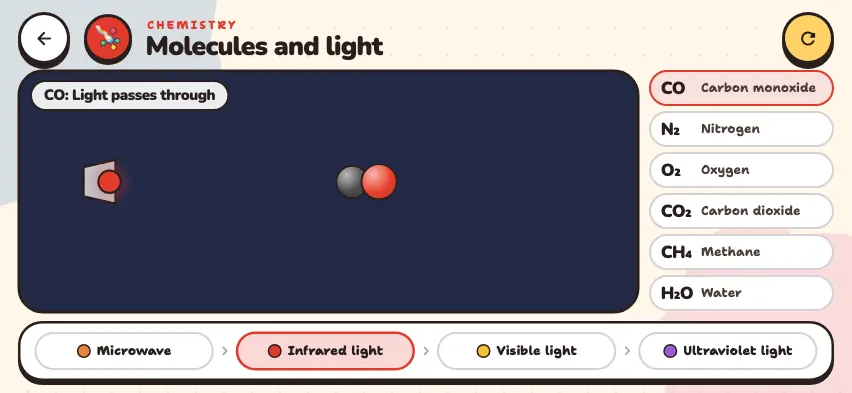 Molecules and light
How light affects molecules, greenhouse gases, the ozone layer, and a simulator guide.
3 min read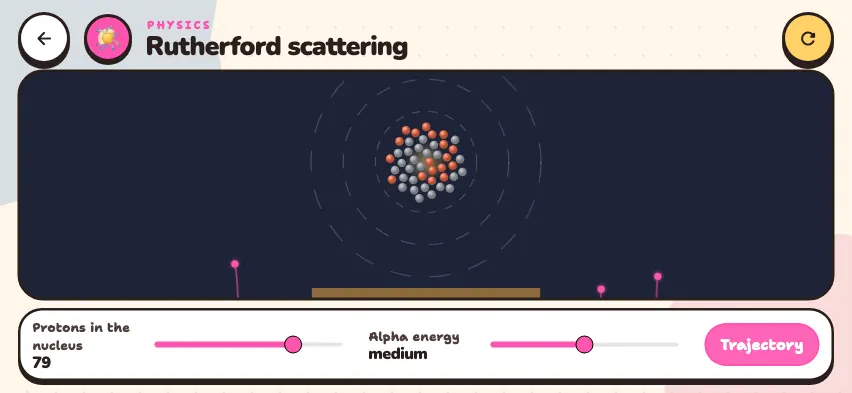 Rutherford's experiment
The gold foil experiment, observations and conclusions, alpha particle deflection, and a simulator guide.
3 min read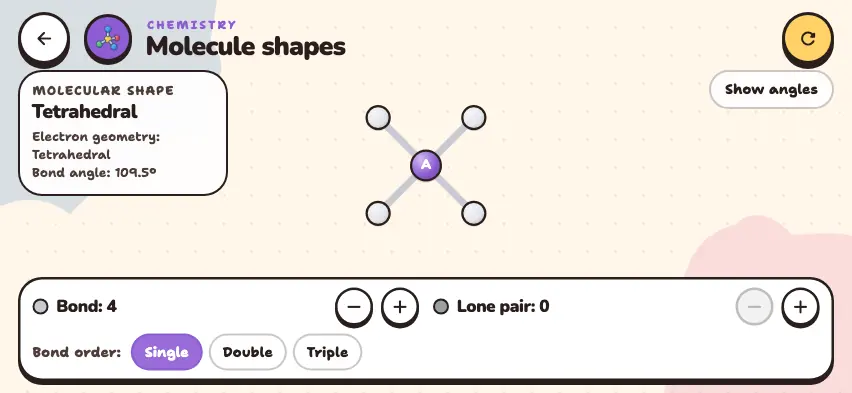 VSEPR theory
Electron geometry for 2–6 domains, a molecular shape chart, and how to count lone pairs.
4 min read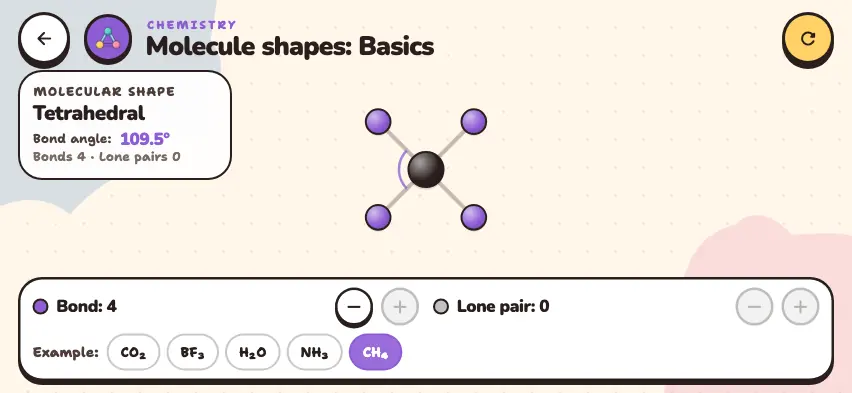 Molecule shapes: Basics
Count bonds and lone pairs to recognize linear, tetrahedral, pyramidal, and bent shapes.
4 min read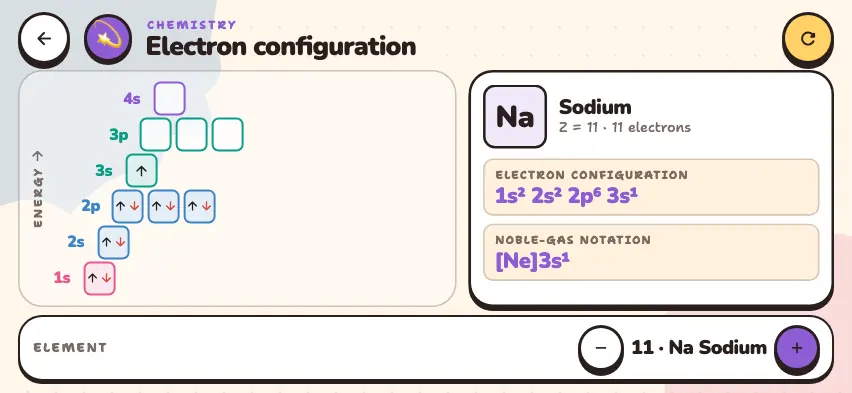 Electron configuration
How to use three rules to write 1s²2s²… notation for the first 20 elements.
3 min read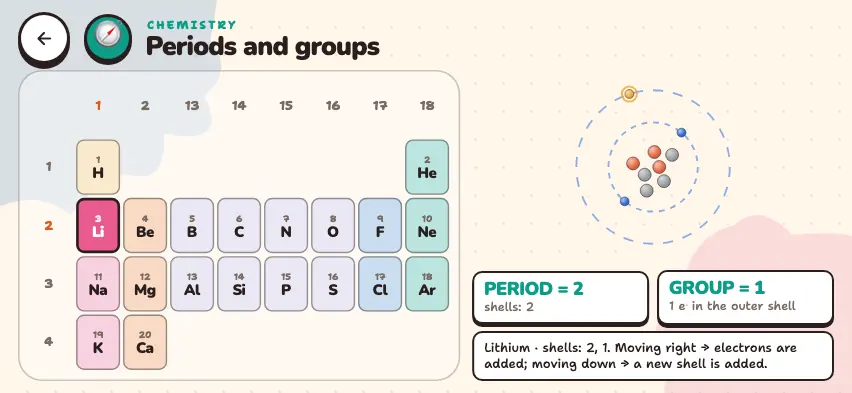 Periods and groups
How to find shells and outer electrons from the period and group, with the first 20 elements as examples.
3 min read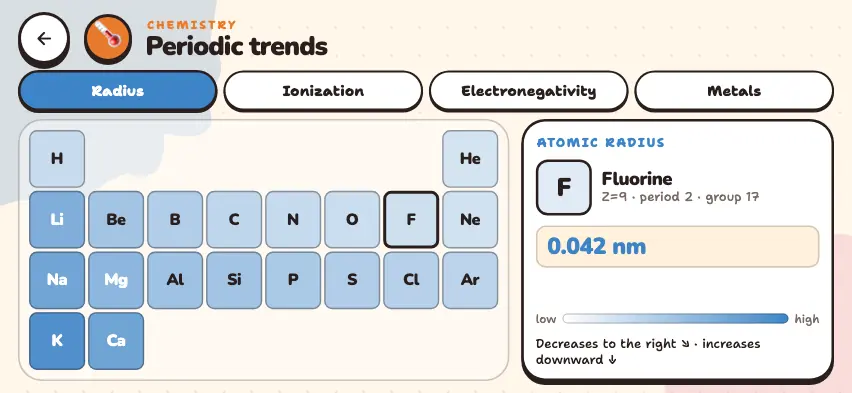 Periodic trends
The direction of radius, ionization, electronegativity, and metallic character, with reasons and exceptions.
3 min read History of atomic models
The key idea of each of the four models, the discoveries that changed them, and each model's flaw.
3 min read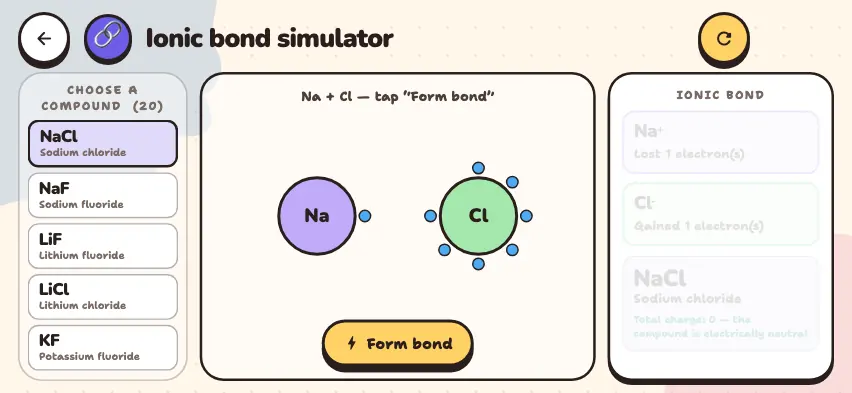 Ionic bonding
See how a metal gives up electrons and how oppositely charged ions attract, with 20 compounds.
3 min read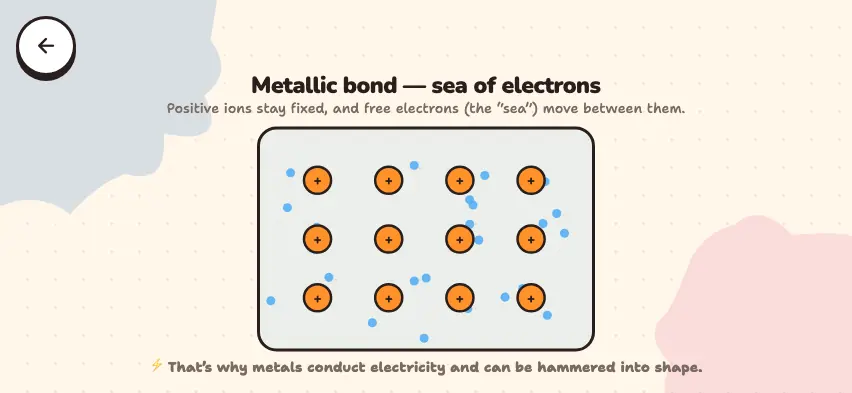 Metallic bonding
How positive ions and free electrons explain why metals conduct electricity and are malleable.
3 min read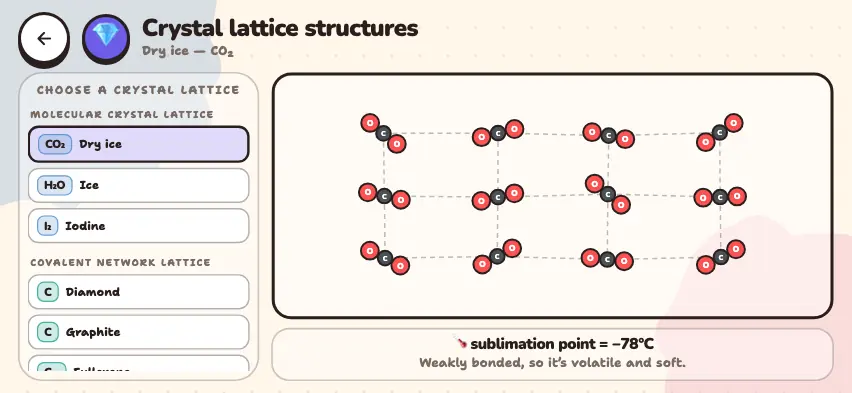 Crystal lattices
Compare the particles, bonds, and properties of the four lattice types with 11 examples.
3 min read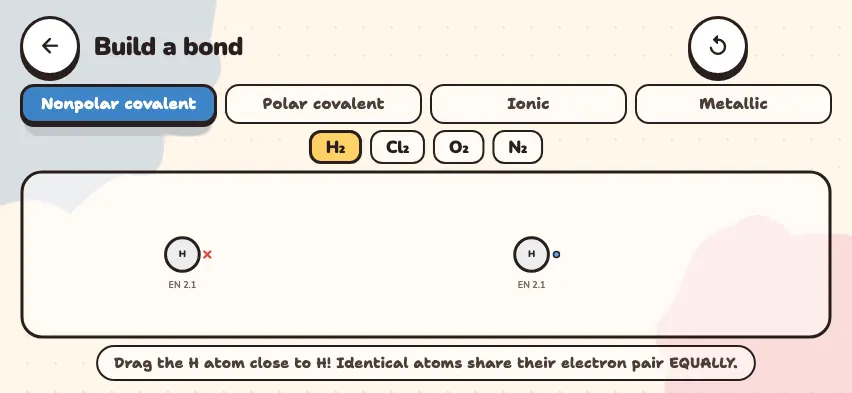 Types of chemical bonds
Tell four types of bonds apart by electron distribution and electronegativity difference.
3 min read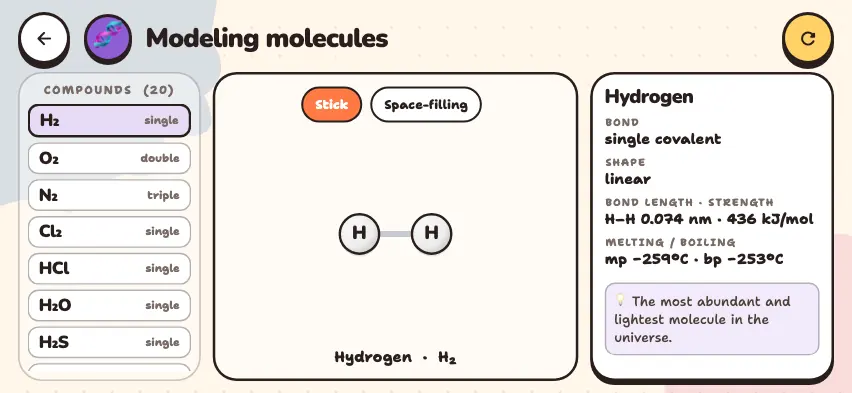 Molecular models
How the two models differ, single, double, and triple bonds, and the shapes and angles of 20 compounds.
3 min read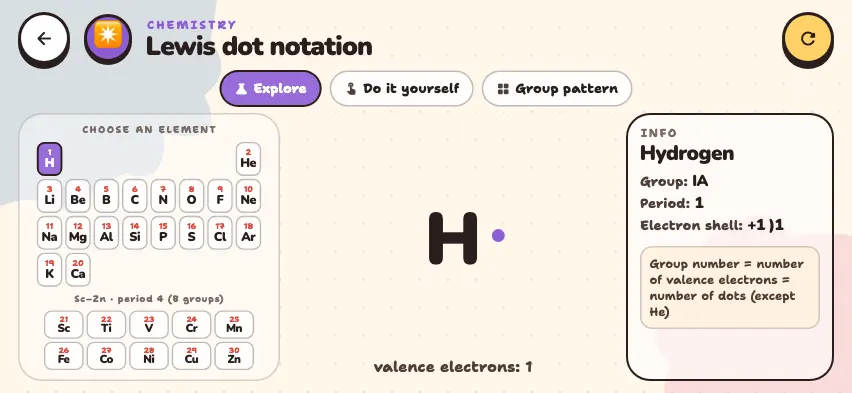 Lewis dot structures
Dot placement rules, the eight-group pattern, and a simulator for the first 30 elements.
3 min readSimulator guides: Matter, states & mixtures
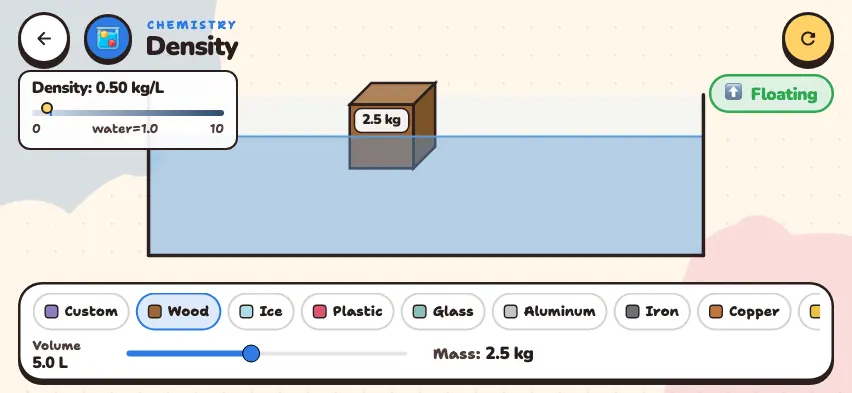 Density
The density formula, the densities of eight materials, and when objects float or sink.
3 min read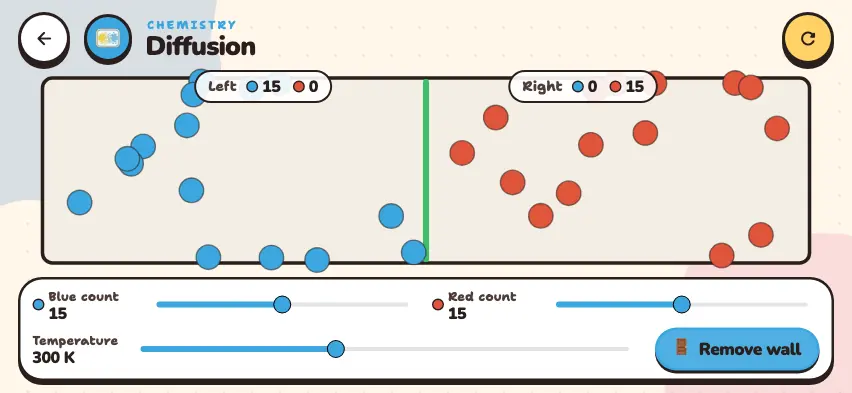 Diffusion of two gases
How two gases mix, counting the particles on each side, and the effect of temperature.
3 min read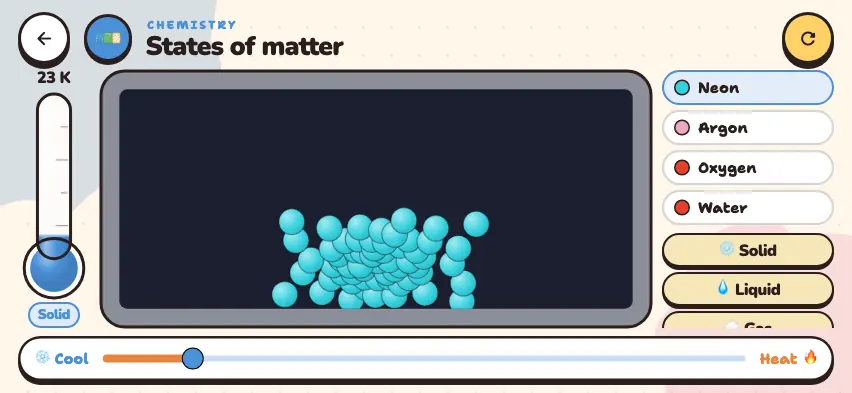 Melting and boiling points
 of four substances, kelvins and °C, and the attraction between particles.
3 min read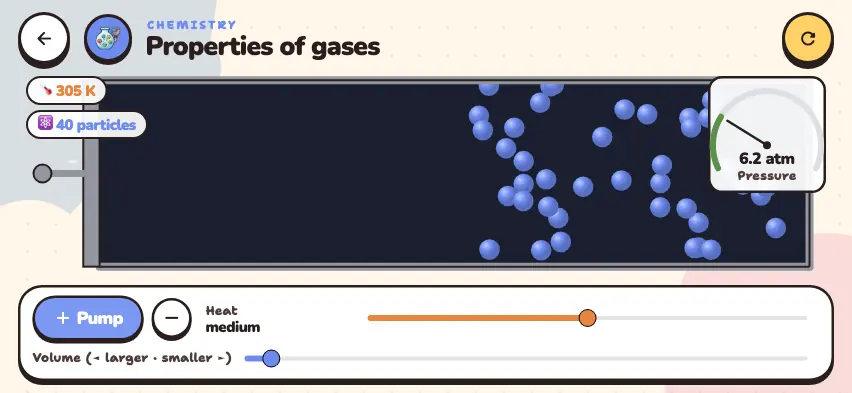 Properties of gases
How pressure forms, the three factors that affect it, and a simulator guide.
3 min read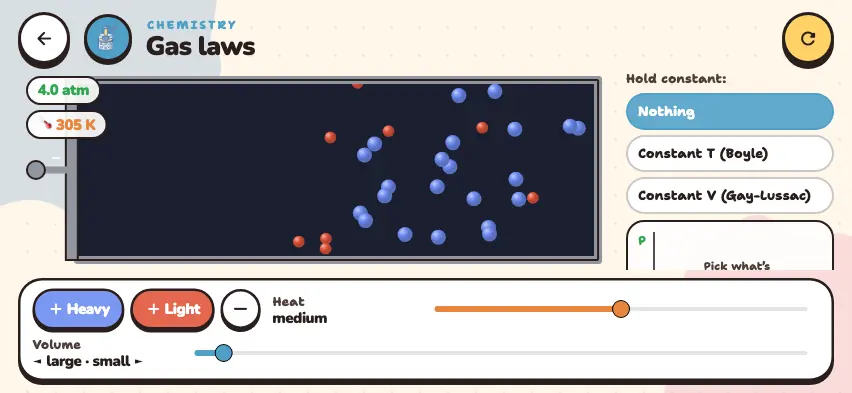 Gas laws
Formulas for the three laws, example problems, and P–V and P–T graphs.
3 min read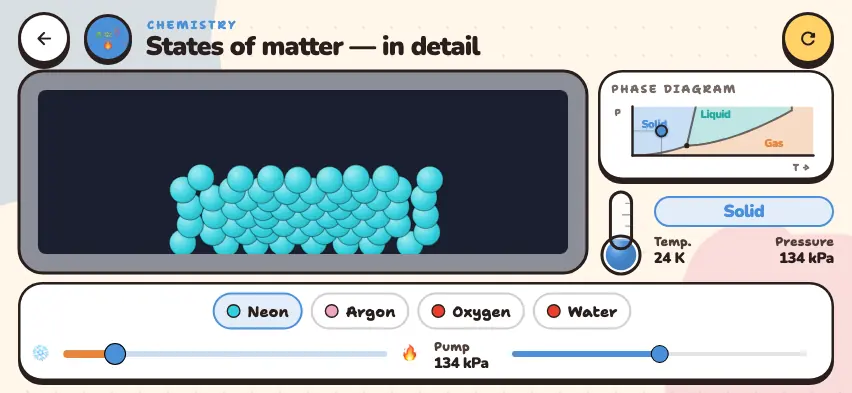 Phase diagram
How to read a phase diagram, the triple point, sublimation, and liquefying a gas with pressure.
3 min read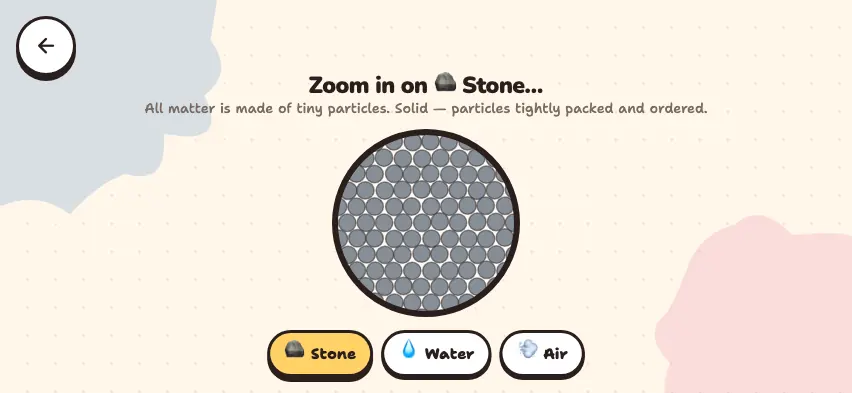 What is matter?
The difference between a substance and an object, plus atoms, molecules, ions, and a zoomed-in view of particles.
3 min read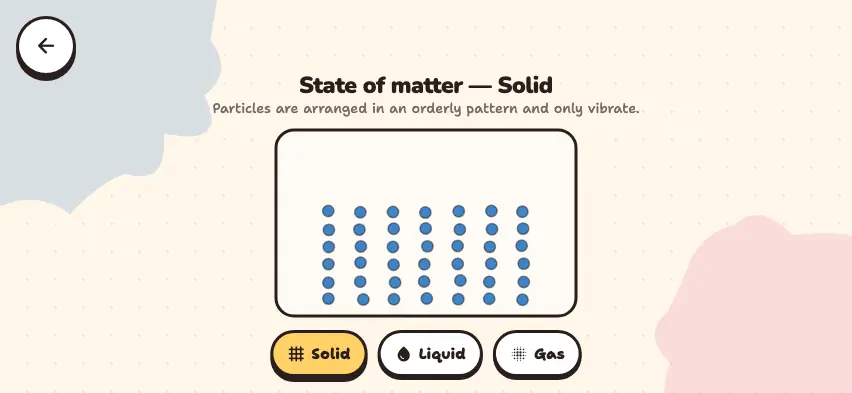 Three states of matter
A table of the differences between solids, liquids, and gases, with particle arrangement and motion.
3 min read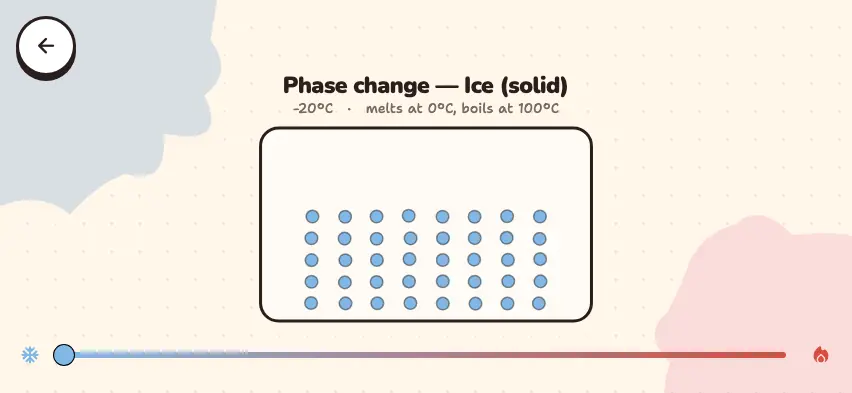 Phase changes
Melting, boiling, condensation, sublimation, particle motion, and a simulator guide.
3 min read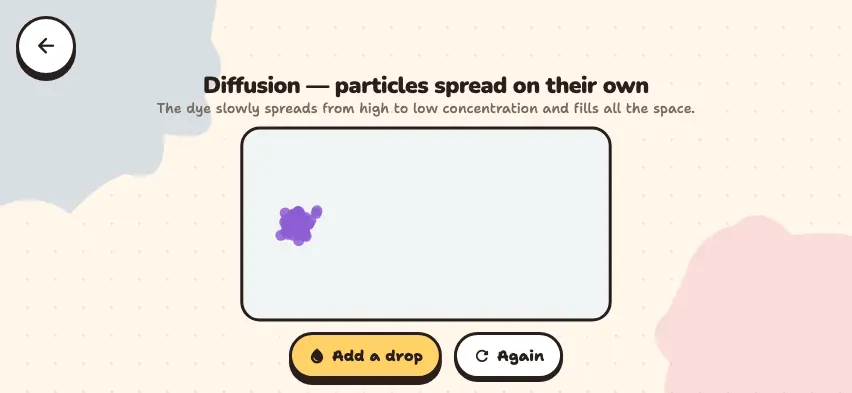 What is diffusion?
The definition of diffusion, why it happens, everyday examples, and a simulator guide.
3 min read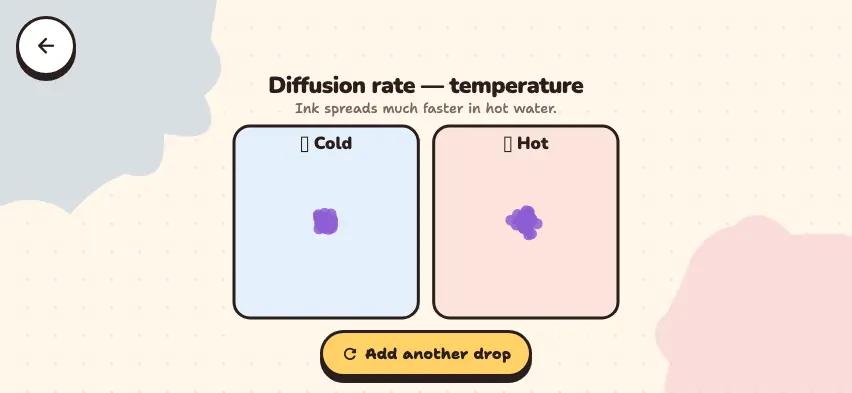 Rate of diffusion
How temperature, state, particle mass, and concentration difference affect diffusion, with a simulator guide.
3 min read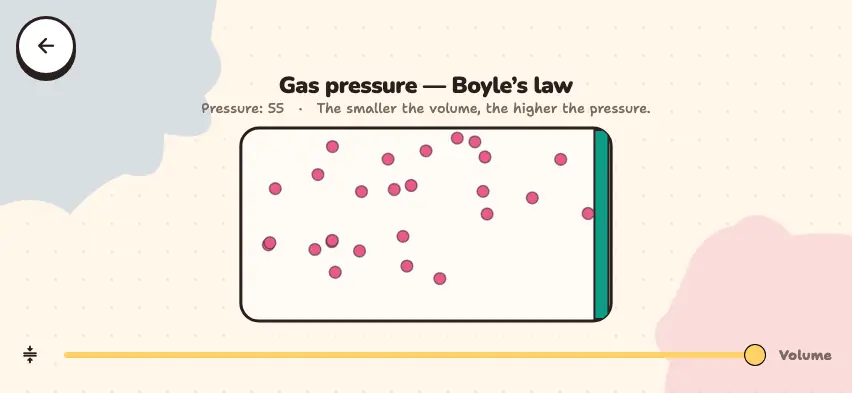 Gas pressure
What causes pressure, the Boyle's law formula, a worked example, and a simulator guide.
3 min read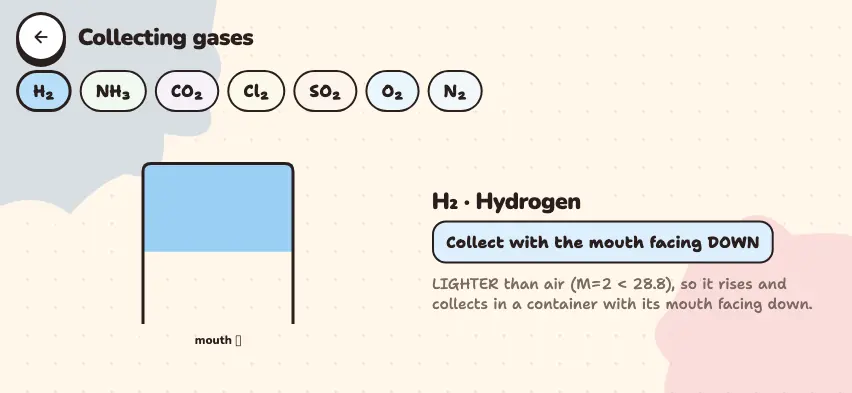 Gas collection methods
How to choose a method by density and solubility, a chart of seven gases, and a simulator guide.
3 min read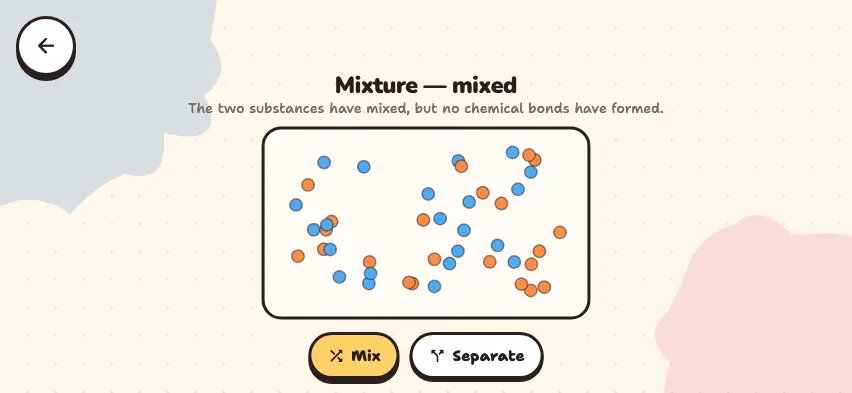 What is a mixture?
The two types of mixtures, how they differ from compounds, and the iron and sulfur example.
3 min read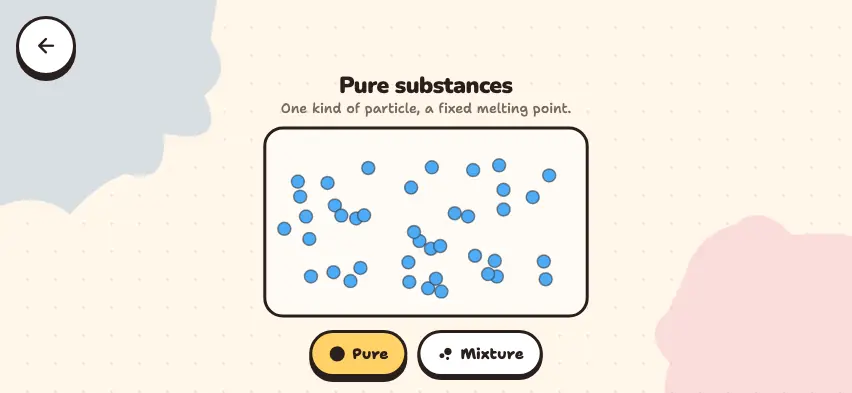 Pure substances and mixtures
The definition of a pure substance, how to test with melting point, and common mistakes.
3 min read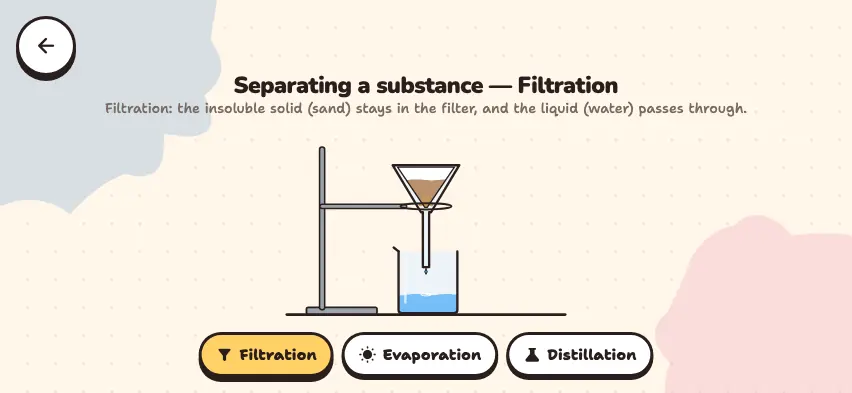 Separating mixtures
The differences between filtration, evaporation, and distillation, the equipment, and a selection table.
3 min read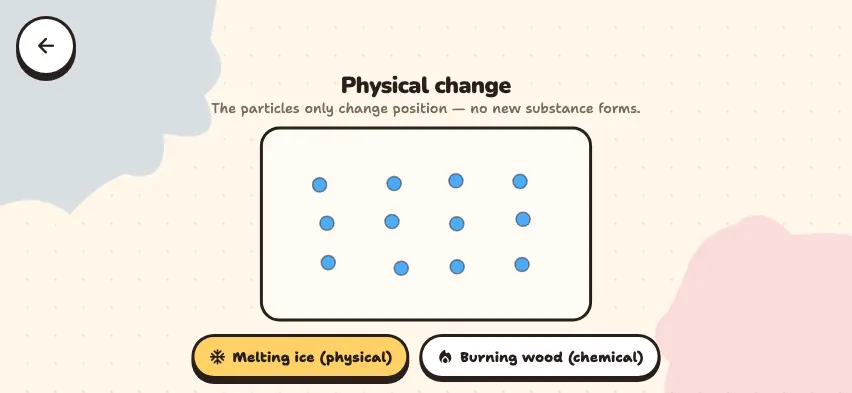 Physical and chemical changes
How to tell them apart by whether a new substance forms, four signs of chemical change, and examples.
3 min read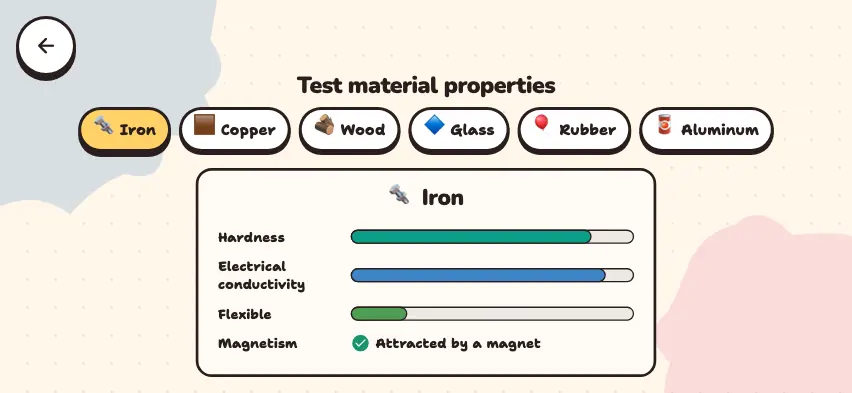 Properties of materials
Hardness, electrical conductivity, flexibility, magnetism, and examples of choosing a material.
3 min read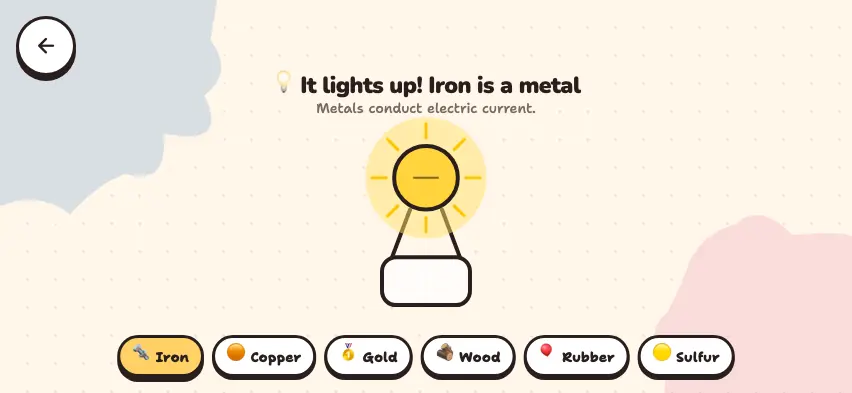 Electrical conductivity test
Test six materials in a bulb circuit and learn why metals conduct electricity.
3 min read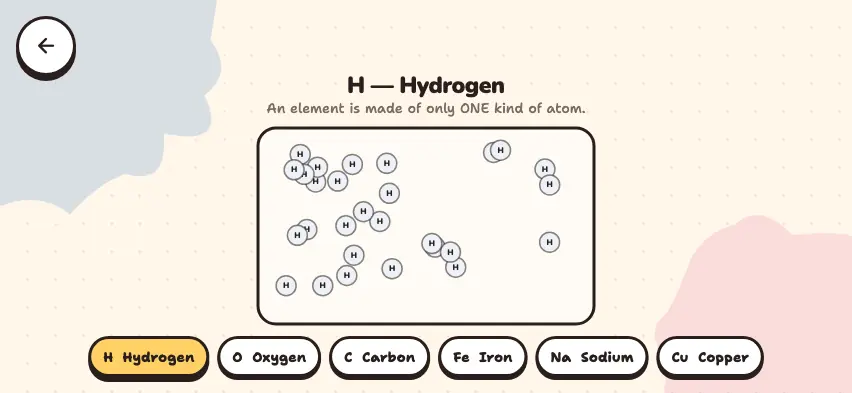 Chemical elements
One kind of atom, atomic number, element symbols, and how to tell an element from a compound.
3 min read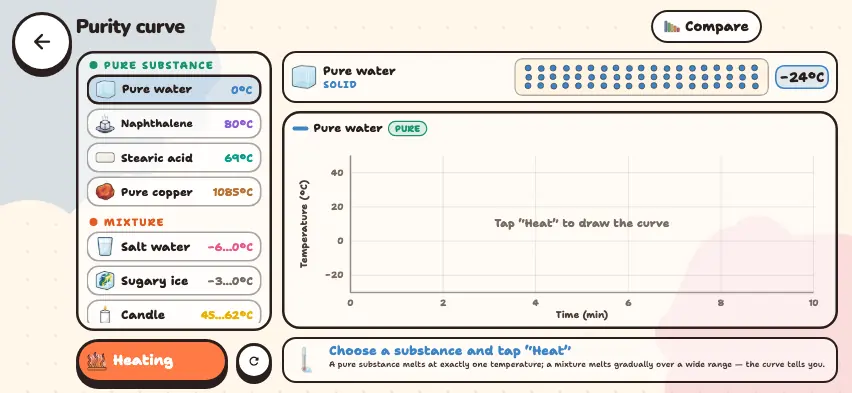 Purity curve
How to tell pure substances from mixtures by flat and sloped curves.
4 min read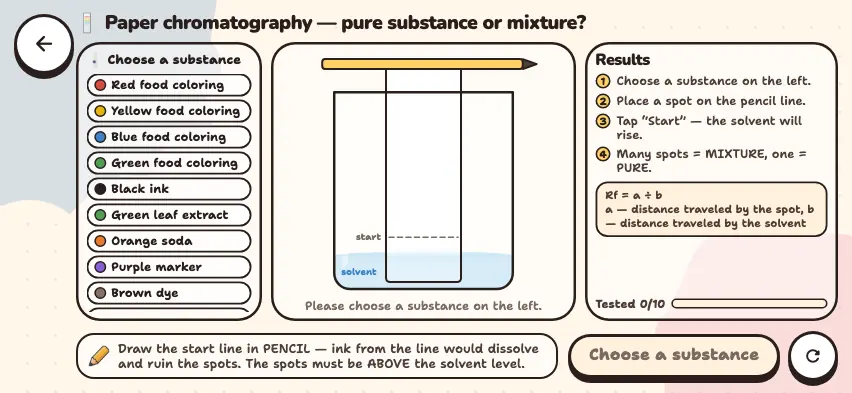 Paper chromatography
Separating dyes into spots, calculating Rf, and telling pure substances from mixtures.
3 min read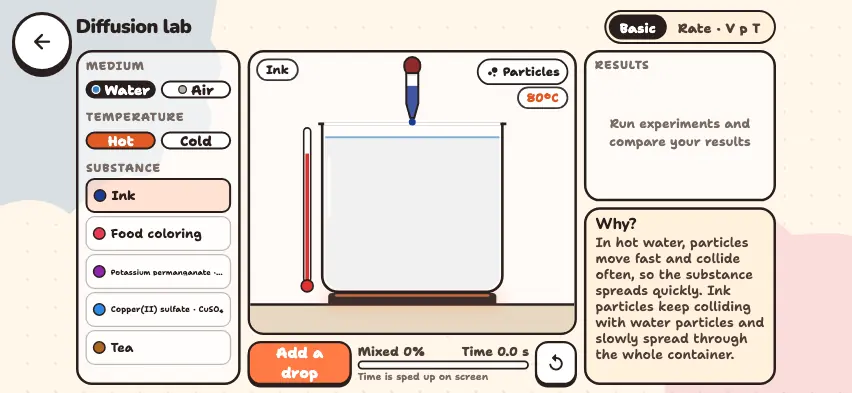 Diffusion
How substances spread on their own, what affects the rate, and tests with 10 substances.
4 min readSimulator guides: Solutions, acids & bases
 Strong and weak acids
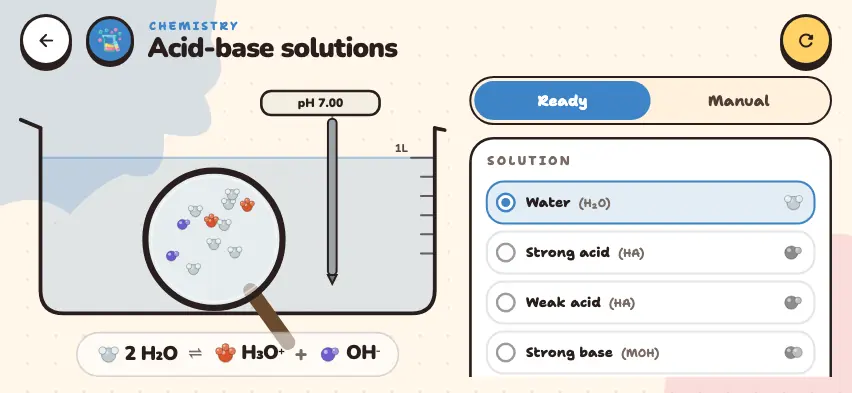
How much acids ionize, differences in pH and conductivity, and the mix-up between strength and concentration.
3 min read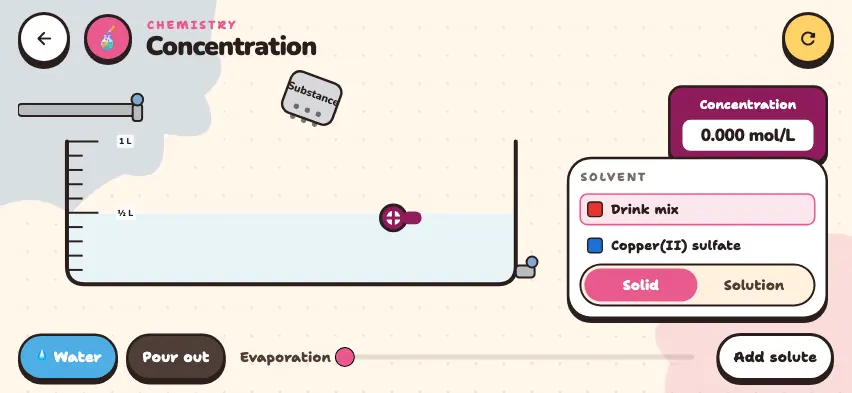 Solution concentration
How do adding solute or water, evaporating, and pouring out change concentration?
3 min read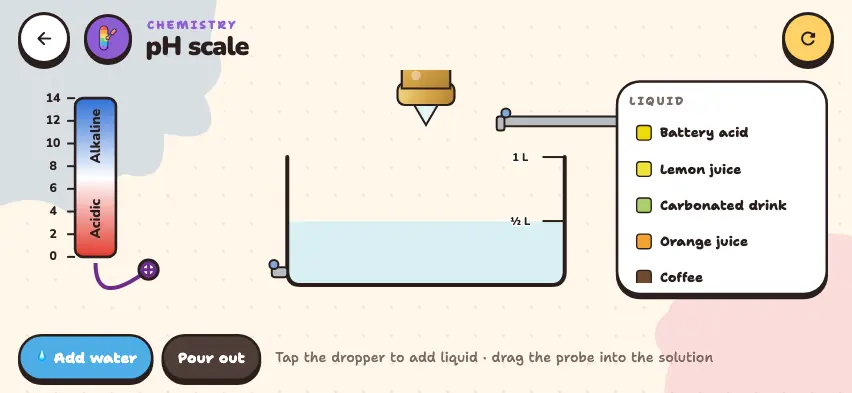 pH scale
A pH chart of 12 liquids and the rule that dilution moves pH toward 7.
3 min read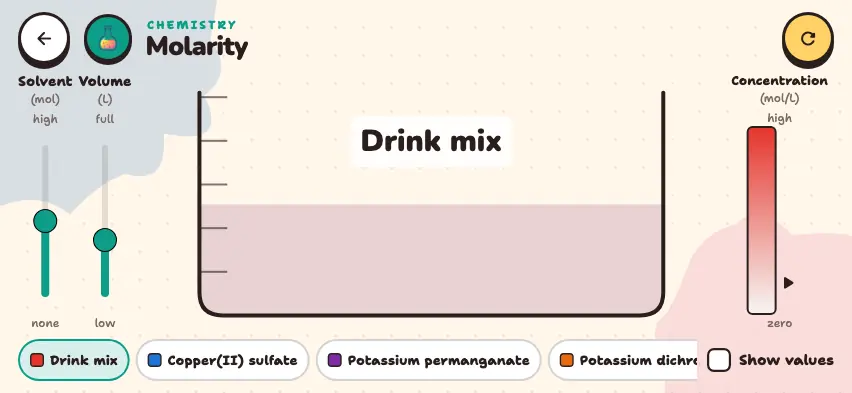 Molarity
The c = n / V formula, worked examples, the mol/L unit, and the saturation limit.
3 min read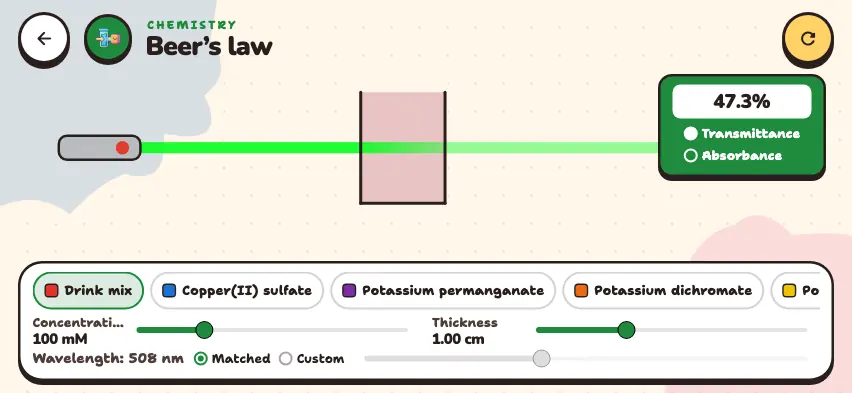 Beer's law
The A = ε·l·c formula, absorbance and transmittance, solution color, and the effect of wavelength.
3 min read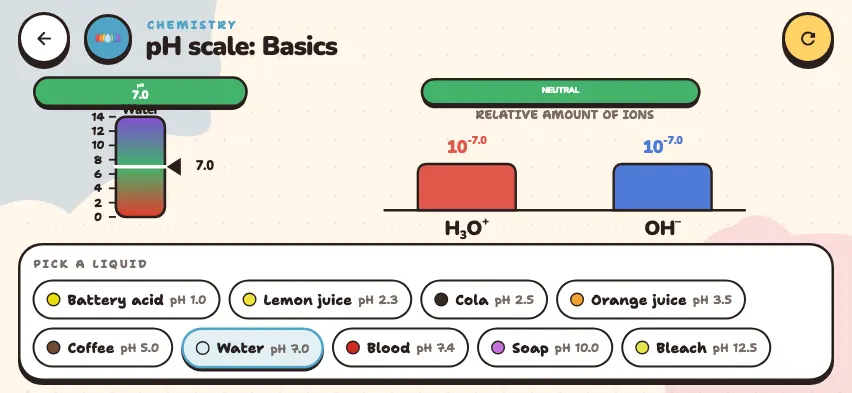 What is pH?
H₃O⁺ and OH⁻ ions, the 0–14 scale, and why 1 pH unit means a factor of 10.
3 min read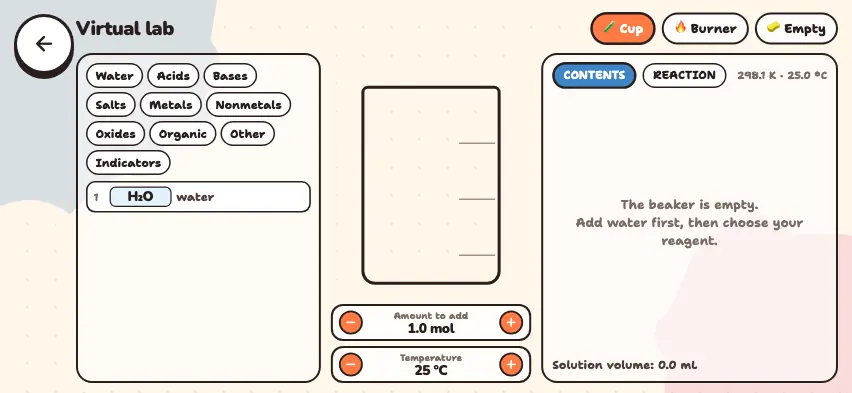 Virtual chemistry lab
Add substances to a beaker and track solubility, percent dissolved, acidity, and reaction equations.
3 min read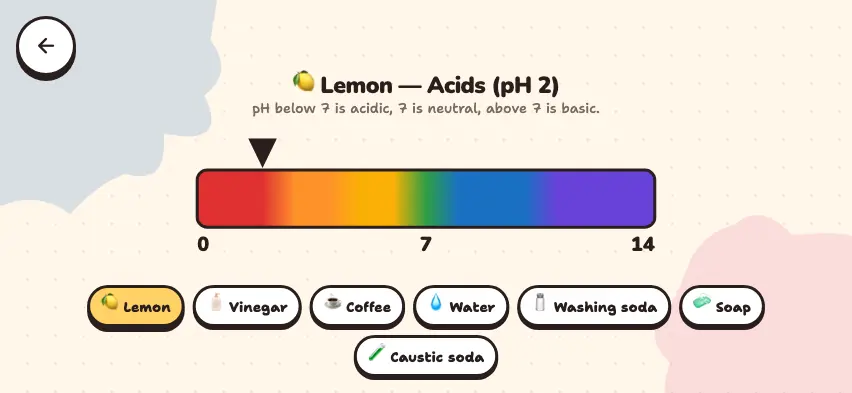 Acidic and basic properties
A table of acid and base properties, and a pH comparison of seven everyday substances.
3 min read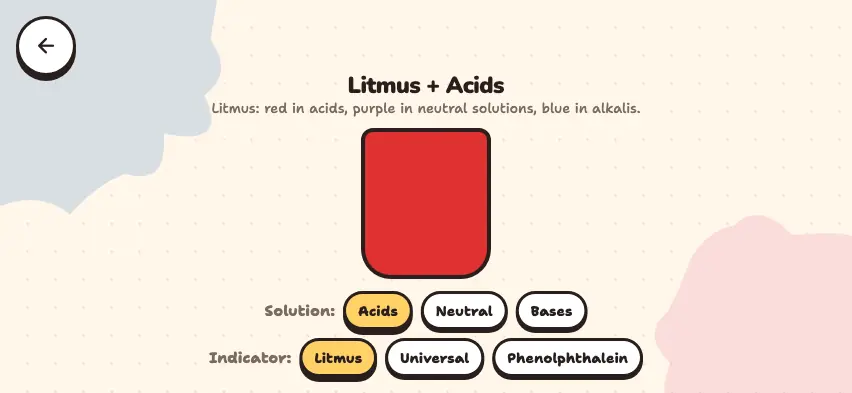 Indicator colors
The colors of three indicators in acids, neutral solutions, and bases, plus a simulator guide.
3 min read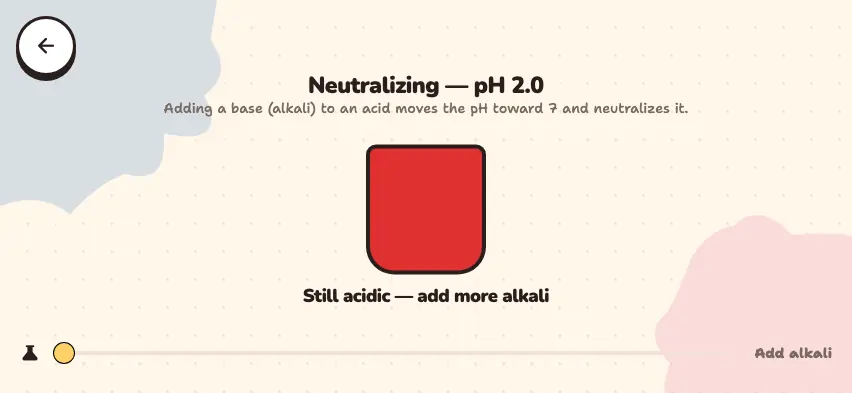 Neutralization reaction
Acid-base reactions, salt-forming equations, and pH changes shown with a slider.
3 min read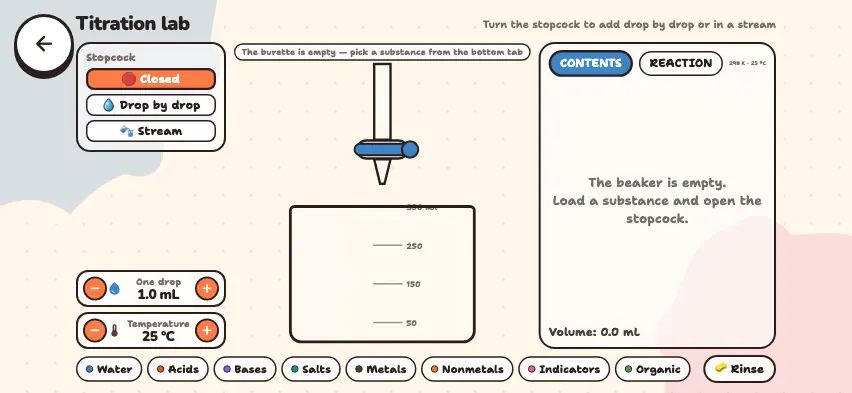 Titration
Burette, indicator, end point, a concentration example, and the Titration lab.
4 min readSimulator guides: Chemical reactions
 Flame test
Flame colors of seven metal ions, test steps, and a simulator guide.
3 min read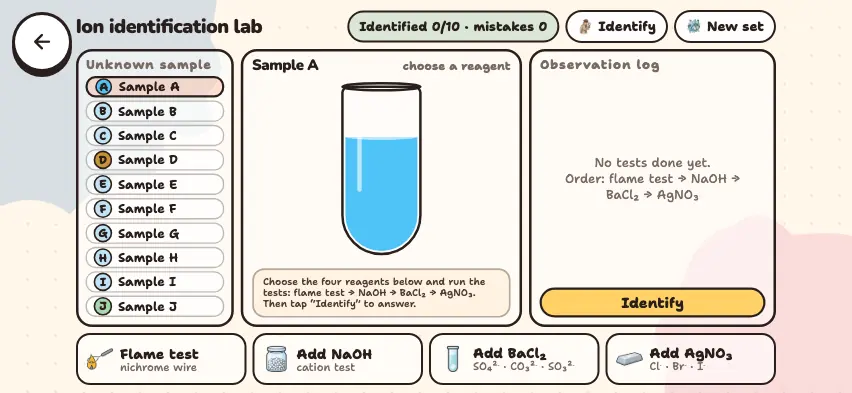 Ion identification
Cation and anion identification charts and a lab guide with ten unknown samples.
3 min read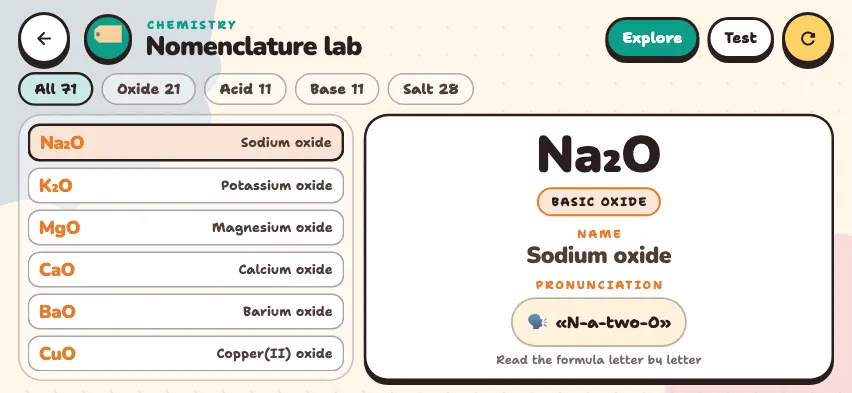 Naming compounds
Rules for naming oxides, acids, bases, and salts, how to read formulas, and a lab with a test.
3 min read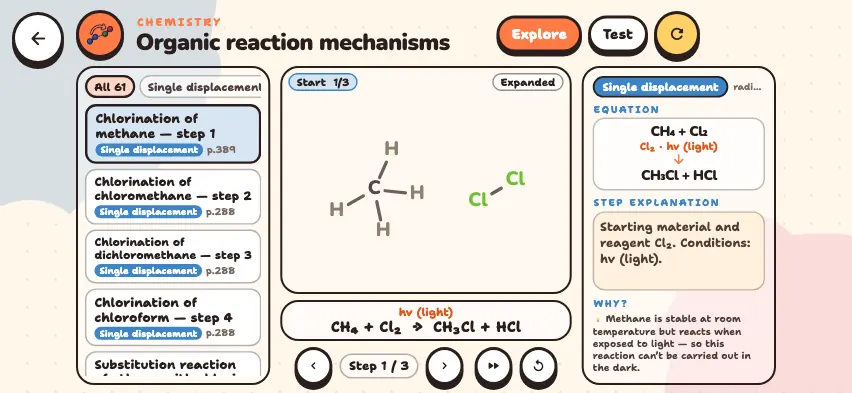 Organic reaction mechanisms
Follow substitution, addition, and elimination, Markovnikov's rule, and carbocations step by step.
3 min read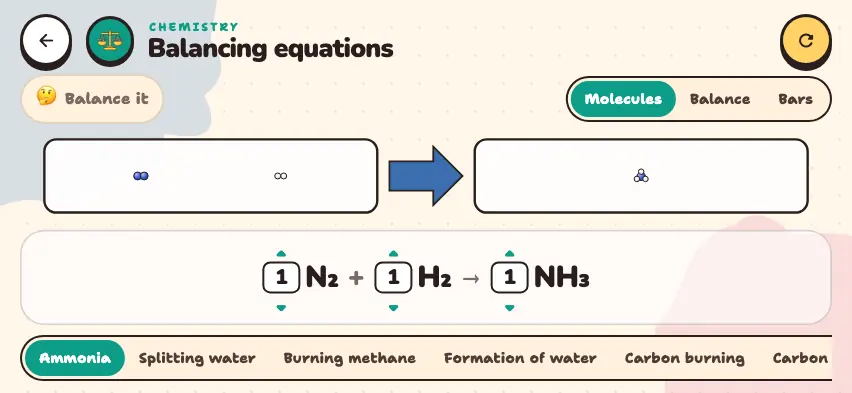 Balancing equations
Balance the burning of methane step by step, then practice on 20 reactions.
3 min read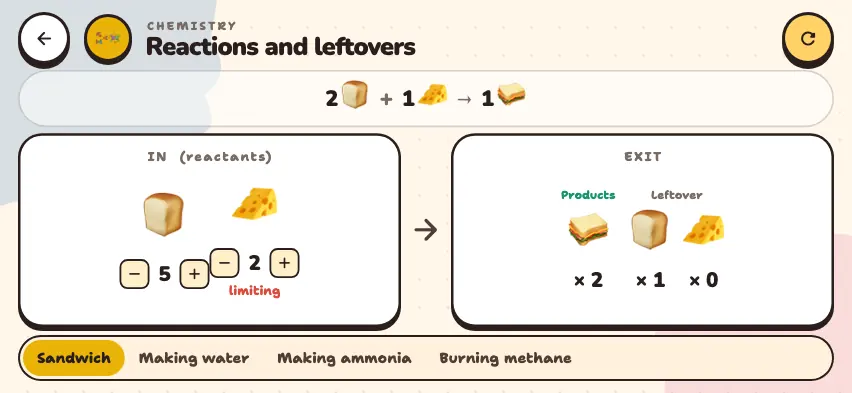 Limiting reactant
Work out products and leftovers, from a sandwich recipe to real reactions.
3 min read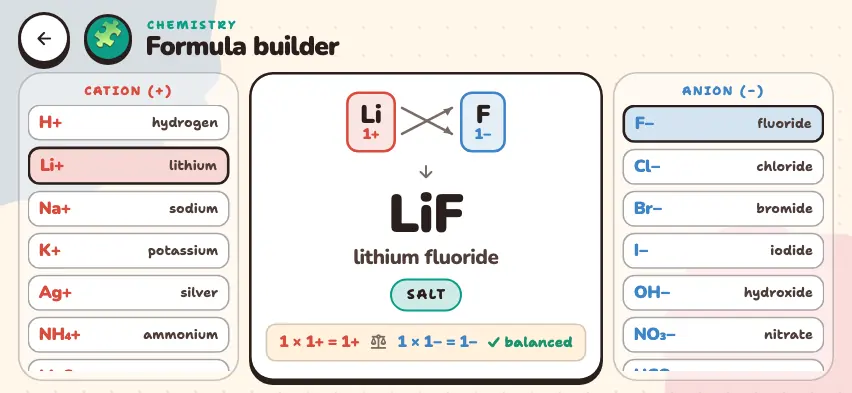 Writing chemical formulas
Rules for writing a compound's formula from its cation and anion, with examples and common mistakes.
3 min read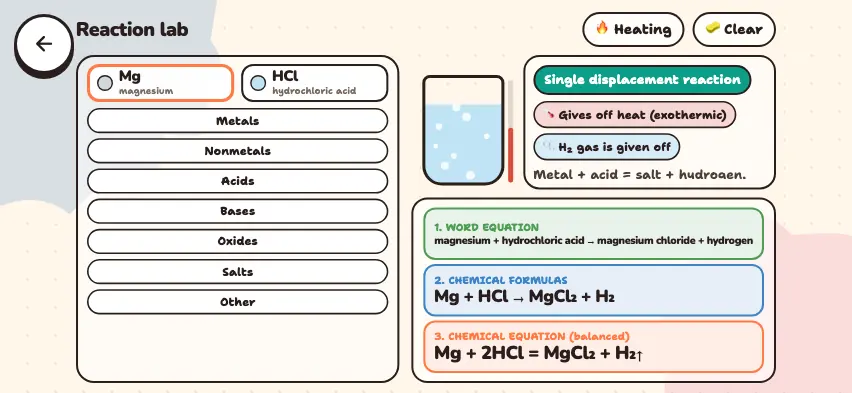 Types of chemical reactions
Synthesis, decomposition, single and double replacement reactions, signs of a reaction, and the activity series.
3 min read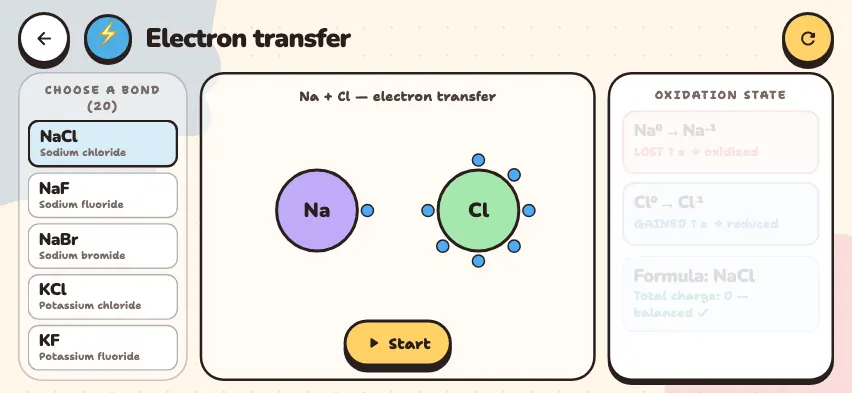 Electron transfer
Oxidation, reduction, and oxidation state changes in 20 compounds.
3 min read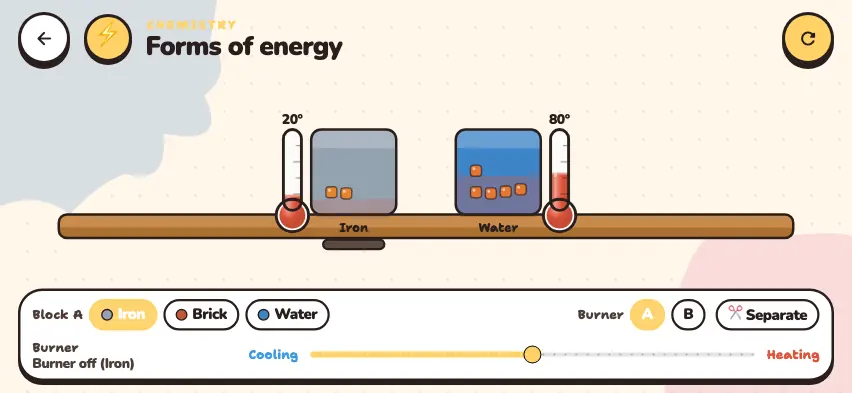 Forms of energy
, heat transfer, heat capacity, and final temperature.
3 min read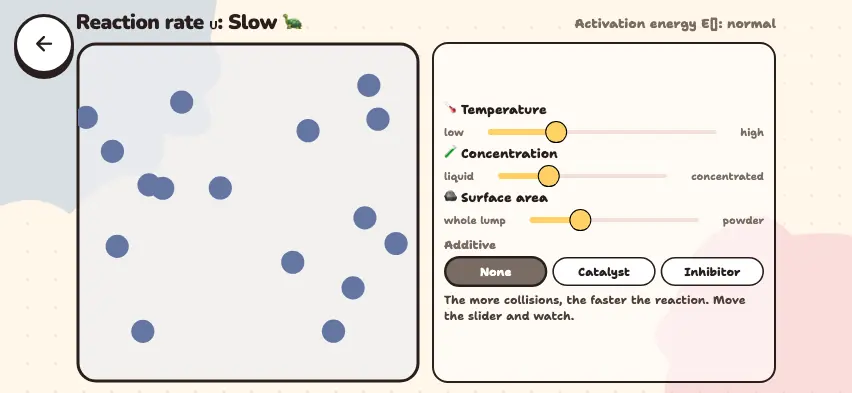 Reaction rate
The effects of temperature, concentration, surface area, catalysts, and inhibitors.
3 min read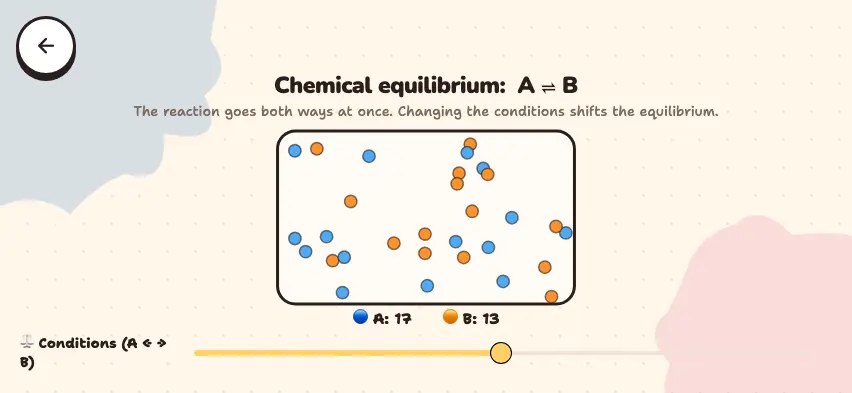 Chemical equilibrium
Reversible reactions, dynamic equilibrium, and Le Chatelier's principle.
3 min read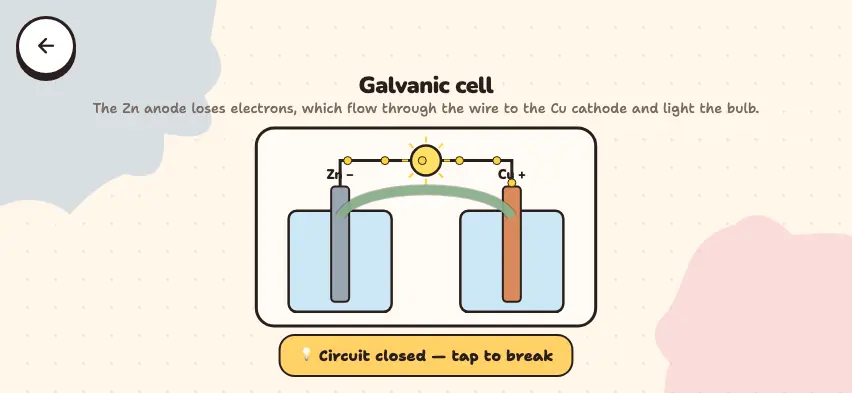 Galvanic cell
The anode, cathode, electron flow, and salt bridge of the zinc–copper cell.
3 min read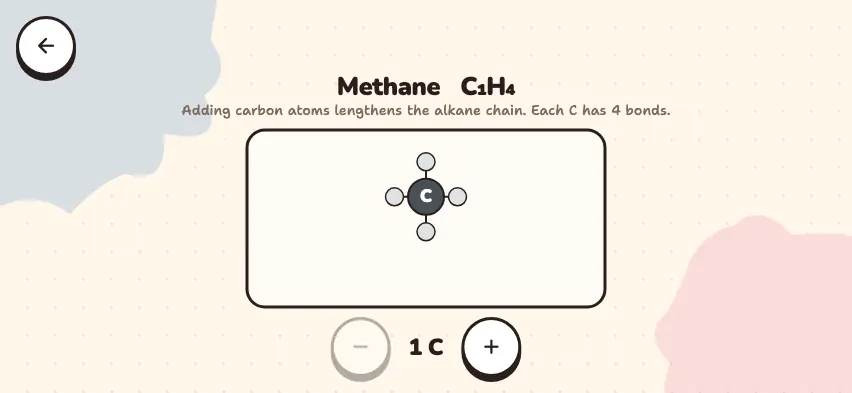 Alkanes and hydrocarbons
Methane to hexane: names, formulas, boiling points, and the homologous series.
2 min read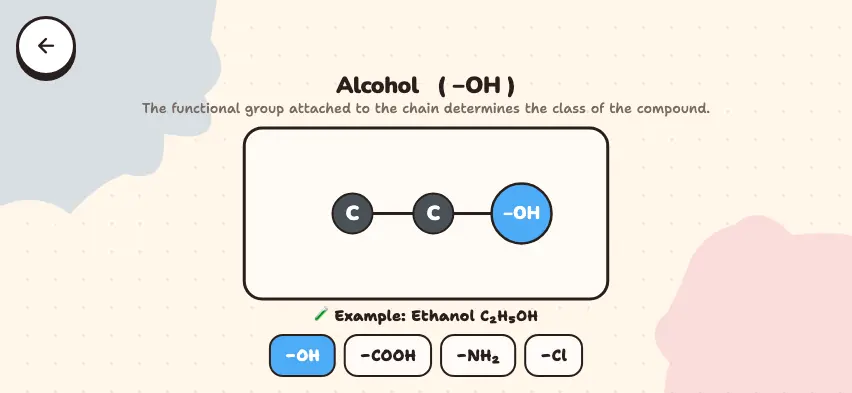 Functional groups
−OH, −COOH, −NH₂, and −Cl groups, and alcohols, carboxylic acids, amines, and haloalkanes.
2 min read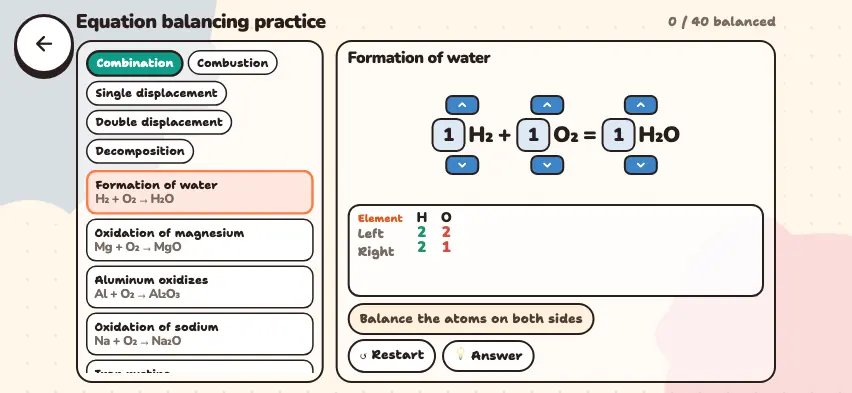 Balancing equations practice
40 reactions in five categories, an answer table, and a way to check yourself.
3 min read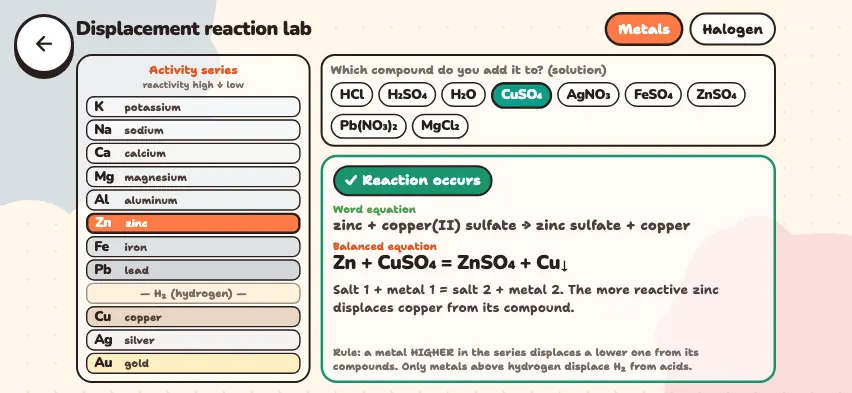 Single replacement and the activity series
The activity series of metals and halogens, the hydrogen line rule, and simulator steps.
3 min read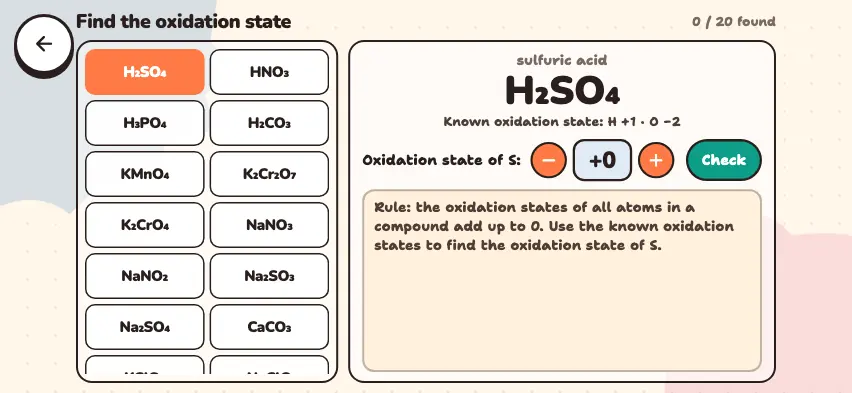 Finding oxidation states
A table of rules, step-by-step solutions, and a simulator with 20 compounds to practice.
3 min read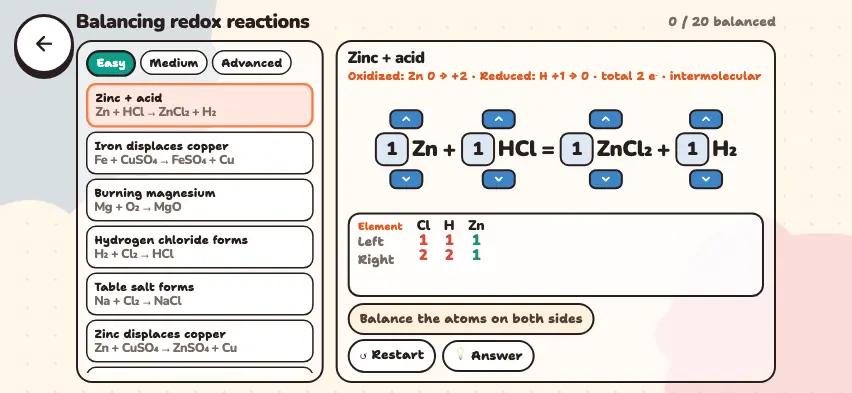 Balancing redox reactions
Oxidizing and reducing agents, electron balance steps, and 20 reactions at 3 levels.
4 min read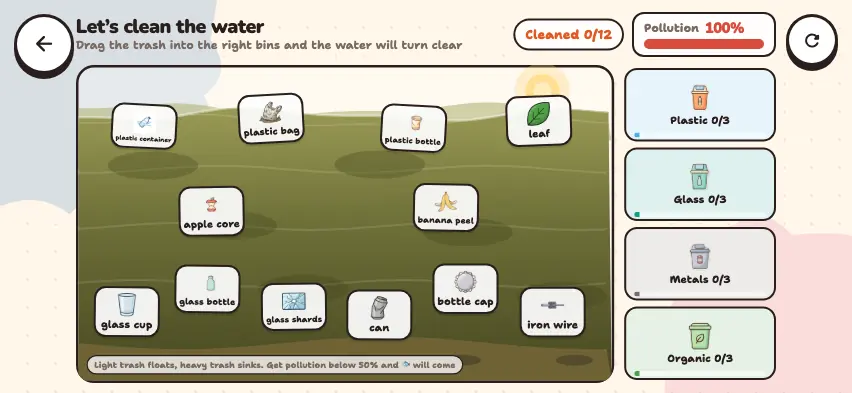 Water pollution and sorting trash
Why trash floats or sinks, 4 sorting categories, simulator steps, and tasks.
3 min read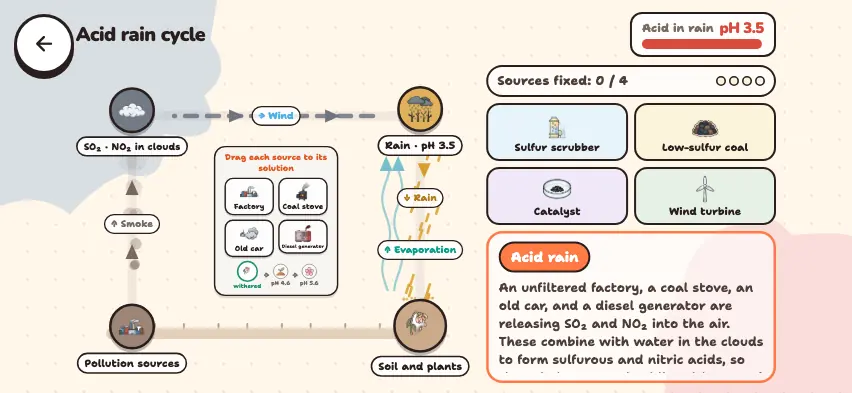 Acid rain
Reactions of SO₂ and NO₂, rain pH, sources and solutions, and simulator steps.
3 min read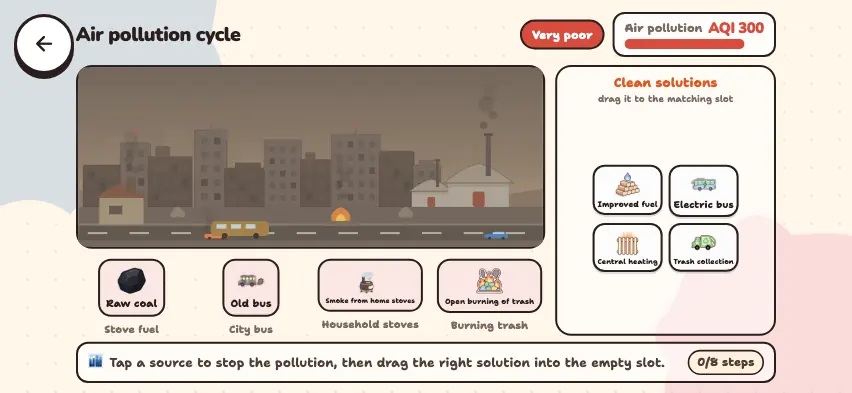 Air pollution and AQI
Pollutants, an AQI table, four sources and solutions, and simulator steps.
2 min read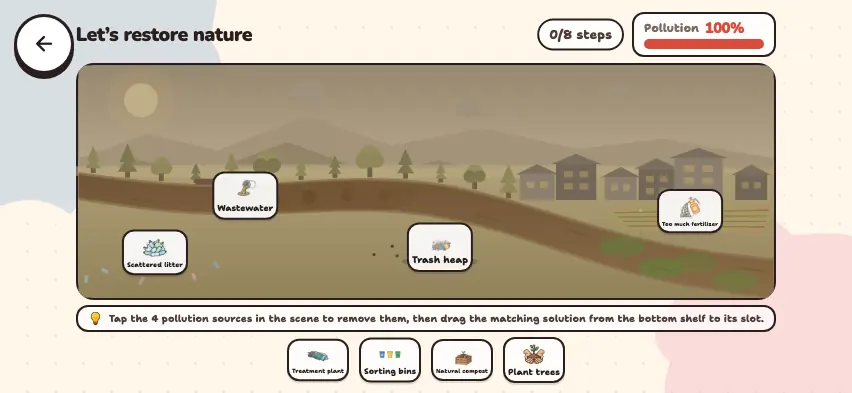 Pollution and eutrophication
Four pollutants, the stages of eutrophication, solutions, and simulator steps.
2 min read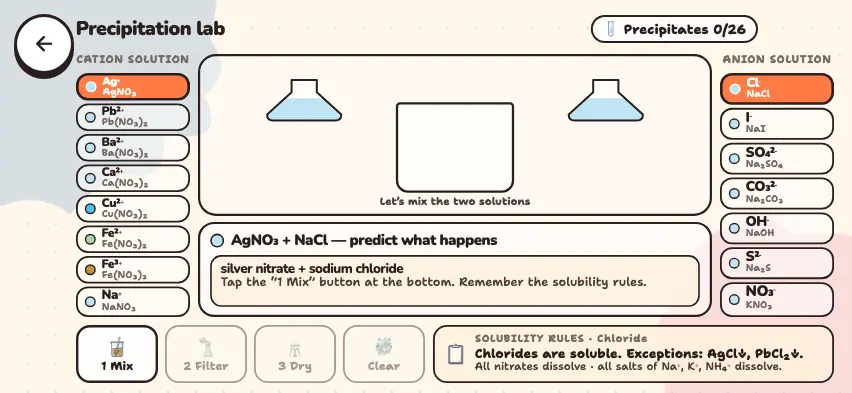 Precipitation reactions
Solubility rules, precipitate colors, ionic equations, and filtering and drying steps.
3 min read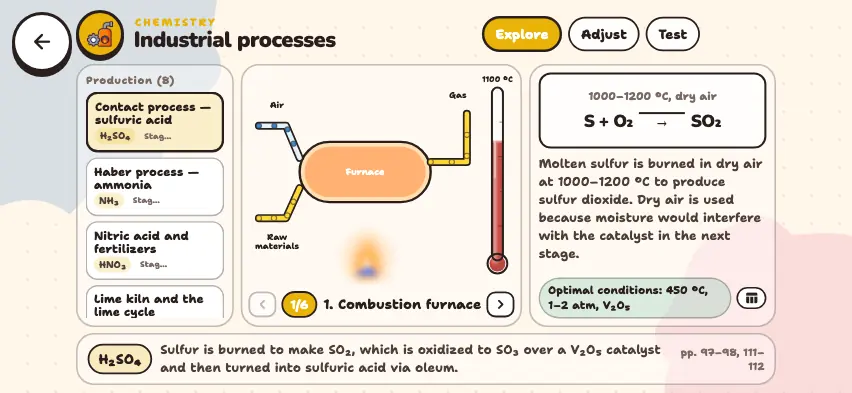 Industrial processes
The Haber process, the contact process, yield versus rate, and 8 industrial processes.
3 min read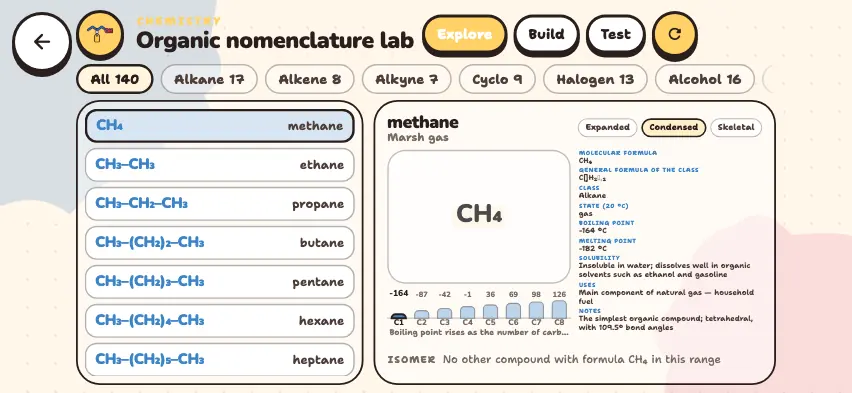 Organic nomenclature
Naming steps, class suffixes, isomers, and a simulator with 140 compounds.
3 min read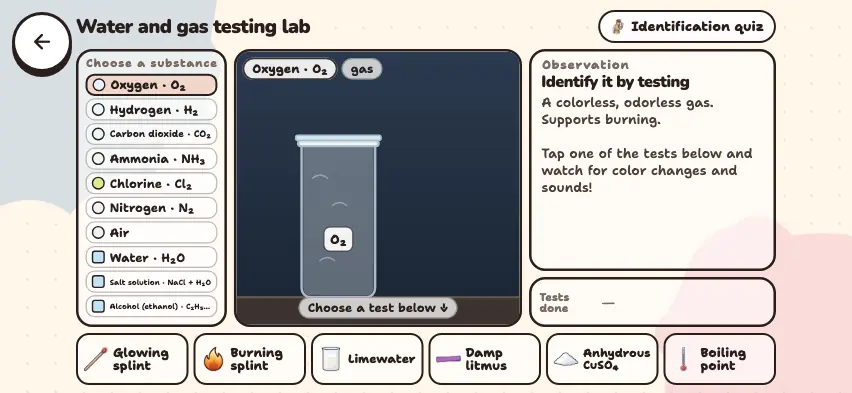 Tests for water and gases
A table of six tests, the reasons behind them, common mix-ups, and simulator steps.
3 min readNothing found. Try another word.
Get Nalukh chem
Free to download. Without an account, 2 units, 5 simulators and the periodic table are open.