What are oxidation and reduction?
Oxidation is the process in which an atom loses electrons, and reduction is the process in which an atom gains electrons. The two always happen together: the electrons lost by one atom are gained by another.
| Feature | Oxidation | Reduction |
|---|---|---|
| Electrons | lost | gained |
| Oxidation state | increases | decreases |
| Role of the substance | reducing agent | oxidizing agent |
| When NaCl forms | sodium: 0 → +1 | chlorine: 0 → −1 |
An oxidation state is a number that shows how many electrons an atom has lost or gained. The atoms of an element in its pure form have an oxidation state of 0. In a neutral compound, the oxidation states of all the atoms add up to 0.
The metals in the simulator lose 1 or 2 electrons:
| Metal | Electrons lost | Example compounds |
|---|---|---|
| Li, Na, K | 1 | NaCl, LiF, K2S |
| Mg, Ca, Ba, Zn | 2 | MgO, CaCl2, ZnO |
Chlorine, fluorine, and bromine gain 1 electron, and oxygen and sulfur gain 2 electrons. So in MgCl2, one magnesium atom gives electrons to two chlorine atoms, and in Na2O, two sodium atoms give electrons to one oxygen atom.
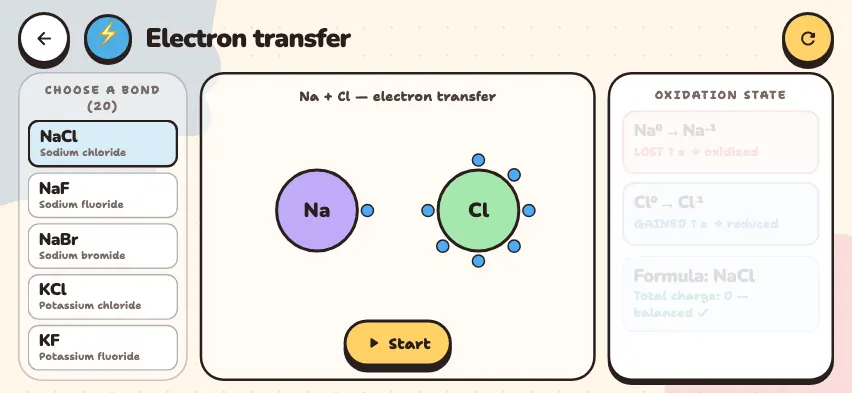
Watch electron transfer in the Nalukh chem app
This simulator is part of full access. The app is free to download, and 2 chapters and 5 simulators are open without sign-up.
How do you use the simulator?
- Choose one of the 20 compounds from the list on the left.
- Press the Start button. An electron from the metal moves along a curved path to the nonmetal atom.
- When the motion ends, a charge appears on each atom, and the name of the compound that formed appears in the top line.
- The OXIDATION STATE panel on the right becomes fully visible and shows how many electrons each atom lost or gained. The formula and total charge appear below it.
- The Restart button repeats the motion. The refresh button in the top corner goes back to the first compound.
Tasks to try in the simulator
Predict the answer first, then check it against the panel.
- Choose MgCl2 and start. How many electrons does magnesium lose, and how many does each chlorine atom gain? Answer: Magnesium loses 2, and each chlorine gains 1.
- Compare Na2O and MgO. Why does one oxygen atom need either two sodium atoms or one magnesium atom? Answer: Oxygen gains 2 electrons. Sodium gives 1, and magnesium gives 2.
- Find the oxidation state of each atom in K2S. Answer: Potassium is +1, and sulfur is −2. Check: 2 × (+1) + (−2) = 0.
- Name the element that is oxidized and the element that is reduced in ZnCl2. Answer: Zinc is oxidized, and chlorine is reduced.
Simulator vs. real reactions
The simulator shows one atom at a time. In a real reaction, chlorine takes part as Cl2 molecules and oxygen as O2 molecules: 2Na + Cl2 = 2NaCl. Here, two sodium atoms lose 2 electrons, and one Cl2 molecule gains 2 electrons.
Oxidation does not have to involve oxygen. There is no oxygen when NaCl forms, but sodium still loses electrons and is oxidized. Also, do not forget that a reducing agent is itself oxidized: sodium reduces chlorine and is oxidized in the process.