What is a single replacement reaction?
In a single replacement reaction, also called a displacement reaction, an element displaces another element from a compound and takes its place. The general form is AB + C → A + CB. For example, when you put an iron nail in blue copper(II) sulfate solution, the nail becomes coated with reddish copper: Fe + CuSO4 → FeSO4 + Cu.
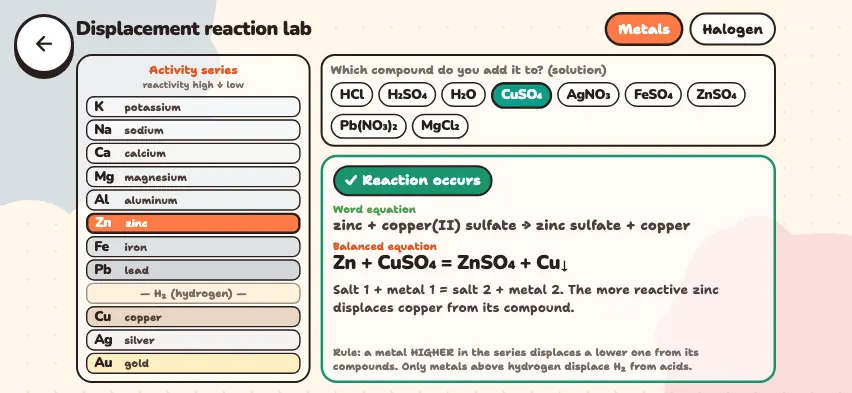
You can predict whether the reaction will happen from reactivity. The simulator always shows the following two series on screen.
| Series | From most to least reactive |
|---|---|
| Metals | K, Na, Ca, Mg, Al, Zn, Fe, Pb, (H2), Cu, Ag, Au |
| Halogens | F2, Cl2, Br2, I2 |
Four rules of single replacement reactions
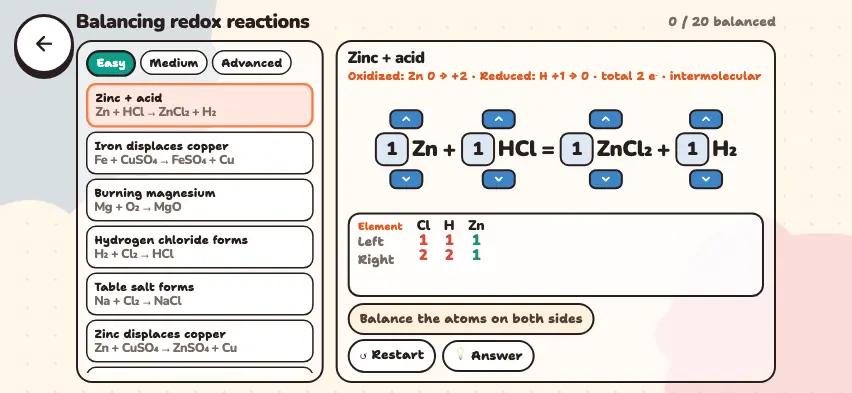
- Metal and salt. A metal higher in the series displaces a lower metal from its salt solution: Zn + CuSO4 → ZnSO4 + Cu. The reverse does not work: copper cannot displace zinc.
- Metal and acid. A metal above hydrogen displaces hydrogen from an acid: Zn + 2HCl → ZnCl2 + H2↑. Copper, silver, and gold do not undergo this reaction. Nitric acid does not follow this rule: it does not release hydrogen when it reacts with metals.
- Metal and water. Potassium, sodium, and calcium react with cold water, and magnesium reacts with hot water. These reactions release hydrogen.
- Halogen and salt. A more reactive halogen displaces a less reactive one from its salt: Cl2 + 2KBr → 2KCl + Br2.
Test the activity series in the Nalukh chem app
Choose an element and a compound, and check whether the reaction occurs. This simulator is included with full access. The app is free to download, and 2 units and 5 simulators are open with no sign-up.
How do you use the simulator?
- At the top, choose Metals or Halogen mode.
- Tap an element in the Activity series panel on the left. The hydrogen line is marked in the middle of the metal series.
- Tap a compound in the upper right area. Metals mode has two acids, water, and six salts, and Halogen mode has four salts.
- Read the result at the top of the card: ✓ Reaction occurs or ✕ No reaction.
- If the reaction occurs, the Word equation and the Balanced equation appear. The reason and the rule are written below them.
Tasks to try in the simulator
- Look at the reaction of zinc with copper(II) sulfate, then choose copper and zinc sulfate. One reaction occurs and the other does not. Use the series to explain why.
- Choose hydrochloric acid and tap the metals from top to bottom. Starting from copper, no reaction occurs: this is the hydrogen line.
- Choose water and compare potassium, magnesium, and copper. Find the difference in the explanations.
- In Halogen mode, choose sodium fluoride and test the four halogens. No reaction occurs, because no halogen can displace fluorine.
How the simulator differs from real experiments
The simulator judges only by position in the series. In a real experiment, keep the following in mind.
- In aqueous solution, potassium, sodium, and calcium react with water first. So when you add them to copper(II) sulfate solution, no copper forms, and a pale blue Cu(OH)2 precipitate forms.
- In solution, fluorine reacts with water first, so schools test with chlorine, bromine, and iodine. Chlorine water turns potassium bromide solution orange and potassium iodide solution brownish yellow.
- An insoluble salt forms on the surface of lead and slows its reaction with acids.