What is matter?
Your phone, a glass of milk, and the air you breathe all have mass and take up space. All of these things are made of matter.
Learn to tell a substance from an object. A cup is an object, and the glass it is made of is a substance. A nail is an object, and iron is a substance. You can make many objects from one substance.
What is matter made of?
All matter is made of particles. There are three kinds of particles:
| Particle | What it is | Example |
|---|---|---|
| Atom | The smallest particle of an element | helium He, iron Fe |
| Molecule | A group of bonded atoms | water H2O, oxygen O2 |
| Ion | An atom or group of atoms with a charge | Na+ and Cl− in table salt |
Particles are extremely small: 18 g of water contains about 6 × 10²³ molecules.
Zoom in on stone, water, and air
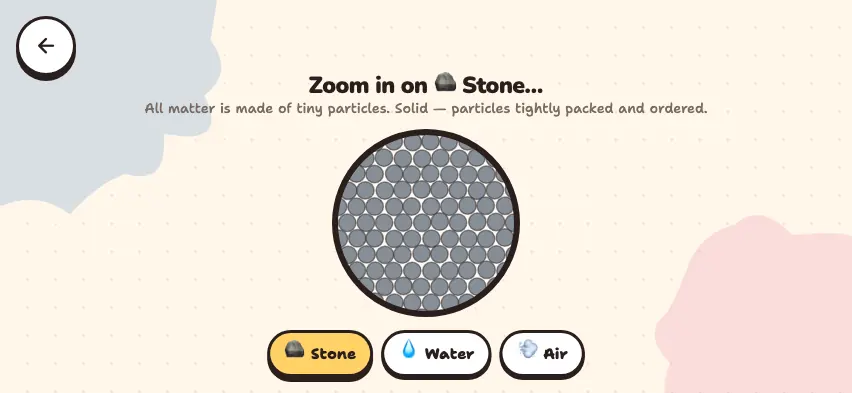
Choose each of the three substances and compare how the particles are arranged and how they move. This simulator unlocks with full access. The app is free to download, and 2 units and 5 simulators are open without signing up.
How do you use the simulator?
- Press one of the Stone, Water, or Air buttons at the bottom.
- Particles appear inside the round magnifier. The top of the screen shows the state of the substance and a short description of its particles.
- Choose the three substances in turn and compare the spacing and motion of the particles.
| Substance | State | When you zoom in |
|---|---|---|
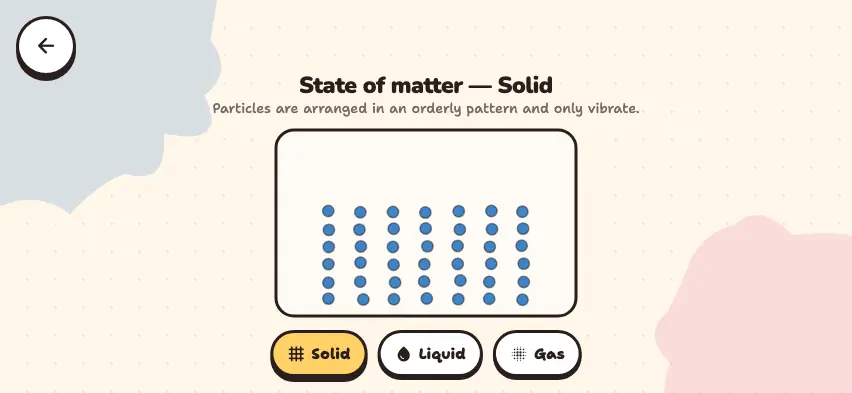
| Stone | solid | particles are closely packed in rows and vibrate |
| Water | liquid | particles are close together and disordered, and they squeeze past each other |
| Air | gas | particles are few, far apart, and fast-moving |
Tasks to try in the simulator
- Select Stone and watch one particle closely. Answer: The particle does not leave its place. It only vibrates.
- Select Water. Where in the magnifier do the particles gather? Answer: They gather in the lower part and form a surface, and the upper part stays empty.
- Select Air, count the particles, and compare them with stone. Answer: In air, about 14 particles move far apart from each other. Stone has several times more particles, with almost no space between them.
How is the simulator's picture different from real matter?
- The picture is a model. You cannot see particles with a real magnifying glass or an ordinary microscope.
- Stone and air are mixtures. Stone is made of several minerals, and air is made of gases such as nitrogen and oxygen. The simulator draws the particles in one color.
Common misconceptions about particles
- A single particle is solid or liquid. State is a property of many particles together. The molecules in ice, water, and steam are the same.
- There is air between gas particles. Air itself is made of these particles. There is empty space between the particles.
- Particles get bigger when heated. Particles do not grow. They move faster, and the space between them increases.
See how the states differ in the guide to the three states of matter.