What is an oxidation state?
An oxidation state, also called an oxidation number, is a number that shows how many electrons an atom in a compound appears to have lost or gained. An atom that appears to have lost electrons has a positive oxidation state, and an atom that appears to have gained electrons has a negative one. This is a calculated value: an oxidation state of +6 for sulfur in H2SO4 does not mean that the atom really has a +6 charge.
Rules for finding oxidation states
In a pure element, the oxidation state is 0. In a neutral compound, the oxidation states of all the atoms add up to 0. In an ion, they add up to the charge of the ion. The oxidation states of some elements almost never change.
| Element | Oxidation state | Exception |
|---|---|---|
| Group 1 metals (Na, K) | +1 | None |
| Group 2 metals (Mg, Ca) | +2 | None |
| Fluorine | −1 | None |
| Hydrogen | +1 | −1 in metal hydrides (NaH) |
| Oxygen | −2 | −1 in hydrogen peroxide (H2O2), +2 in OF2 |
Worked examples
Call the element you are solving for x. Multiply each oxidation state by the number of atoms, then add the results.
H2SO4: (+1)×2 + x + (−2)×4 = 0, so x = +6.
K2Cr2O7: There are two chromium atoms, so multiply x by 2. (+1)×2 + x×2 + (−2)×7 = 0, so x = +6.
MnO4− ion: The sum equals the charge of the ion. x + (−2)×4 = −1, so x = +7.
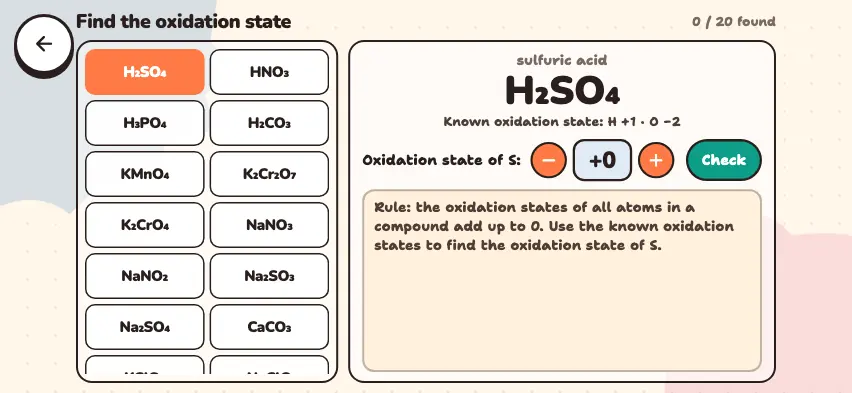
Learn to find oxidation states in the Nalukh chem app
Choose a compound, calculate the oxidation state yourself, and check it. This simulator is included with full access. The app is free to download, and 2 units and 5 simulators are open with no sign-up.
How do you use the simulator?
- Tap a compound in the list on the left. There are 20 compounds in total.
- The right panel shows the compound's name, its formula, the known oxidation states, and the element to solve for.
- Write the sum equation on paper and solve it.
- Set your answer with the minus and plus buttons. The value can go from −4 to +8.
- Press the Check button. If you are correct, the full solution appears and the compound gets a green mark in the list. If you are wrong, you get a reminder that the sum must be 0.
The top corner shows how many compounds you have solved.
Tasks to try in the simulator
- Find the oxidation state of nitrogen in HNO3, NaNO3, and NaNO2. Which one is different, and why?
- Find the oxidation state of chlorine in NaClO, KClO3, and NaClO4. Notice that it rises as the number of oxygen atoms increases.
- Compare the oxidation state of sulfur in Na2SO3 and Na2SO4. By how much does it rise when one oxygen atom is added?
- Find the oxidation state of chromium in K2Cr2O7 and K2CrO4. The formulas are different, but the oxidation state is the same.
- In Fe2(SO4)3, the oxidation state of sulfur is given as +6. Find the oxidation state of iron.
Common mistakes
- Forgetting the number of atoms. K2Cr2O7 has two chromium atoms, so write x×2 in the sum.
- Not expanding parentheses. Ca3(PO4)2 has 2 phosphorus atoms and 8 oxygen atoms.
- Confusing oxidation state with ionic charge. Write the sign of an oxidation state before the number (+3), and the sign of an ionic charge after the number (Fe3+).