What is electronegativity?
Electronegativity (EN) is the ability of an atom to pull a bonding pair of electrons toward itself. Fluorine has the highest value: 4.0. Oxygen is 3.5, chlorine 3.0, hydrogen 2.1, and sodium 0.9.
If two atoms have the same EN, the electron pair sits evenly between them. If their EN values differ, the pair shifts toward the atom that pulls harder. That atom gets a partial negative charge (δ−), and the other atom gets a partial positive charge (δ+). A bond like this is called a polar bond.
| EN difference | Bond | Example |
|---|---|---|
| Less than 0.4 | Nonpolar covalent | O2: 3.5 − 3.5 = 0 |
| 0.4–2.0 | Polar covalent | HCl: 3.0 − 2.1 = 0.9 |
| More than 2.0 | Ionic | NaF: 4.0 − 0.9 = 3.1 |
These cutoffs are approximate. The character of a bond does not switch all at once. It changes gradually.
What is a dipole?
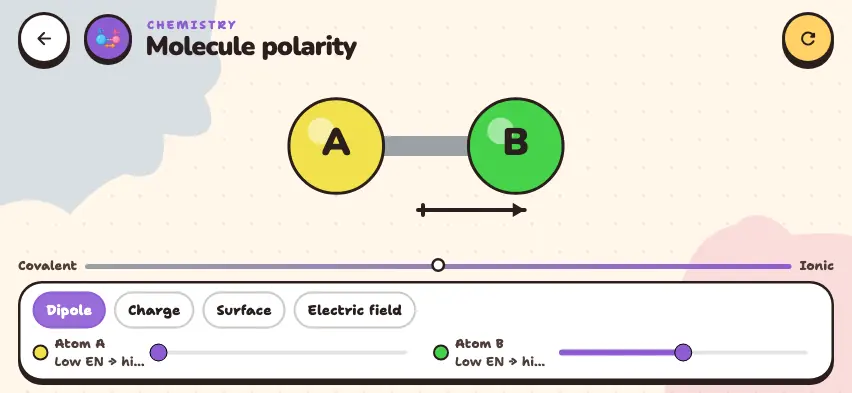
A dipole is a pair of poles, one positive and one negative. It is drawn as an arrow pointing from the δ+ atom to the δ− atom. The + sign at the tail of the arrow marks the positive side. The larger the EN difference, the longer the arrow.
A molecule can be nonpolar even if its bonds are polar. CO2 is linear, so its two dipoles add up to zero and the molecule is nonpolar. H2O is bent, so its dipoles add together and the molecule is polar. This simulator shows only molecules with two atoms.
Test polarity in the Nalukh chem app
Change the electronegativity of two atoms and watch the dipole. This simulator is included with full access. Downloading is free, and 2 units and 5 simulators are open without signing up.
How do you use the simulator?
- Use the Atom A and Atom B sliders on the bottom panel to change the electronegativity of the two atoms. The left end of each slider is 2.0, and the right end is 4.0.
- The Dipole button turns the arrow on and off. The arrow points toward the atom with the higher EN and gets longer as the difference grows.
- The Charge button shows the δ+ and δ− signs. The Surface button shows the charge with color: δ− is red and δ+ is blue.
- The dot on the line between Covalent and Ionic shows the difference.
- Drag your finger in the molecule area to rotate the molecule.
- Press the Electric field button, and a + plate appears on the left and a − plate on the right. The molecule rotates on its own so that its δ− side points toward the + plate. While the field is on, you cannot rotate it by hand.
Tasks to try in the simulator
- Drag both sliders to the left end. The difference is 0, so the arrow and the δ signs disappear, and the dot moves to the Covalent end.
- Drag slider A to the left end and slider B to the right end. The difference reaches its maximum of 2.0, the arrow is at its longest, and the dot moves to the Ionic end.
- Drag slider A past slider B to the right. The arrow turns toward the other atom, and the δ+ and δ− signs switch.
- Turn on Electric field and switch which of A and B is higher. The molecule rotates half a turn. When the difference is 0, the molecule does not rotate.
What does polarity affect?
- Water is polar, so it dissolves substances such as salt and sugar. Oil is nonpolar, so it does not dissolve in water.
- Polar molecules attract each other strongly. Water and methane molecules have similar masses, but water boils at 100°C and methane at −162°C.