Why did the atomic model change?
Atoms cannot be seen with the naked eye, so scientists build models to explain their experimental results. When new results do not fit an old model, the model is revised. That is how four different models appeared between 1803 and 1913.
| Model | Year | Key idea | Flaw |
|---|---|---|---|
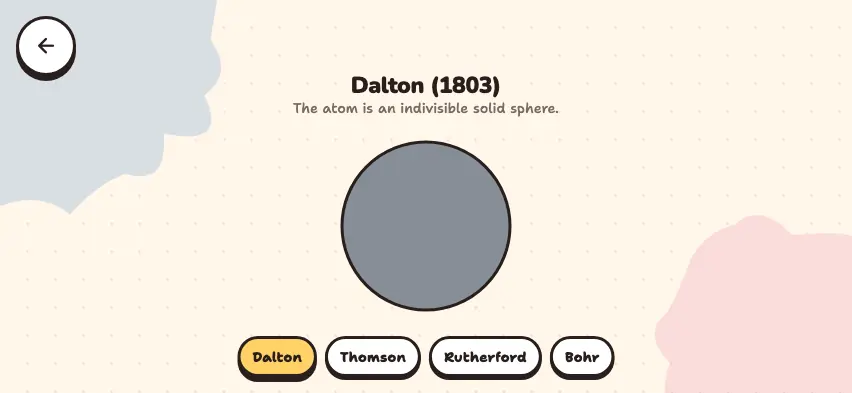
| Dalton | 1803 | The atom is a solid ball that cannot be divided | Did not know the atom contains electrons and a nucleus |
| Thomson | 1897 | Electrons embedded in a positively charged ball ("plum pudding") | Did not know positive charge is concentrated in one nucleus |
| Rutherford | 1911 | A small, dense positive nucleus at the center, with electrons around it | Did not explain why electrons do not fall into the nucleus |
| Bohr | 1913 | Electrons orbit in fixed shells | Does not fit atoms with many electrons |
What changed each model?
- Thomson discovered the electron in 1897, which proved that the atom can be divided. He published his model in 1904. The year 1897 in the simulator is the year the electron was discovered.
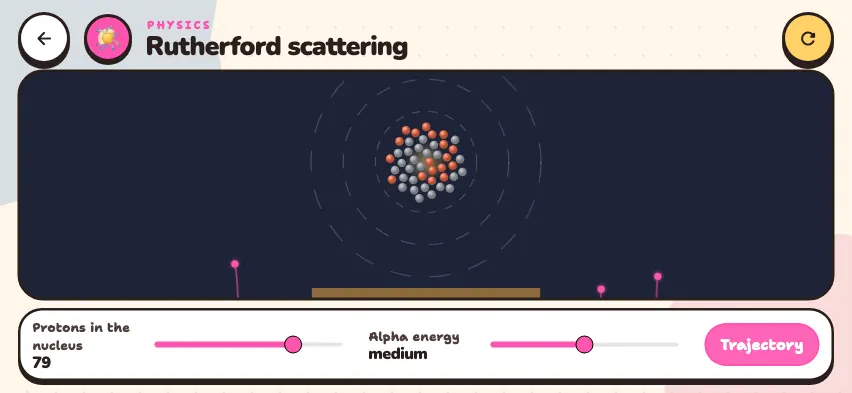
- Under Rutherford's direction, alpha particles were fired at gold foil. Most of the particles passed straight through, but a few were deflected at large angles, and some bounced back. In Thomson's model, this bouncing back should not have happened. The conclusion was that most of the atom is empty space, and that its positive charge and mass are concentrated in a small nucleus.
- Bohr proposed that an electron can exist only at certain energy levels. When an electron drops to a lower level, it gives off light of a specific color. This explained why hydrogen gives off only certain colors of light. The colors of the flame test are also related to this.
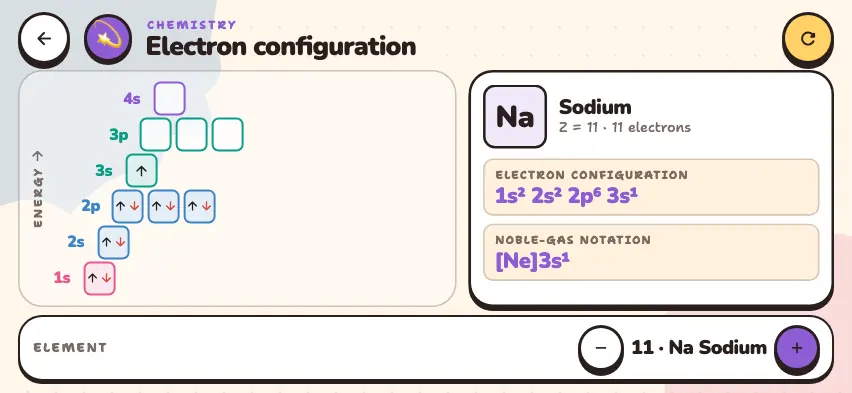
Today, electrons are described by orbitals, not by exact circular paths. An orbital is the region of space where an electron is most likely to be found. To continue, see the electron configuration guide.
See the four models in the Nalukh chem app
Press a button to compare the models from Dalton to Bohr. This simulator is part of full access. The app is free to download, and 2 chapters and 5 simulators are open without sign-up.
How do you use the simulator?
- The simulator opens on the Dalton model.
- Choose a model with the Dalton, Thomson, Rutherford, and Bohr buttons at the bottom. The selected button turns yellow.
- The top line shows the scientist's name and the year. Below it, the key idea of the model appears in one sentence.
- Look at the picture in the middle. The blue balls are electrons, and the orange parts are positive charge. In the Rutherford and Bohr models, the electrons move around the nucleus.
Tasks to try in the simulator
- Find the models that have a nucleus. Answer: Rutherford and Bohr.
- Compare where the positive charge is in the Thomson and Rutherford models. Answer: In Thomson's model, it is spread through the whole ball. In Rutherford's model, it is concentrated in a small nucleus at the center.
- Count how many electrons are drawn in each shell of the Bohr model. Answer: 2 in the inner shell and 5 in the outer shell. A nitrogen atom has this arrangement.
Common mistakes
- Thinking the Bohr model is the final model. It gives the idea of shells, but it does not fully explain how electrons move.
- Taking the sizes in the picture as real. The nucleus and electrons are drawn large enough to see. A real nucleus is many thousands of times smaller than the atom.
- Mixing up the years. Dalton presented his idea in 1803 and published it in a book in 1808, so some sources give 1808.