What is static electricity?
Every object is made of atoms. An atom has equal numbers of protons and electrons, so an object is usually neutral. When you rub two objects together, some electrons move from one object to the other. Protons are fixed inside the nucleus, so they do not move.
An object that loses electrons becomes positively charged, and an object that gains electrons becomes negatively charged. The charge does not flow through a wire. It stays on the surface, so it is called static electricity.
| Object | What happens | Charge |
|---|---|---|
| Sweater | Loses electrons | Positive |
| Balloon | Gains electrons | Negative |
| Wall | Does not gain or lose electrons | Stays neutral, but becomes polarized |
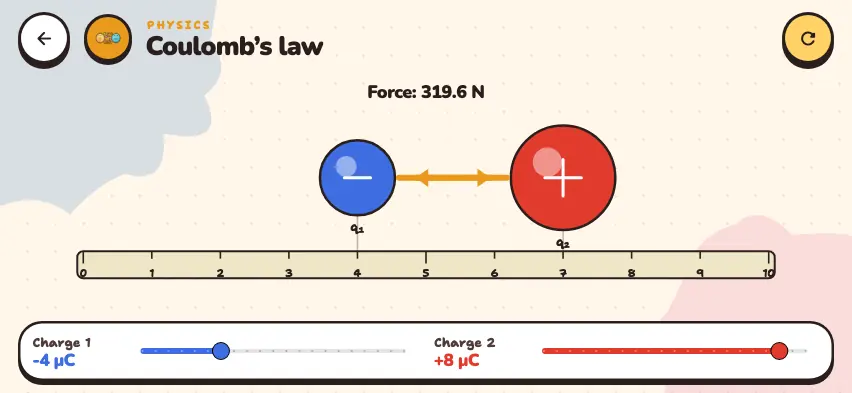
Charge is not created. It only moves. The number of electrons the sweater loses equals the number of electrons the balloon gains. Like charges repel, and opposite charges attract.
Why does a balloon stick to a neutral wall?
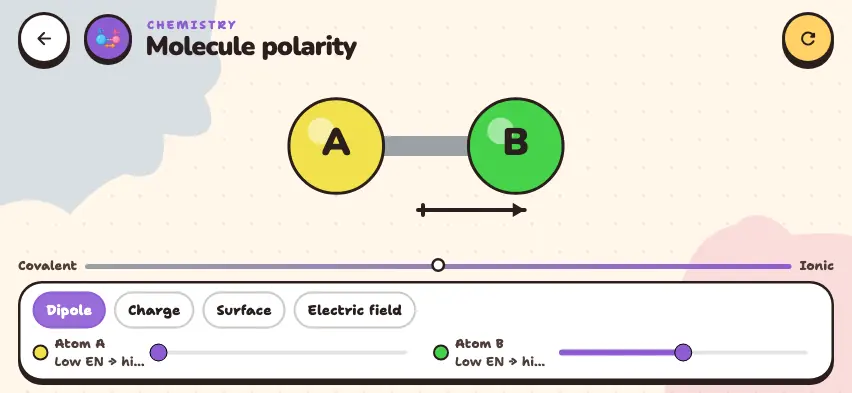
The wall has no charge, but when a charged balloon comes close, the electrons in the wall's atoms shift slightly away from the balloon. The positive side of each atom points toward the balloon, and the negative side points the opposite way. This is called polarization.
The positive side is closer to the balloon, so the attraction is stronger than the repulsion. As a result, the balloon sticks to the wall while the wall as a whole stays neutral.
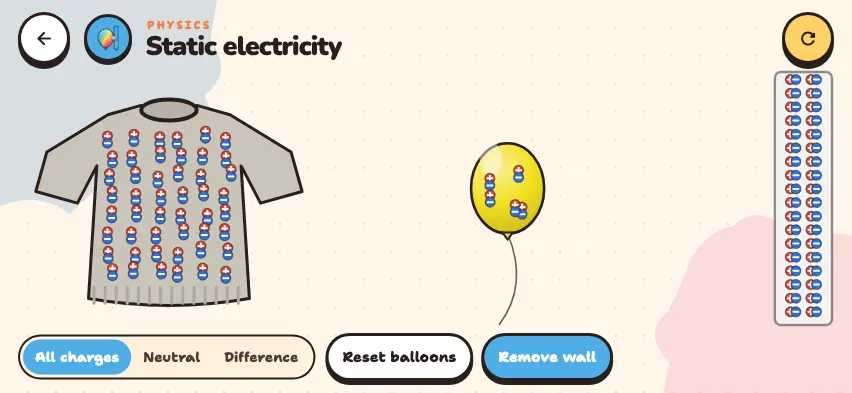
Try the balloon experiment in the Nalukh chem app
Rub the balloon on the sweater and watch how charge moves. This simulator is included with full access. Downloading is free, and 2 units and 5 simulators are open without signing up.
How do you use the simulator?
- Drag the yellow balloon onto the sweater with your finger and rub it back and forth. Blue negative charges move from the sweater to the balloon.
- Lift your finger. If you leave the charged balloon in the right half of the area, it moves to the wall on its own. If you leave it in the left half, it moves to the sweater.
- Choose a charge view: All charges shows all charges, Difference shows only the excess charges, and Neutral hides the charges.
- Use the Remove wall button to remove the wall and the Add wall button to put it back.
- The Reset balloons button returns the electrons to the sweater and puts the balloon back in its starting position.
Tasks to try in the simulator
- Choose the Difference view and rub the balloon on the sweater. Count the positive charges on the sweater and the negative charges on the balloon. The two numbers are equal.
- Leave the charged balloon in the right half so that it moves to the wall. Then press Remove wall. The balloon goes back to the positively charged sweater.
- Press Reset balloons, then place the uncharged balloon next to the wall. The balloon does not move, because the wall does not become polarized.
- Compare a balloon rubbed a few times with one rubbed many times. The more charge the balloon has, the faster it moves to the wall.
Where do you see it in everyday life?
- When you take off a wool hat, your hair stands up: your hair and the hat rub together and become charged.
- When you walk across a carpet and touch a metal doorknob, you get a shock: the charge built up on your body suddenly moves to the doorknob.
- In lightning, a large amount of charge built up in a cloud suddenly moves.
In humid air, charge leaves surfaces quickly. That is why you notice static electricity more on dry winter days.