Before you start practicing
This article is for practice. To learn the balancing method step by step, read the Balancing chemical equations article. The practice has three rules:
- Change only the coefficient in front of a formula. Never touch the subscripts.
- Number of atoms = coefficient × subscript. 2H2O contains 4 hydrogen atoms and 2 oxygen atoms.
- Write the answer in the smallest whole numbers.
Practice table
Cover the Answer column and balance each equation yourself. All the reactions are in the simulator, and the answers match what the simulator's 💡 Answer button shows.
| Category | Task | Answer |
|---|---|---|
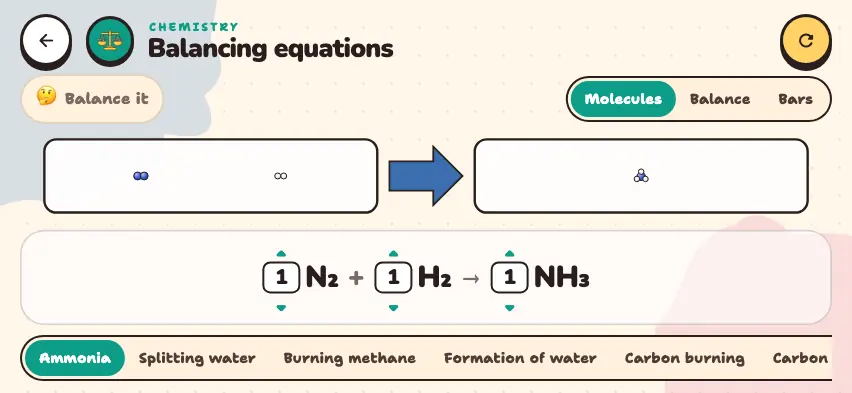
| Combination | N2 + H2 → NH3 | N2 + 3H2 = 2NH3 |
| Combination | Al + O2 → Al2O3 | 4Al + 3O2 = 2Al2O3 |
| Combination | Fe + O2 → Fe2O3 | 4Fe + 3O2 = 2Fe2O3 |
| Combustion | CH4 + O2 → CO2 + H2O | CH4 + 2O2 = CO2 + 2H2O |
| Combustion | C3H8 + O2 → CO2 + H2O | C3H8 + 5O2 = 3CO2 + 4H2O |
| Combustion | C2H6 + O2 → CO2 + H2O | 2C2H6 + 7O2 = 4CO2 + 6H2O |
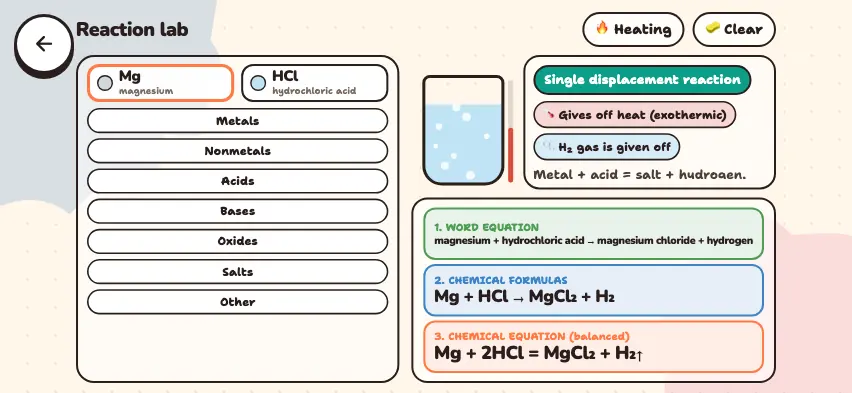
| Single displacement | Na + H2O → NaOH + H2 | 2Na + 2H2O = 2NaOH + H2 |
| Single displacement | Al + HCl → AlCl3 + H2 | 2Al + 6HCl = 2AlCl3 + 3H2 |
| Single displacement | Al + Fe2O3 → Al2O3 + Fe | 2Al + Fe2O3 = Al2O3 + 2Fe |
| Double displacement | NaOH + H2SO4 → Na2SO4 + H2O | 2NaOH + H2SO4 = Na2SO4 + 2H2O |
| Double displacement | CaCO3 + HCl → CaCl2 + CO2 + H2O | CaCO3 + 2HCl = CaCl2 + CO2 + H2O |
| Double displacement | CuSO4 + NaOH → Cu(OH)2 + Na2SO4 | CuSO4 + 2NaOH = Cu(OH)2 + Na2SO4 |
| Decomposition | H2O2 → H2O + O2 | 2H2O2 = 2H2O + O2 |
| Decomposition | KClO3 → KCl + O2 | 2KClO3 = 2KCl + 3O2 |
| Decomposition | AgNO3 → Ag + NO2 + O2 | 2AgNO3 = 2Ag + 2NO2 + O2 |
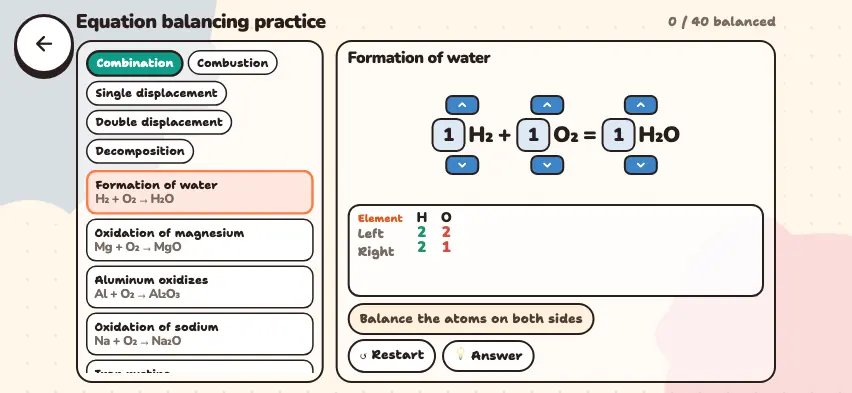
Balance 40 reactions in the Nalukh chem app
This simulator is included with full access. The app is free to download, and 2 units and 5 simulators are open with no sign-up.
How do you use the simulator?
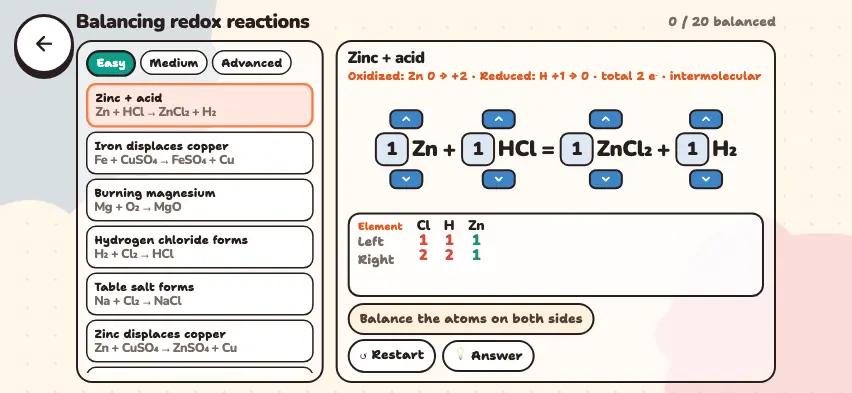
- Choose a category on the left: Combination, Combustion, Single displacement, Double displacement, or Decomposition.
- Choose a reaction from the list. All coefficients start at 1.
- Use the up and down arrow buttons on each formula to change the coefficient from 1 to 20.
- The table shows, for each Element, the number of atoms on the Left and Right sides. Numbers that match are green, and numbers that do not match are red.
- When everything matches and the coefficients are the smallest whole numbers, the label changes to Balanced! ⚖️ and a green mark appears in the list.
- The ↺ Restart button sets the coefficients back to 1. The 💡 Answer button fills in the correct coefficients.
The top corner shows how many reactions you have balanced. Reactions you viewed with the 💡 Answer button also count, and the counter starts from 0 again when you leave the simulator.
Tasks to try in the simulator
- In the first reaction of the Combination category, set the coefficients to 4, 2, 4. Answer: All the numbers are green, but Balanced! ⚖️ does not appear, because the correct answer is 2, 1, 2.
- Balance the combustion of ethane without the 💡 Answer button. Answer: 2, 7, 4, 6.
- Balance all the reactions in one category without the 💡 Answer button, so that every row in the list has a mark.
Tips for each category
- Combustion: Balance carbon first, then hydrogen, and oxygen last. If the number of oxygen atoms comes out odd, multiply all the coefficients by 2.
- Double displacement: If a group such as SO4 or CO3 is the same on both sides, it is easier to count it as one unit.
- Decomposition and combination: Balance substances made of one element, such as O2, H2, and Fe, last.