What are material properties?
Car tires are made of rubber, and electrical wires are made of copper. That is because each material has different properties. The simulator shows four properties.
| Property | What it means | Example |
|---|---|---|
| Hardness | Ability to resist scratching and denting | A fingernail leaves no scratch on glass |
| Electrical conductivity | Ability to let current pass through | A copper wire conducts current well |
| Flexibility | Ability to bend or stretch without breaking | Rubber stretches and returns to its shape |
| Magnetism | Being attracted to a magnet | An iron nail is attracted to a magnet |
How do you choose a material by its properties?
When you choose a material, you look at the properties the job needs.
| Use | Material | Why |
|---|---|---|
| Electrical wire | Copper | Conducts current well, bends |
| Wire coating | Rubber | Does not conduct current, flexible |
| Car tire | Rubber | Flexible |
| Window | Glass | Hard, transparent |
| Nail | Iron | Hard, strong |
| Can | Aluminum | Light, bends |
No material is good in every property. Glass is hard but brittle, and rubber is flexible but soft.
Compare six materials in the Nalukh chem app
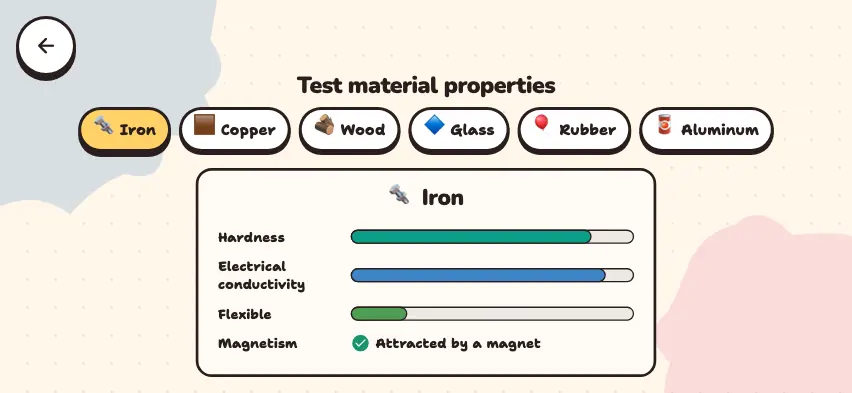
Choose a material and see its properties as bars. This simulator unlocks with full access. The app is free to download, and 2 units and 5 simulators are open without signing up.
How do you use the simulator?
- Choose a material at the top: Iron, Copper, Wood, Glass, Rubber, or Aluminum. The simulator opens on iron.
- The card below shows the name of the selected material.
- For Hardness, Electrical conductivity, and Flexible, a longer bar means a stronger property.
- The Magnetism row shows Attracted by a magnet or Not attracted.
- Press the materials in turn and compare the bars.
Tasks to try in the simulator
- Find the one material of the six that is attracted to a magnet. Answer: Iron.
- Find the three materials whose Electrical conductivity bar is almost empty. Answer: Wood, glass, and rubber.
- Find the materials with the longest and the shortest Flexible bars. Answer: Rubber and glass.
- You want to make an electrical wire. Which material suits the inside, and which suits the outside? Answer: Copper inside and rubber outside.
How do you test properties in real life?
The simulator shows properties directly. You can test real materials in these ways:
- Hardness: scratch two materials against each other. The one that gets a scratch is softer.
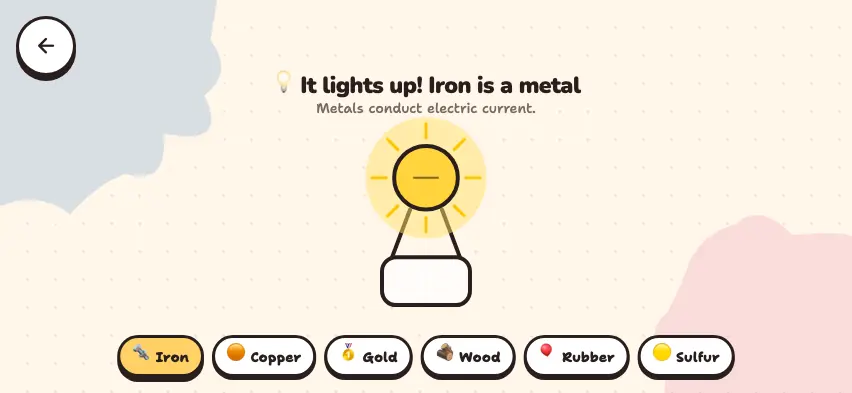
- Electrical conductivity: put the material in a circuit with a battery and a bulb. If the bulb lights, the material conducts.
- Flexibility: bend it slowly. Do not bend glass, because it can break and cut your hand.
- Magnetism: bring a magnet close to the material.
Common mistakes
- "Hard means strong." Glass is hard but brittle, so it breaks when you hit it.
- "All metals are attracted to magnets." Only a few metals are attracted, such as iron, nickel, and cobalt. In the simulator, copper and aluminum are not attracted.
To test whether a material is a metal with a circuit, see the electrical conductivity test guide.