Why does trash float or sink?
In the simulator's lake, trash sits at three levels. Things less dense than water float, and things denser than water sink. The density of water is about 1 g/cm³, and the density of glass and metal is several times greater. An empty plastic container has air inside, so it floats on the surface.
| Bin | Trash | Where it sits in the lake |
|---|---|---|
| Plastic | plastic container, plastic bag, plastic bottle | surface |
| Glass | glass bottle, glass shard, glass cup | bottom |
| Metals | can, wire, bottle cap | bottom |
| Organic | apple core, banana peel, leaf | middle of the water, surface |
How does trash harm water?
- Plastic does not break down for many years. It breaks into pieces and becomes microplastics smaller than 5 mm. Fish swallow them, and they pass along the food chain.
- Organic waste is broken down by bacteria, and the bacteria use up the dissolved oxygen in the water. When there is less oxygen, fish cannot breathe.
- Glass and metal last a long time in water, and their sharp pieces can injure animals and people.
Sorting makes trash useful. Glass, metal, and plastic are recycled into new raw materials, and organic waste becomes compost.
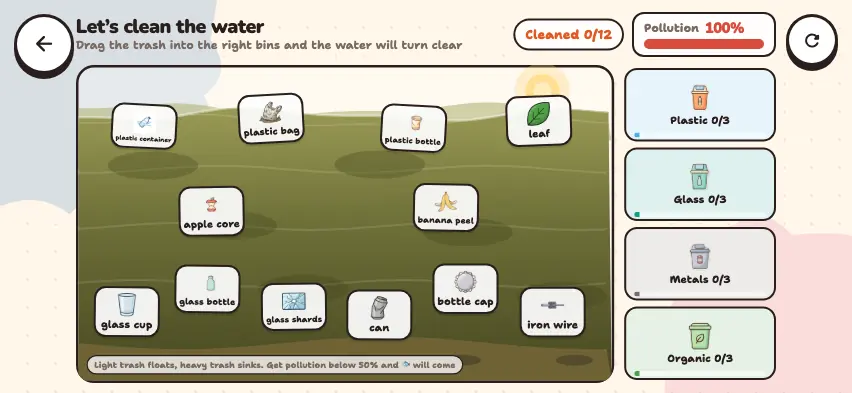
Clean up the lake in the Nalukh chem app
Drag the trash into the right bin and watch the water turn clear. This simulator is included with full access. The app is free to download, and 2 units and 5 simulators are open with no sign-up.
How do you use the simulator?
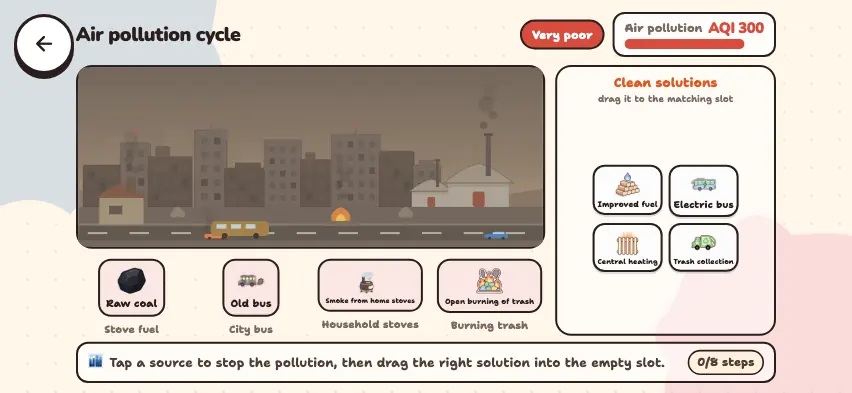
- Press a piece of trash on the lake and drag it to the matching bin on the right.
- If you drag it to the wrong bin, the bin shakes and does not take the trash. If it goes into the right bin, the water splashes and the number on the bin goes up.
- Watch the Pollution meter at the top. Each time you remove a piece of trash, the percentage falls, and the water changes from dirty brownish green to clear blue.
- Follow the explanation line. When pollution falls below 50%, fish return, and when it falls below 20%, algae and birds return.
- After you sort all 12 pieces of trash, press the circular arrow button in the upper right corner to start again.
Tasks to try in the simulator
- First predict how many pieces of trash you must remove for the fish to return, then check. The pollution level is the number of pieces left divided by 12. Answer: 7 pieces.
- How many pieces must you remove for the algae and birds to return? Answer: 10 pieces.
- Remove the trash in a different order. Check that the pollution percentage depends only on the number of pieces left.
- Look at where each piece of trash sits, and predict whether it is denser or less dense than water.
Clear water is not always clean
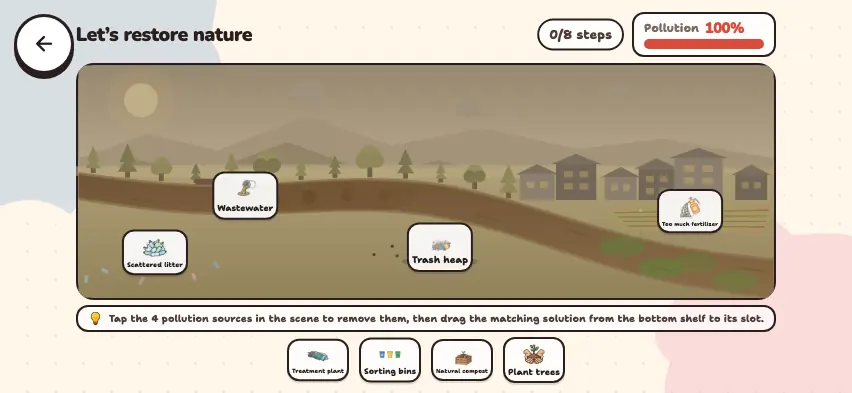
The simulator shows only trash that you can see. Dissolved substances such as fertilizer and lead cannot be seen, so even clear water can be polluted. You cannot remove these substances by picking up trash. The water must be filtered and treated with chemical methods. So do not drink river or lake water just because it looks clear.