What is a crystal lattice?
The particles of a crystalline substance are not arranged at random. They repeat in a regular pattern in space. This structure is called a crystal lattice, and the points where the particles sit are called lattice points. Lattices are divided into four types by the particles at those points:
| Lattice | At the lattice points | Bonding between particles | Properties | Examples |
|---|---|---|---|---|
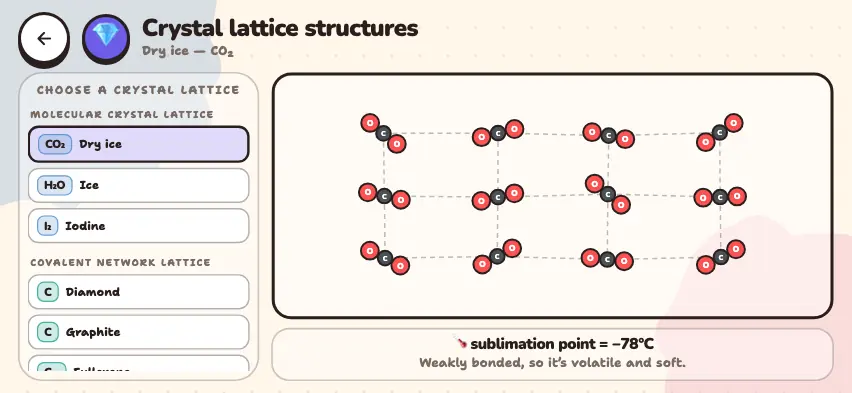
| Molecular | Molecules | Weak forces between molecules | Soft, low melting point | Dry ice, ice, iodine |
| Covalent network (atomic) | Atoms | Covalent bonds | Very high melting point, usually very hard | Diamond, graphite |
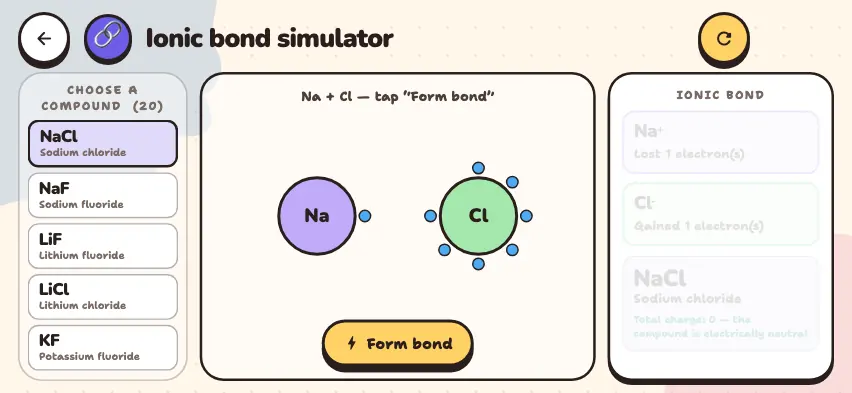
| Ionic | Cations and anions, alternating | Ionic bonds | Hard, brittle, conducts electricity when melted | Salt |
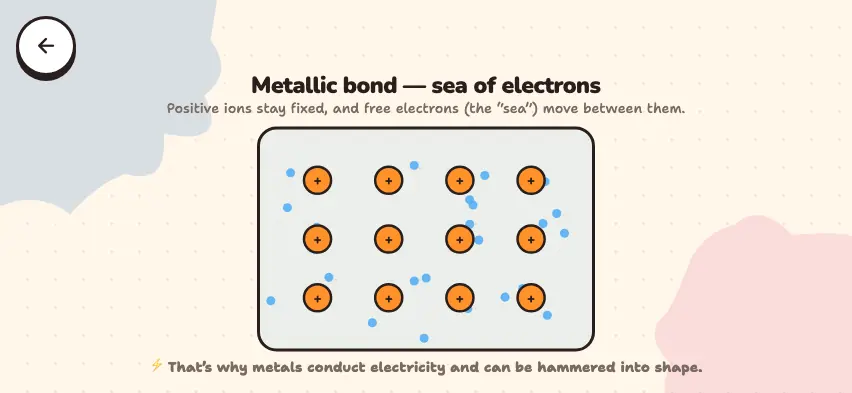
| Metallic | Positive ions | Metallic bonds | Malleable, conducts electricity | Copper |
Why do properties depend on the lattice?
- Molecular lattice: When ice melts, the O–H bonds inside the molecules do not break. Only the bonds between the molecules weaken. That is why ice melts at 0°C.
- Covalent network lattice: In diamond, each atom is joined to its four neighbors by covalent bonds, so diamond is very hard. Graphite is also carbon, but its layers are weakly bonded and slide. That is why it is used as pencil lead.
- Ionic lattice: When salt is struck, a layer of ions shifts, ions with the same charge move close together and repel each other, and the salt shatters.
- Metallic lattice: Free electrons move between the positive ions and conduct electricity. By how the ions are arranged, metallic lattices are classified as Hexagonal close-packed (Zn, Mg, Cd), Body-centered cubic (Cr, Fe, W), or Face-centered cubic (Al, Cu, Ag).
See crystal lattices in the Nalukh chem app
Choose a substance and compare its lattice structure and how its particles move. This simulator is part of full access. The app is free to download, and 2 chapters and 5 simulators are open without sign-up.
How do you use the simulator?
- Choose a substance from the CHOOSE A CRYSTAL LATTICE list on the left. The 11 substances are grouped by lattice type. Scroll down to see them all.
- The large area shows an animated drawing of that lattice. A solid line is a strong bond, and a dashed line is a weak bond.
- The line below shows the melting point or a special feature, followed by an explanation of the properties.
- Read the name and formula of the selected substance in the line below the top bar.
Tasks to try in the simulator
- Compare Diamond and Graphite. Which one clearly moves? Answer: The layers of graphite slide back and forth, and diamond barely moves.
- Choose Salts and look at the neighbors to the right, left, top, and bottom of one + ion. Answer: All are − ions.
- Compare Copper and Salts. Which one has blue electrons? Answer: Copper. Salt has no free electrons, so it does not conduct electricity when solid.
- Where is the extra atom in Body-centered cubic and in Face-centered cubic? Answer: At the center of the cube, and at the center of the cube's faces.