Which method fits which mixture?
Before you choose a method, ask two questions: Does the solid dissolve in water? Which substance do you want from the mixture?
| Mixture | What you want | Method | The other substance |
|---|---|---|---|
| Sand and water | Sand and water | Filtration | Both are kept |
| Salt water | Salt | Evaporation | The water turns to vapor and goes into the air |
| Salt water | Pure water | Distillation | The salt stays in the flask |
You cannot filter salt water: the dissolved salt passes through the paper with the water. To learn what a mixture is, see the guide to mixtures.
How do the three methods work?
Filtration
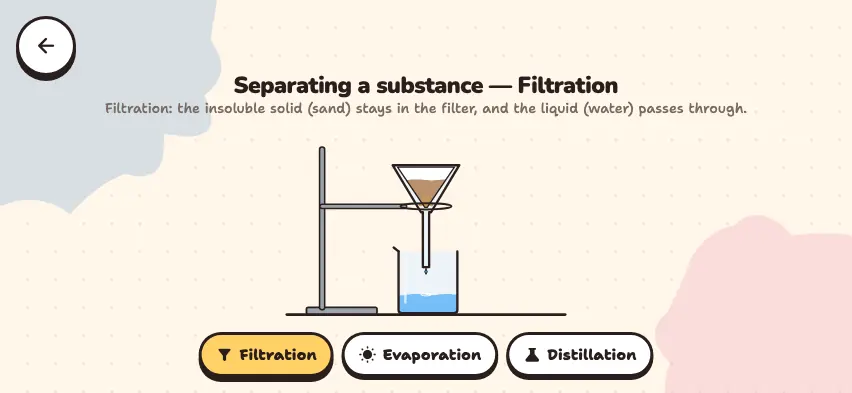
Filter paper lets liquid through and holds back the insoluble solid. The solid left on the paper is called the residue, and the liquid that passes through the paper is called the filtrate.
Evaporation
When you heat a solution in an evaporating dish, the water turns to vapor and goes into the air. Salt does not evaporate, so it stays in the dish as crystals.
Distillation
When you boil salt water in a flask, the water turns to vapor and the salt stays behind. The vapor cools in the condenser, turns back into a liquid, and collects in an Erlenmeyer flask. Cold water flows along the outside of the condenser: it enters at the lower end and leaves at the upper end. The thermometer bulb sits level with the side arm and measures the temperature of the vapor.
See all three methods in the Nalukh chem app
Watch the equipment and process of filtration, evaporation, and distillation as animations. This simulator unlocks with full access. The app is free to download, and 2 units and 5 simulators are open without signing up.
How do you use the simulator?
- Choose a method from the three buttons at the bottom: Filtration, Evaporation, or Distillation. The simulator opens on Filtration.
- In Filtration, you see a ring stand, a funnel, filter paper, and a beaker. From muddy water, sand stays on the paper and clear water drips into the beaker.
- In Evaporation, an alcohol burner heats an evaporating dish. The water level drops, vapor rises, and white salt crystals appear.
- In Distillation, salt water boils in a flask, the vapor passes through the condenser, and drops fall into an Erlenmeyer flask.
- The line under the title explains the method in one sentence. The animation repeats every 6 seconds.
You cannot enter numbers or change substances here. Choose a method and watch.
Tasks to try in the simulator
- In Filtration, write down what stays on the paper and what goes into the beaker. Answer: Sand stays on the paper, and clear water goes into the beaker.
- Compare Evaporation and Distillation. Both work on salt water. In which method is the water lost, and in which is it kept? Answer: Evaporation loses it to the air, and distillation collects it in the Erlenmeyer flask.
- In Distillation, find the two tubes on the condenser. Why does the cold water enter at the bottom? Answer: This way the condenser fills completely with water, and the vapor cools well.
Methods not in the simulator
| Mixture | Method |
|---|---|
| Iron filings and sand | Separating with a magnet |
| Two liquids that do not mix, such as water and oil | Separatory funnel |
| Liquids with close boiling points | Fractional distillation |
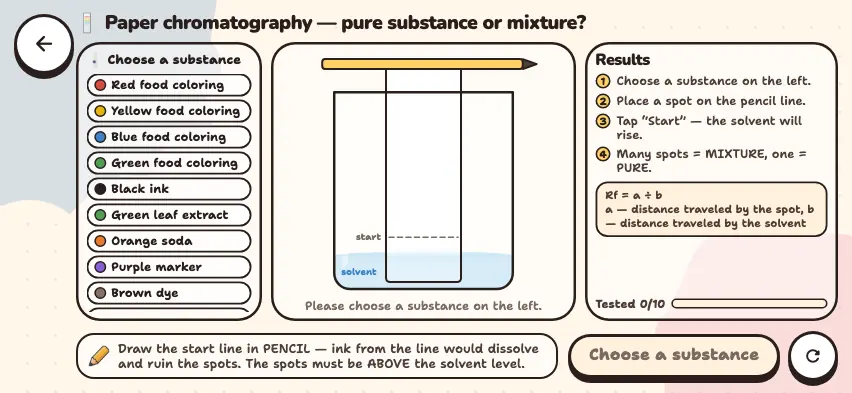
| Colored substances in dyes | Paper chromatography |