How are physical and chemical changes different?
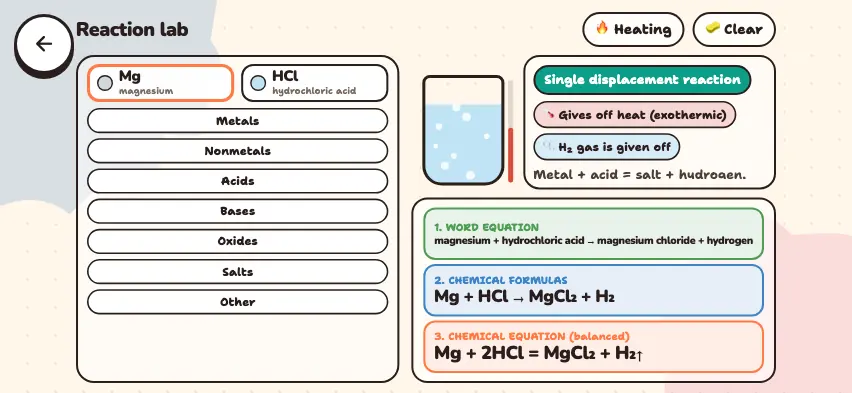
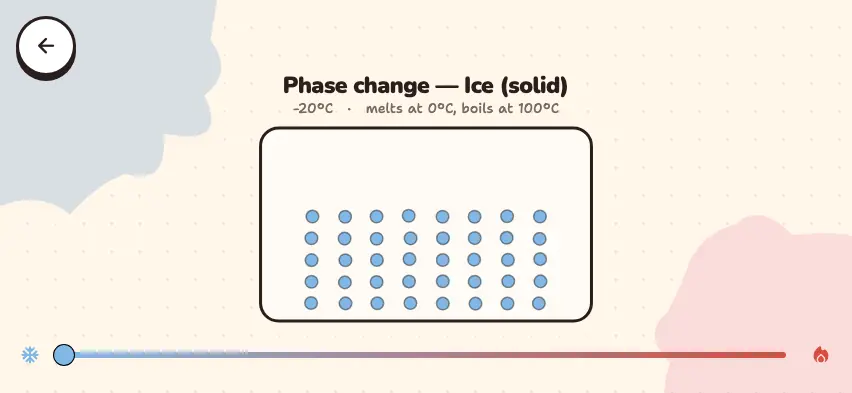
When ice melts into water, the substance stays the same and only its state changes. When wood burns, it reacts with oxygen in the air, and carbon dioxide, water, and ash form.
| Feature | Physical | Chemical |
|---|---|---|
| New substance | Does not form | Forms |
| Particles | Their position and spacing change | Atoms bond in a new way |
| Number of atoms | Does not change | Does not change |
| Reversing it | Usually easy | Usually hard |
| Change | Type | Why |
|---|---|---|
| Ice melting | Physical | It is still water, and only the state changes |
| Salt dissolving in water | Physical | If the water evaporates, the salt is left behind |
| Glass breaking | Physical | It is still glass, and only the shape changes |
| Coal burning | Chemical | Ash and gases form |
| Iron rusting | Chemical | Rust is a new substance |
| Milk fermenting | Chemical | New substances form |
How can you recognize a chemical change?
These four signs tell you that a new substance has formed:
- The color changes.
- A gas or bubbles appear.
- Heat or light is given off.
- A precipitate settles at the bottom.
These are clues, not proof. The final test is whether a new substance formed. For one kind of physical change, see the phase changes guide.
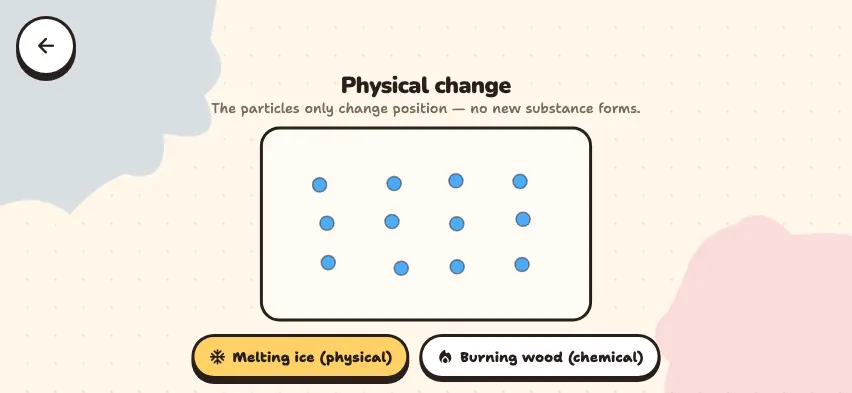
See both changes as particles in the Nalukh chem app
Switch between melting ice and burning wood with the buttons and compare them. This simulator unlocks with full access. The app is free to download, and 2 units and 5 simulators are open without signing up.
How do you use the simulator?
- The simulator opens in Melting ice (physical) mode. The blue particles move and change position, and their color does not change.
- Press the Burning wood (chemical) button. Blue and orange particles move together in pairs and join to form large green particles.
- Press this button again to replay the reaction from the start.
- Press Melting ice (physical) to go back to physical mode. The title and description change with the mode.
The colored particles are a model. Real wood is not made of blue and orange particles. The green particles only show that a new substance has formed.
Tasks to try in the simulator
- Watch Melting ice (physical) mode for a while. Does a particle of a new color appear? Answer: No, all the particles stay blue.
- Press the Burning wood (chemical) button and count the green particles. How many pairs of particles were there at the start? Answer: There are 12 green particles, so there were 12 pairs.
- At the end of chemical mode, are any of the original blue and orange particles left? Answer: No, they all turn green. In physical mode, on the other hand, the original particles stay the same.
Common mistakes
- "If you cannot reverse it, it is chemical." You cannot make torn paper the way it was, but no new substance has formed, so this is a physical change.
- "If there are bubbles, it is chemical." Boiling water forms bubbles, and that is physical. When you drip vinegar onto baking soda, the bubbles are a new gas, so that is chemical.
- "Only one change happens at a time." When a candle burns, the wax melting is physical and the wax burning is chemical. The two happen together.