What are oxidation and reduction?
In a redox reaction, the oxidation state of an element changes. The two processes always happen together.
| Term | Electrons | Oxidation state |
|---|---|---|
| Oxidation | lost | rises |
| Reduction | gained | falls |
| Reducing agent | loses them and is itself oxidized | rises |
| Oxidizing agent | gains them and is itself reduced | falls |
In the reaction Zn + 2HCl → ZnCl2 + H2, the oxidation state of zinc goes from 0 to +2, so zinc is oxidized. The oxidation state of hydrogen goes from +1 to 0, so hydrogen is reduced. Therefore zinc is the reducing agent and HCl is the oxidizing agent.
Steps of the electron balance method
As an example, balance the reaction of copper with concentrated nitric acid: Cu + HNO3 → Cu(NO3)2 + NO2 + H2O.
- Find the elements whose oxidation states change: Cu goes from 0 to +2, and N goes from +5 to +4.
- Count the electrons transferred: copper loses 2 electrons, and nitrogen gains 1 electron.
- The least common multiple of the two numbers is 2. So put 1 in front of copper and 2 in front of NO2.
- Balance the remaining atoms. The salt contains two nitrates, so you need 4 HNO3 in total: Cu + 4HNO3 → Cu(NO3)2 + 2NO2 + 2H2O.
- Check with oxygen: 12 on the left, and 6 + 4 + 2 = 12 on the right.
Three types of redox reactions
| Type | Example | Feature |
|---|---|---|
| Intermolecular | Zn + 2HCl → ZnCl2 + H2 | The oxidized and reduced elements are in different substances |
| Intramolecular | 2KClO3 → 2KCl + 3O2 | The two elements are in the same substance |
| Disproportionation | 2H2O2 → 2H2O + O2 | The same element is oxidized and reduced at the same time |
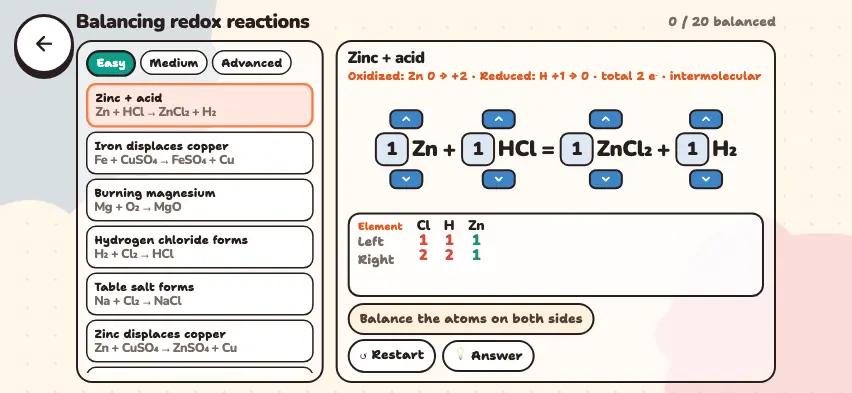
Balance redox reactions in the Nalukh chem app
Practice on 20 reactions, from easy to advanced. This simulator is included with full access. The app is free to download, and 2 units and 5 simulators are open with no sign-up.
How do you use the simulator?
- In the upper left area, choose a level: Easy, Medium, or Advanced. They have 7, 8, and 5 reactions.
- Tap a reaction in the list. The right panel shows the oxidized and reduced elements, the total number of electrons, and the reaction type.
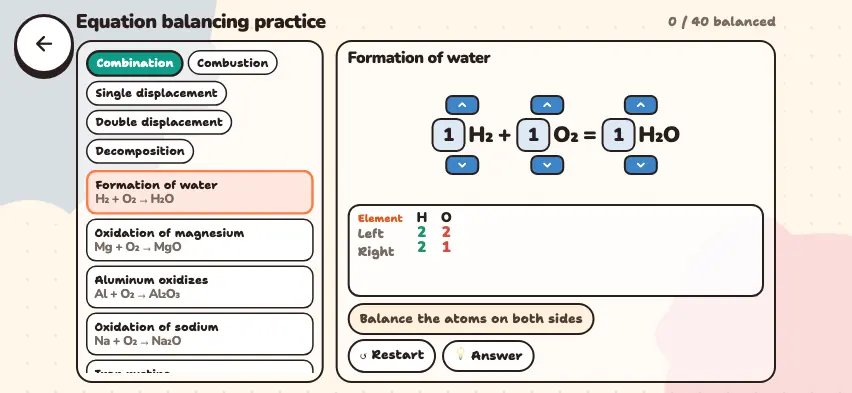
- Use the up and down arrows on each formula to change the coefficient.
- In the table below, read the number of atoms for each Element on the Left and Right sides. Numbers that match are green, and numbers that do not match are red.
- When all the elements balance, Balanced! ⚖️ appears. The coefficients must be the smallest whole numbers: if you double them all, the simulator does not count the reaction as balanced.
- ↺ Restart sets the coefficients back to 1, and 💡 Answer fills in the correct answer.
Tasks to try in the simulator
- At the Easy level, balance the Burning magnesium reaction. Use the coefficients to explain why the total is given as 4 electrons.
- At the Medium level, in the Blast furnace reaction exercise, write the changes in the oxidation states of carbon and iron, and check that the electrons lost and gained both equal 6.
- At the Advanced level, balance the Permanganate and acid exercise. The coefficient of HCl comes out as 16, but only 10 chlorine atoms are oxidized. Find which substance the other 6 chlorine atoms go into.
- In the Peroxide decomposes exercise, check that the oxidation state of oxygen goes from −1 to 0 and −2.
Common mistakes
- Changing a subscript. Change only the coefficient in front of a formula. If you turn H2O into H2O2, it becomes a different substance.
- Forgetting the two roles of the acid. In the copper reaction, 2 of the 4 HNO3 act as the oxidizing agent and 2 go into the salt. The electron balance gives you only the 2.
- Not checking the atoms. Even when the electrons balance, the atom counts can differ. At the end, count every element.