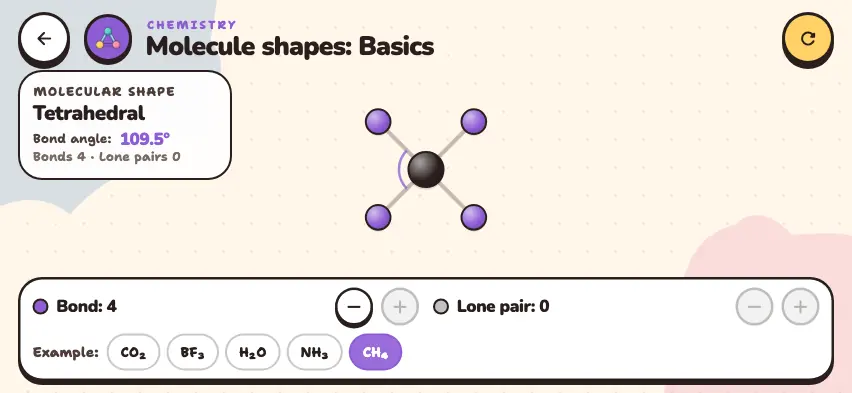
What is VSEPR theory?
VSEPR stands for valence shell electron pair repulsion. The domains around a central atom repel each other and spread as far apart as possible. One bond or one lone pair is one domain. A double or triple bond is also one domain, because its electrons point in the same direction.
Do not confuse these two terms:
- Electron geometry: the arrangement of all domains, including lone pairs.
- Molecular shape: the arrangement of the atoms only, not including lone pairs.
Electron geometry and molecular shape chart
Each row is a total number of domains, and each column is a number of lone pairs. The number of bonds is the difference between the two.
| Electron geometry | 0 lone pairs | 1 lone pair | 2 lone pairs | 3 lone pairs |
|---|---|---|---|---|
| Linear (2 domains) | Linear, 180°, CO2 | — | — | — |
| Trigonal planar (3) | Trigonal planar, 120°, BF3 | Bent, ≈120°, SO2 | — | — |
| Tetrahedral (4) | Tetrahedral, 109.5°, CH4 | Trigonal pyramidal, 107°, NH3 | Bent, 104.5°, H2O | — |
| Trigonal bipyramidal (5) | Trigonal bipyramidal, 90°/120°, PCl5 | Seesaw, ≈90°/120°, SF4 | T-shaped, 90°, ClF3 | Linear, 180°, XeF2 |
| Octahedral (6) | Octahedral, 90°, SF6 | Square pyramidal, 90°, BrF5 | Square planar, 90°, XeF4 | — |
A molecule with 1 bond has 2 atoms, so it is always linear.
From strongest to weakest, the repulsions are: lone pair with lone pair, lone pair with bond, and bond with bond. So lone pairs push the bonds closer together and make the angles smaller. In a trigonal bipyramid, a lone pair takes a position in the trigonal plane. In an octahedron, 2 lone pairs sit opposite each other.
How do you count lone pairs?
- Find the number of valence electrons of the central atom.
- Subtract the electrons that go into bonds: 1 for a single bond, 2 for a double bond, 3 for a triple bond.
- Divide the remaining electrons by 2 to get the number of lone pairs.
For example, in SF4, sulfur has 6 valence electrons. Of these, 4 go into bonds, which leaves 2 electrons, or 1 lone pair. With 4 bonds and 1 lone pair, the molecule has a seesaw shape.
Try VSEPR shapes in the Nalukh chem app
Change the bonds, lone pairs, and bond order, and check the electron geometry, shape, and angle. This simulator is included with full access. Downloading is free, and 2 units and 5 simulators are open without signing up.
How do you use the simulator?
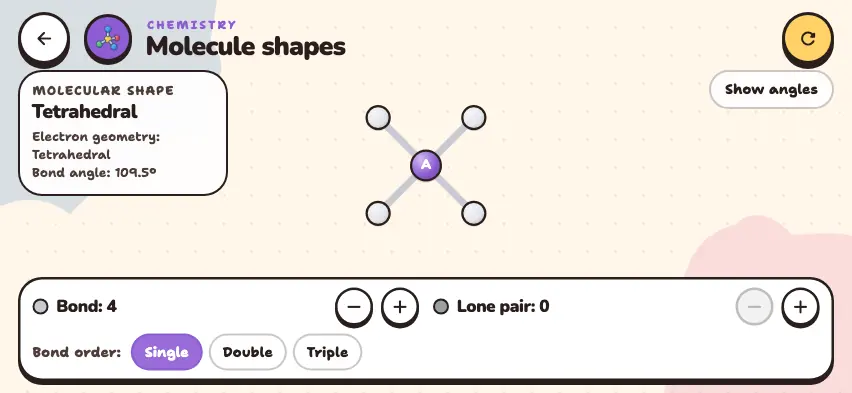
- The simulator opens with a molecule that has 4 bonds and no lone pairs. The purple A ball is the central atom.
- In the bottom panel, use the − and + buttons in the Bond and Lone pair rows to add or remove domains. Their sum cannot go above 6.
- Read the molecular shape, electron geometry, and bond angle on the upper-left card.
- The Single, Double, and Triple buttons draw all the bonds with that bond order.
- The Show angles button draws an arc between the first two bonds and writes the angle value.
- The yellow button in the upper-right corner returns to the starting state.
Tasks to try in the simulator
- Keep the total at 4 domains and set the lone pairs to 0, 1, and 2. What does not change? Answer: The electron geometry stays tetrahedral, and the shape goes from tetrahedral to trigonal pyramidal to bent.
- Set 3 bonds and 1 lone pair, then tap Double and Triple. Does the shape change? Answer: No, it stays trigonal pyramidal.
- Predict the shape of XeF4 and check it. Xenon has 8 valence electrons. Answer: 4 bonds, 2 lone pairs, square planar.
Common mistakes
- Writing the electron geometry as the shape. The electron geometry of NH3 is tetrahedral, but its shape is trigonal pyramidal.
- Counting a double bond as 2 domains. CO2 has 2 double bonds, and it has 2 domains.
- Counting lone pairs on the outer atoms. Only lone pairs on the central atom affect the shape.
If this is your first time, start with the basics of molecular shapes.