What is metallic bonding?
Metallic bonding is the attraction between positive ions and free electrons. A metal atom has few electrons in its outer shell and releases them easily. The released electrons do not belong to any one atom. They move through the whole metal and form an electron sea. The atoms that lost electrons become positive ions and stay in place.
In a covalent bond, a pair of electrons is between two atoms. In metallic bonding, the electrons are shared by all the ions.
Among metals in the same period, the more valence electrons a metal has, the stronger the bond. Sodium has 1 valence electron and melts at 98°C. Magnesium has 2 valence electrons and melts at 650°C.
How does it explain the properties of metals?
| Property | Explanation |
|---|---|
| Conducts electricity | When a voltage is applied, the free electrons move in one direction and form a current. |
| Conducts heat | The free electrons move through the whole metal and carry energy. |
| Malleable and ductile (can be hammered and stretched) | Layers of ions slide past each other, but the electron sea keeps them bonded. |
| Shiny | Light reflects off the free electrons at the surface. |
When you hit them, salt shatters, but metal can be hammered into shape. In an ionic crystal, when a layer shifts, ions with the same charge move close together and repel each other. This does not happen in a metal, because the electron sea is between the ions.
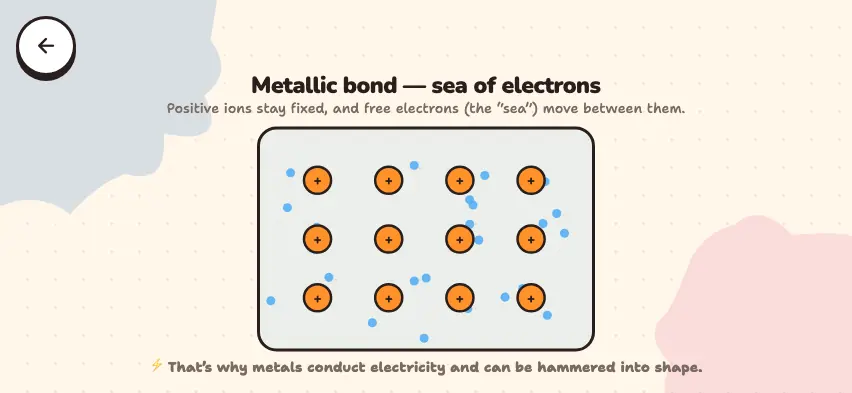
See the electron sea in the Nalukh chem app
Watch free electrons move between the positive ions. This simulator is part of full access. The app is free to download, and 2 chapters and 5 simulators are open without sign-up.
How do you use the simulator?
This simulator has no buttons. It starts running when you open it, and you only watch.
- Look at the picture inside the frame. The orange circles have a + sign: these are the positive ions.
- The blue dots are the free electrons. They move between the ions and bounce off the frame.
- Compare the two: the ions stay in place while the electrons move.
- Read the captions above and below the picture.
Tasks to try in the simulator
- Count the positive ions. Answer: 3 rows and 4 columns, 12 ions in total.
- Follow one blue electron with your eyes. Does it circle one ion? Answer: No. It moves between the ions and bounces off the frame.
- All the ions have the same positive charge. Why do they not repel each other and scatter? Answer: Each ion is attracted to the negative electrons around it.
Examples in everyday life
Electrical wires are made of copper because copper conducts electricity well and can be stretched into wire. Aluminum is used for the bottoms of pots because it conducts heat well and can be hammered into thin sheets.
To see how salts differ from metals, read the ionic bonding guide and the crystal lattice guide.