Why do atoms attract and repel?
Atoms of noble gases such as neon and argon have no charge and do not form chemical bonds with each other. Yet neon becomes a liquid at −246°C and argon at −186°C. A liquid can form only because there is an attractive force between the atoms.
This weak attraction is called the van der Waals force. The electrons in an atom are always moving, so at some moments there are more electrons on one side of the atom. The atom gets a temporary positive side and negative side, and it attracts a neighboring atom. If two atoms get too close, their electron shells overlap and they repel strongly.
| Distance between atoms | Force | On the curve |
|---|---|---|
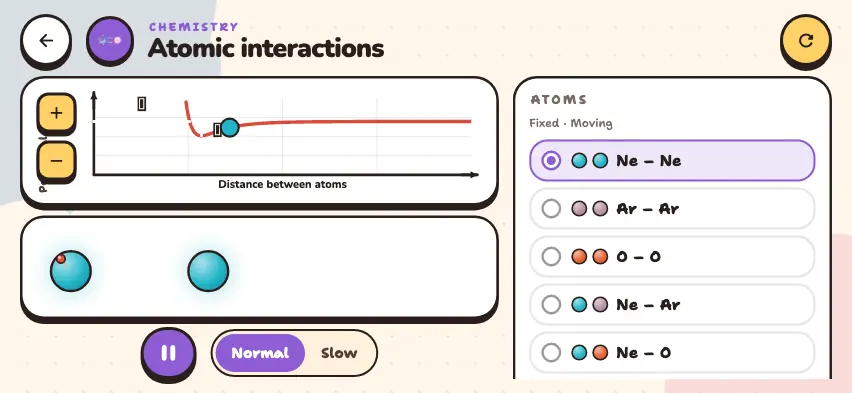
| Closer than the equilibrium distance | Repulsion dominates | The curve rises steeply |
| Equilibrium distance | Attraction and repulsion are equal | The lowest point |
| Farther than the equilibrium distance | Attraction dominates and weakens as the distance grows | The curve approaches zero |
How do you read the potential energy curve?
The simulator draws the curve with the Lennard-Jones formula: V(r) = 4ε[(σ/r)¹² − (σ/r)⁶]. Here r is the distance between the atoms. The first term in the brackets represents repulsion, and the second represents attraction.
- σ (sigma): the distance at which potential energy equals zero. The larger the atom, the larger σ is.
- ε (epsilon): the depth of the lowest part of the curve, also called the depth of the potential well. The deeper the well, the more strongly the atoms attract.
- Equilibrium distance: the distance at which the two forces balance. It is 1.12 times σ. An atom oscillates around this distance.
Test atomic attraction in the Nalukh chem app
Change the distance between the atoms and watch the dot on the curve. This simulator is included with full access. Downloading is free, and 2 units and 5 simulators are open without signing up.
How do you use the simulator?
- Choose a pair from the ATOMS list on the right. In each pair, the first atom is fixed and the second is the moving atom.
- In the lower area, drag your finger right or left to change the distance between the two atoms. When you lift your finger, the moving atom starts to oscillate.
- In the graph at the top, watch the dot that has the same color as the moving atom. The dot moves along the curve and shows the current distance and energy. The + and − buttons at the side zoom the energy axis in and out.
- Turn on the Show forces option. A red arrow pointing away from the fixed atom means repulsion, and a blue arrow pointing toward it means attraction.
- Use the play button to stop the motion, and choose the speed with the Normal and Slow buttons.
- If you select the Adjust row, the Attractive force slider appears and you can change ε yourself.
Tasks to try in the simulator
- Compare the curves of the Ne – Ne and Ar – Ar pairs. Argon has a larger σ and a deeper well. That is why argon becomes a liquid at a higher temperature than neon.
- Drag the atom closer than σ and lift your finger. The atom is pushed away hard and moves out to the right edge of the area.
- Move the atom slightly farther than the equilibrium distance and lift your finger. The atom oscillates inside the potential well. Watch the dot move in Slow mode.
- Select the Adjust row and drag the Attractive force slider to the right. The well gets deeper, but σ does not change.
Common misconceptions
- The van der Waals force is not a chemical bond. Covalent bonds inside a molecule are much stronger. That is why, when a liquid boils, only the attraction between molecules breaks and the molecules themselves do not come apart.
- The O – O pair is not an O2 molecule. In reality, two oxygen atoms form a double bond. This curve does not show that bond. It shows only weak attraction and repulsion.
- The graph axes have no numbers. The simulator shows only relative values, so compare the pairs by the shape of their curves.