Tests for gases and water
| Substance | Test | What you see |
|---|---|---|
| Oxygen O2 | Glowing splint | The splint bursts back into flame |
| Hydrogen H2 | Burning splint | The gas burns with a squeaky pop |
| Carbon dioxide CO2 | Limewater | The limewater turns cloudy, like milk |
| Ammonia NH3 | Damp litmus | Red litmus turns blue |
| Chlorine Cl2 | Damp litmus | Blue litmus turns red, then white |
| Water H2O | Anhydrous CuSO₄ | White powder turns blue |
| Pure water | Boiling point | It boils at exactly 100 °C |
Why do these changes happen?
- Oxygen supports burning, so the glowing tip of the splint bursts back into flame.
- Hydrogen mixed with air burns very fast and makes a sound: 2H2 + O2 → 2H2O.
- CO2 reacts with limewater and forms calcium carbonate, which does not dissolve in water: CO2 + Ca(OH)2 → CaCO3↓ + H2O.
- Ammonia dissolves in the moisture and forms an alkaline solution, which turns red litmus blue.
- Chlorine forms an acid with the moisture, which turns blue litmus red, and then it bleaches the litmus white.
- Anhydrous copper(II) sulfate absorbs water and turns blue: CuSO4 + 5H2O → CuSO4·5H2O.
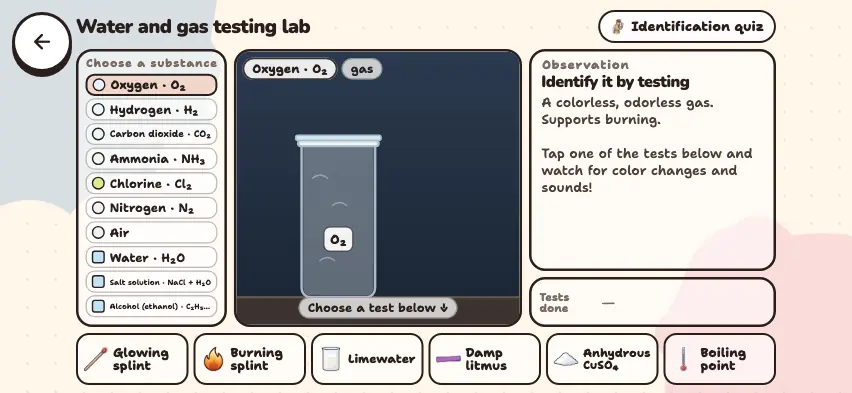
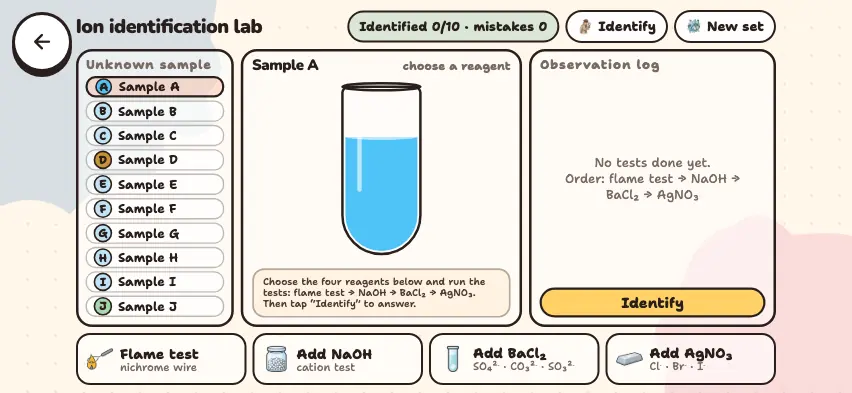
Identify gases and water in the Nalukh chem app
Choose a substance, run a test, and identify the unknown samples. This simulator is included with full access. The app is free to download, and 2 units and 5 simulators are open with no sign-up.
How do you use the simulator?
- Tap a substance in the Choose a substance list on the left. There are seven gases and three liquids.
- Press a test in the bottom row. The stage shows the action and plays a sound.
- Read the result and explanation on the Observation card on the right.
- In the Tests done row, see the tests you have done on that substance. A test that shows an identifying sign gets a green mark.
- Press the Identification quiz button to get five unknown samples. Test them, choose your answer on the left, and press the Next sample button.
- At the end, your score appears. Restart gives you new samples, and the Explore button takes you back.
Tasks to try in the simulator
- Use the Burning splint on nitrogen and carbon dioxide. The flame goes out in both. Find the test that tells them apart.
- Compare water, salt solution, and alcohol with the Boiling point test. Answer: 100 °C, about 101 °C, about 78 °C.
- Use the Glowing splint on oxygen and air. Why does the glowing splint not burst into flame in air? Answer: Air is only about 21% oxygen.
- In Identification quiz, identify each sample with as few tests as possible.
Common mix-ups
- A flame going out does not mean CO2. Nitrogen also puts out a flame, so confirm with limewater.
- Powder turning blue does not mean pure water. Salt solution also turns it blue. Confirm pure water by its boiling point.
- There is no test for nitrogen here. If all the other tests are negative, conclude that it is nitrogen.
- Do not mix up the two splints. A glowing splint detects oxygen, and a burning splint detects hydrogen.