What is gas pressure?
Gas particles move fast without stopping and keep hitting the walls of their container. The force of one hit is tiny, but the number of hits is huge. The push from all these hits on each unit of wall area is called pressure. The unit of pressure is the pascal (Pa). 1 atm is about 101 kPa.
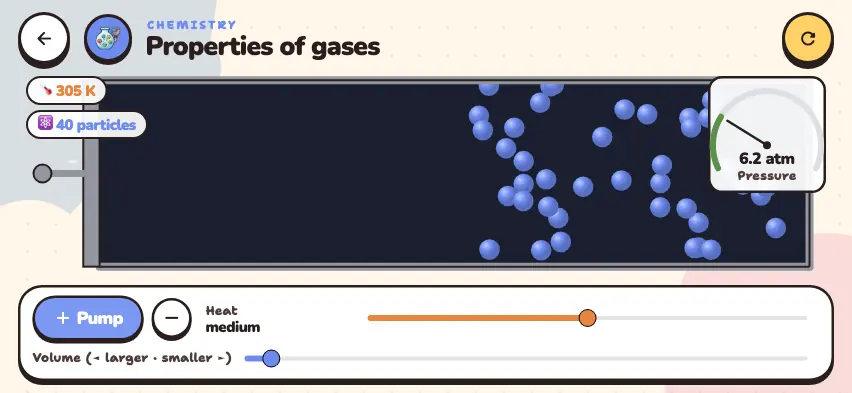
The pressure of a gas in a container depends on three things: the number of particles, the temperature, and the volume. This simulator shows the effect of volume.
What is Boyle's law?
When the temperature and the amount of gas are constant, pressure is inversely proportional to volume. The product of pressure and volume does not change:
P1 · V1 = P2 · V2
| Volume | Pressure |
|---|---|
| Divided by 2 | Multiplied by 2 |
| Divided by 3 | Multiplied by 3 |
| Multiplied by 2 | Divided by 2 |
Example. A 3 L sample of gas at 100 kPa is compressed to 1 L with no change in temperature. What is the new pressure? 100 · 3 = P2 · 1, so P2 = 300 kPa.
Why does this happen? The temperature is constant, so the speed of the particles does not change. But the walls are closer together, so each particle hits them more often.
Push the piston in the Nalukh chem app
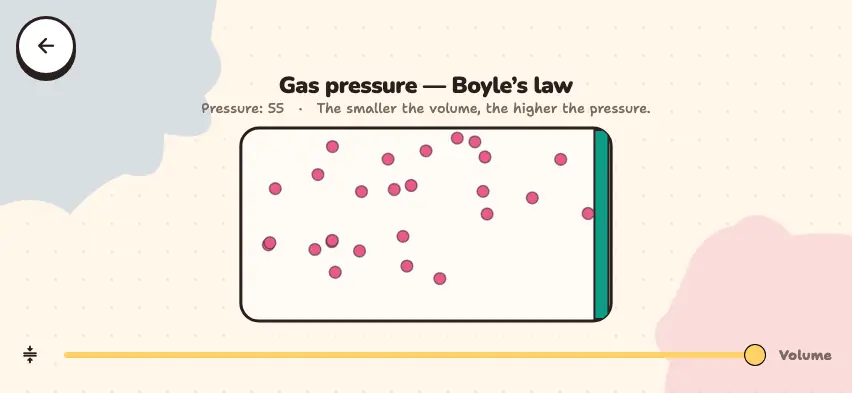
Change the volume with a slider and watch the pressure number. This simulator unlocks with full access. The app is free to download, and 2 units and 5 simulators are open without signing up.
How do you use the simulator?
- At the start, the piston sits at the right edge of the container, and the pressure reads 55.
- Drag the Volume slider to the left. The piston moves left, and the gas has less space.
- Watch the pressure number under the title. As the pressure rises, the piston turns red.
- Drag the slider back to the right. The piston moves back, and the pressure drops.
The pressure on the screen has no unit. It is a number for comparison. The number of particles and their speed do not change, so the conditions of Boyle's law are met.
Tasks to try in the simulator
- Drag the slider all the way to the left. What is the highest pressure? Answer: 157.
- Set the pressure to 110. Where is the piston? Answer: Exactly in the middle of the container. The volume is divided by 2, and the pressure is 2 times the starting value of 55.
- Use Boyle's law: at a pressure of 157, what percentage of its starting volume does the gas fill? Answer: 55 ÷ 157 ≈ 0.35, or 35%.
Where is Boyle's law used?
- Tire pump. When you press the piston, the volume of air in the cylinder decreases and the pressure rises. Then the air goes into the tire.
- Syringe. When you cover the tip with your finger and press the plunger, the compressed air pushes the plunger back.
- Breathing. When you breathe in, your chest cavity gets larger and the pressure inside your lungs drops. So air flows into your lungs.
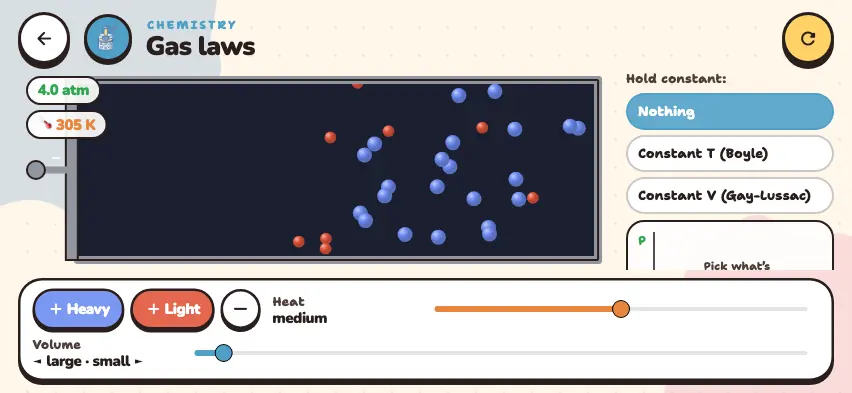
This simulator does not show how pressure changes when you heat a gas. According to Gay-Lussac's law, when volume is constant, pressure rises as temperature rises. You can see this in the Gas laws simulator.