What is a limiting reactant?
A balanced equation works like a recipe: it shows the ratio in which reactants are used up. As soon as one reactant runs out, the reaction stops. That reactant is called the limiting reactant. A substance that remains is called an excess reactant.
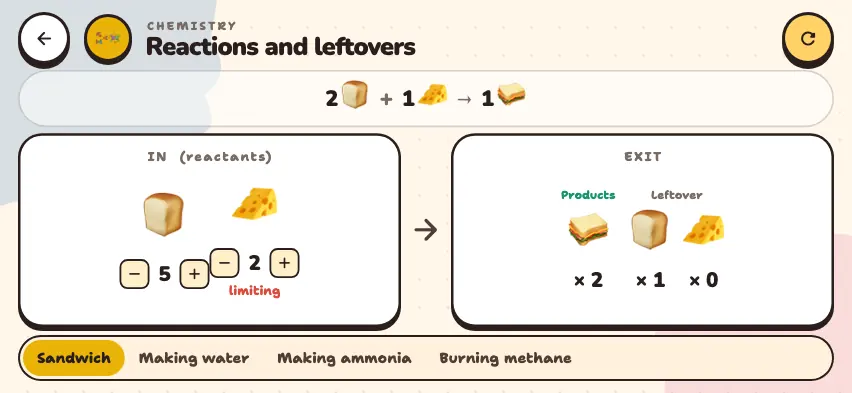
For example, 1 sandwich takes 2 slices of bread and 1 slice of cheese. If you have 5 slices of bread and 3 slices of cheese:
- The bread is enough for 2 sandwiches (5 ÷ 2 = 2.5).
- The cheese is enough for 3 sandwiches (3 ÷ 1 = 3).
- Bread gives the smaller number, so bread is the limiting reactant. You make 2 sandwiches, with 1 slice of bread and 1 slice of cheese left over.
The rule: divide the amount of each reactant by its coefficient. The reactant with the smallest number is the limiting reactant.
How do you solve a mole problem?
How many grams of water can you make from 8 g of hydrogen and 32 g of oxygen? Reaction: 2H2 + O2 → 2H2O
| Step | H2 | O2 |
|---|---|---|
| Moles | 8 ÷ 2 = 4 | 32 ÷ 32 = 1 |
| Divide by the coefficient | 4 ÷ 2 = 2 | 1 ÷ 1 = 1 |
The number for O2 is smaller, so oxygen is the limiting reactant. 1 mol of O2 uses up 2 mol of H2 and gives 2 mol of water, or 36 g of water. 2 mol of hydrogen, or 4 g, is left over. Check: 8 + 32 = 36 + 4. Mass is conserved.
Calculate reactions and leftovers in the Nalukh chem app
This simulator is included with full access. Downloading is free, and 2 units and 5 simulators are open without signing up.
How do you use the simulator?
- Choose a reaction from the bottom row: Sandwich, Making water, Making ammonia, or Burning methane.
- Read the recipe in the top row. This is the balanced equation.
- In the IN (reactants) box, use the minus and plus buttons to set the amount of each substance from 0 to 8.
- In the EXIT box, look at the numbers of Products and Leftover.
- The word limiting appears in red under the substance that runs out first.
- The circular arrow button returns the numbers to their starting values.
The simulator counts molecules in whole numbers and repeats the recipe only in full. So with 5 H2 and 3 O2, you get 4 H2O, with 1 H2 and 1 O2 left over: the last H2 has no partner. In a mole problem, fractions are allowed: 5 mol of H2 reacts completely with 2.5 mol of O2, and 0.5 mol of O2 is left over.
Tasks to try in the simulator
Work out your answer before you enter the numbers.
- Sandwich: 5 slices of bread, 3 slices of cheese. Answer: 2 sandwiches, with 1 slice of bread and 1 slice of cheese left over.
- Making ammonia: 3 N2, 6 H2. Answer: 4 NH3, with 1 N2 left over. The limiting reactant is H2.
- Burning methane: 3 CH4, 4 O2. Answer: 2 CO2 and 4 H2O, with 1 CH4 left over. The limiting reactant is O2.
- Making water: Find numbers that leave no leftovers. Answer: 4 H2 and 2 O2 (this makes 4 H2O), or other numbers in this ratio.
Common mistakes
- Assuming the substance with the smallest mass is the limiting reactant. In the problem above, hydrogen has the smaller mass, but the limiting reactant is oxygen.
- Comparing grams directly. First convert to moles, then divide by the coefficients.
- Forgetting the coefficients. If you calculate from an unbalanced equation, your answer will be wrong. To learn how to balance one, see the balancing equations guide.