Pick a metal and see the flame
Press a button to change the flame color. The colors match the ones in the Nalukh chem app simulator.
Lithium: crimson
Main wavelength of light: 671 nm. It looks similar to the strontium color, so the two are easy to confuse.
Flame test chart for metal ions
| Metal | Ion | Flame color | Notes |
|---|---|---|---|
| Lithium | Li+ | crimson | Main wavelength of light: 671 nm. It looks similar to the strontium color, so the two are easy to confuse. |
| Sodium | Na+ | yellow | Main wavelength of light: 589 nm. This is the strongest color. Even a small amount of sodium masks other colors. |
| Potassium | K+ | lilac | Main wavelengths of light: 766 and 404 nm. It is a pale color, so it is barely visible if sodium is mixed in. |
| Calcium | Ca2+ | orange-red | Main wavelength of light: about 622 nm. Some books call it brick red. |
| Strontium | Sr2+ | red | Strontium salts give fireworks their red color. |
| Barium | Ba2+ | pale green | Main wavelength of light: about 524 nm. Barium salts give fireworks their green color. |
| Copper | Cu2+ | blue-green | Main wavelength of light: 510–530 nm. The color is bright and easy to tell apart from the others. |
Not every metal colors a flame. For example, magnesium salts barely change the flame color. Iron filings do not give a bright color. They heat up and fly off as golden sparks instead.
Why does a flame change color?
The heat of the flame moves electrons in the metal atoms up to higher energy levels. When the electrons drop back down, they give off the extra energy as light. The gap between energy levels is different for each element. That is why the wavelength of the light, and therefore the flame color, is different too.
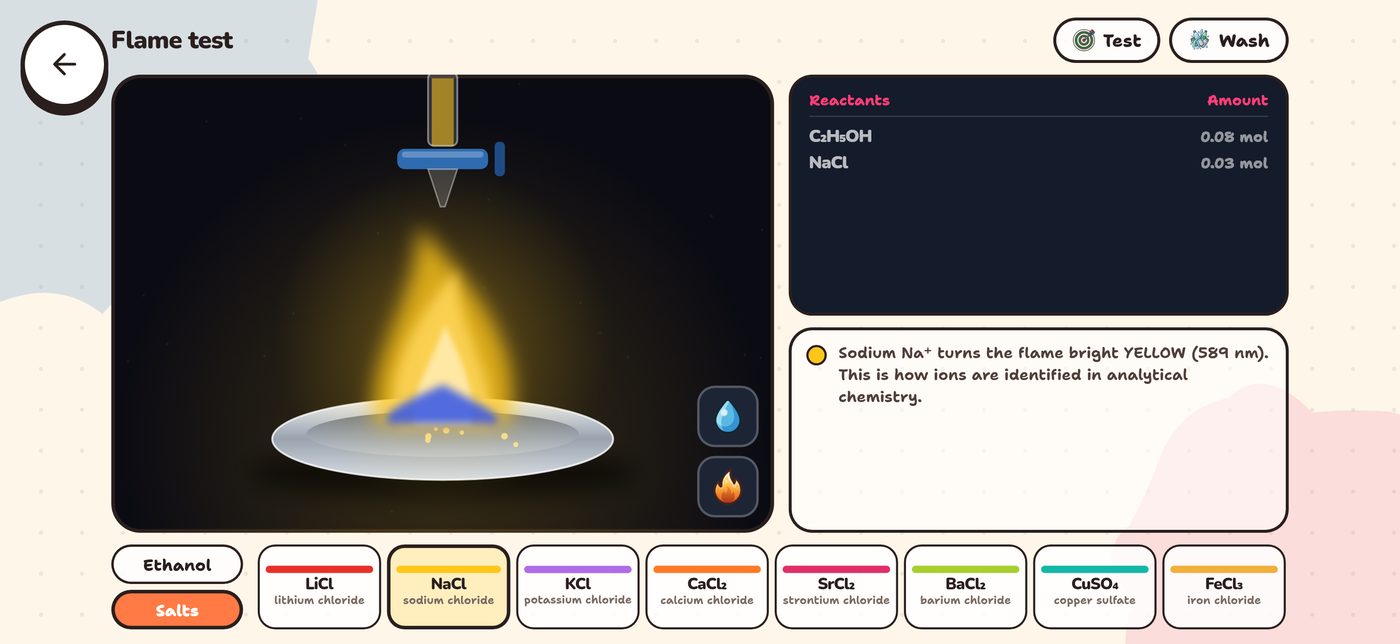
Try this experiment in the Nalukh chem app
Add ethanol drops, add a salt, and compare the flame colors. The simulator is free and needs no sign-up.
How do you use the simulator?
- Open the Ethanol tab and use the drop button to add ethanol to the dish.
- Light it with the flame button. Ethanol burns with a clean blue flame. Without metal ions, the flame does not change color.
- Go to the Salts tab, choose a salt, and add it. The flame takes on the color of that ion.
- Compare the flame color with the chart above to identify the ion.
- Before you test another salt, clean the dish with the Wash button.
- Press the Test button to start a 10-question quiz. Watch the flame of a hidden salt and choose the ion.
Tasks to try in the simulator
- Light lithium chloride and then strontium chloride, and find the difference between the two shades of red.
- Compare the pale lilac flame of potassium chloride with the strong yellow flame of sodium chloride.
- Take the quiz without looking at the chart, and check how many of the 10 questions you answer correctly.
How to do a flame test in a school lab
- Dip a nichrome wire in hydrochloric acid and heat it in a blue flame until it gives off no color.
- Dip the wire in the acid again and touch it to a small amount of the salt.
- Hold the wire at the edge of the blue flame and watch the color.
Why might the color look different?
Sodium is a very common contaminant, and its yellow color masks other colors. That is why you clean the wire well and use a separate wire for each salt. If you look through blue cobalt glass, the yellow of sodium is filtered out and the lilac of potassium is easier to see. To tell similar colors apart, such as those of lithium and strontium, you need to do extra tests.