What is chemical equilibrium?
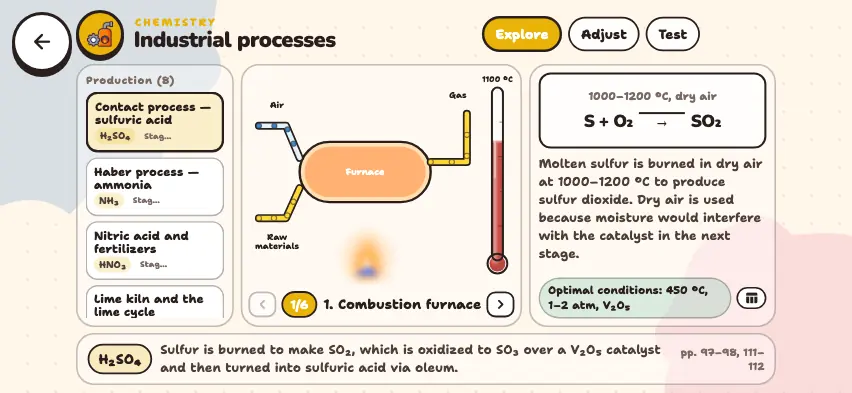
Some reactions go in both directions at once: reactants form products, and products form reactants again. These are called reversible reactions and are written with the ⇌ sign, for example N2 + 3H2 ⇌ 2NH3.
At first, the forward reaction is fast. As products build up, the reverse reaction speeds up. When the two rates are equal, dynamic equilibrium is reached. At this point:
- The reactions do not stop. They keep going in both directions.
- The amounts of the substances stay constant, but the reactants and products are not necessarily equal.
- Equilibrium is reached only in a closed container.
How does equilibrium shift?
Le Chatelier's principle: if an outside change acts on a system at equilibrium, the system shifts in the direction that reduces that change.
| Change | Which way does equilibrium shift? |
|---|---|
| Add reactant | Toward products (to the right) |
| Remove product | To the right |
| Raise temperature | In the endothermic direction |
| Lower temperature | In the exothermic direction |
| Raise pressure | Toward the side with fewer moles of gas |
| Add catalyst | No shift, but equilibrium is reached faster |
The ammonia reaction is exothermic, with 4 moles of gas on the left and 2 on the right. So raising the pressure shifts the equilibrium to the right, and raising the temperature shifts it to the left.
The equilibrium constant Kc expresses equilibrium as a number. When pressure or concentration changes, the equilibrium can shift, but the value of Kc stays the same. It depends only on temperature.
See equilibrium in the Nalukh chem app
This simulator is part of full access. The app is free to download, and 2 chapters and 5 simulators are open without sign-up.
How do you use the simulator?
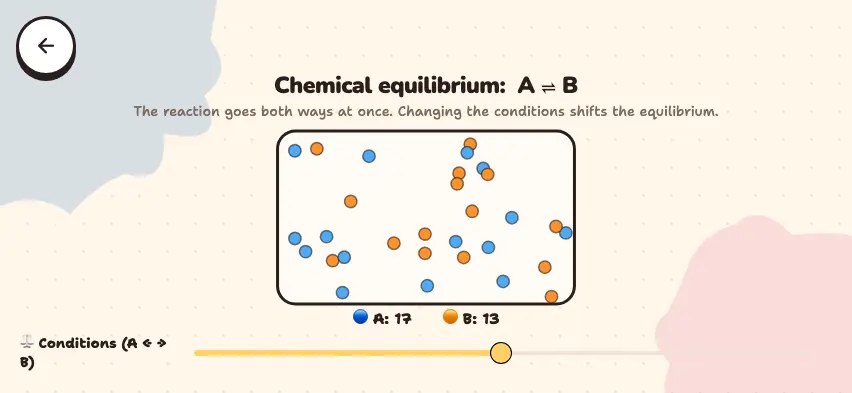
There are 30 particles moving in the box: blue is A, and orange is B. Think of A as the reactant and B as the product.
- Read the numbers of A and B particles in the line below the box.
- Drag the ⚖️ Conditions (A ← → B) slider to the right, and A particles slowly turn into B. Drag it to the left, and B particles turn into A.
- After the numbers settle, watch the colors of the particles: the totals do not change, but particles change color from time to time. This is dynamic equilibrium.
The slider does not stand for one specific change. It shows a change in conditions in general. The simulator has no temperature or pressure numbers.
Tasks to try in the simulator
- Leave the slider in the middle and wait for the numbers to settle. How many A and B particles are there? Answer: 15 and 15. But the particles keep changing color.
- Drag the slider to the right and wait for the numbers to settle. Answer: There are more B and fewer A particles, and the numbers become constant again. This means a new equilibrium has been reached.
- Imagine raising the pressure in the ammonia reaction, and drag the slider in the correct direction. Answer: To the right, and the amount of product increases.
- Drag the slider all the way to the right. Answer: All 30 particles become B. This is a simplified picture: in a real reversible reaction, both sides remain.
Everyday examples
Carbonated drinks are bottled with CO2 forced in under high pressure. When you open a can, the pressure drops, and the dissolved CO2 comes out as bubbles. The equilibrium has shifted toward the gas. Ammonia plants remove the product continuously, which also shifts the equilibrium to the right.