Ion identification lab
FreeA virtual lab where you use qualitative reactions to identify which cations and anions an unknown sample contains.
Used in: Identifying ions and gases
More details
Ten unknown samples are given, named “Sample A … Sample J”, and you analyze them with four reagents: flame color, sodium hydroxide, barium chloride and silver nitrate. After a precipitate forms, you add excess NaOH/NH₃, dilute HCl or ammonia solution for the final identification, and the ionic equation for each reaction appears right away. It follows the textbook flowcharts in Figure 1.4.2 (cations) and 1.4.3 (anions) exactly, and once you identify all the samples, it shows your score and number of mistakes.
Learn a compound’s formula, name and pronunciation all in one place, then check yourself with a test.
Used in: Oxides, Bases, Acids, Salts

Organic reaction mechanisms
Breaks down 61 organic reactions from the textbook step by step — bonds that break are shown in red, bonds that form in green dashes, electron movement as curved arrows, and carbocations with a ⊕ sign.
Used in: Basic concepts, Hydrocarbons, Oxygen-containing hydrocarbon derivatives, Cyclic hydrocarbons, Nitrogen-containing hydrocarbon derivatives, Halogen-containing hydrocarbon derivatives
More details
On the left, filter by reaction type (substitution, addition, elimination, esterification, hydrolysis, oxidation, polymerization, isomerization, nitrogen compounds) and choose a reaction. In the center, the mechanism plays frame by frame: starting material and reagent → bond breaking, new bond formation, carbocation or enol intermediate → product. Step through it manually with the ◀ ▶ buttons, or automatically with ▶▶ (every 0.9 s). In reactions that follow Markovnikov’s rule, the reminder “hydrogen adds to the carbon that already has more hydrogens” appears, and secondary and primary carbocations are shown side by side. On the right: the full equation with its conditions, an explanation of the step and a “Why?” note. In “Test” mode you get 10 questions: predict the product, name the reaction type, choose the major Markovnikov product and identify the conditions.
Acid–base solutions
Compare strong and weak acids and bases by their particles and pH.
More details
How are strong and weak acids different? Use your lab tools to find out! Dip pH paper or the meter into the solution to measure the pH, or test the conductivity with the electrodes. Then watch how the type and strength of the solution affect the pH. Can a weak acid solution have the same pH as a strong acid solution?
Atomic interactions
Show how two atoms attract and repel each other, using force and energy.
Used in: Intermolecular forces
More details
What happens when two atoms get close? Atoms weakly attract each other from far away, but strongly repel if they get too close. Choose a pair of atoms (neon, argon, oxygen), change the distance between them and watch how the potential energy curve (σ and ε) changes. The movable atom oscillates around its equilibrium point — just as if the two were joined by an invisible spring!

Balancing equations
Adjust the coefficients to balance chemical equations.
Used in: Law of conservation of mass, Chemical equations
More details
In a chemical reaction, atoms are neither created nor destroyed — they are only rearranged. So the number of atoms of each element must be equal on both sides of the equation. Adjust the coefficients (the numbers) up and down to balance the equation. You can check it with molecules, a balance scale or a bar chart. When it balances, 😊 appears!

Static electricity
Rub the balloon on the sweater to charge it, then stick it to the wall.
More details
What happens when you rub a balloon on a sweater? Negative charges (electrons) move from the sweater to the balloon, and the balloon becomes negatively charged. The negatively charged balloon attracts the wall and sticks to it (static electricity). Drag the balloon, rub it on the sweater, then take it to the wall. Tap “Remove wall” and the balloon goes back to the positively charged sweater. Watch what’s happening in the show-charges mode!
Concentration
Add a substance or water, or evaporate water, to change a solution’s concentration.
Used in: Concentration of solutions
More details
What is the concentration of a solution? Concentration = moles of solute / volume of solution. Add substance to the beaker and the concentration rises; add water (dilute) and it drops. Evaporate water and the concentration rises again, but pouring out solution leaves the concentration unchanged. Choose substances of different colors, dip the concentration meter into the solution and measure in mol/L. Add too much substance and the solution becomes saturated, and the excess settles to the bottom!

pH scale
Measure the pH of everyday liquids and dilute them with water.
Used in: Bases, Uses of chemicals
More details
Coffee, milk, soda, battery acid — how acidic or basic are these liquids? The pH scale runs from 0-14: 7 is neutral (water), below 7 is acidic, and above it is basic. Choose a liquid, dip the pH meter into the solution and measure. Watch how adding water (diluting) brings the pH closer to 7 (neutral)!

Molarity
Change the moles of solute and the volume of solution to calculate the concentration.
More details
Molarity (mol/L) = moles of solute / volume of solution (in liters). Use the sliders to change the amount of solute (mol) and the volume of solution, and watch how the concentration changes. The more solute or the smaller the volume, the higher the concentration. If it gets too high, the solution becomes saturated and the excess settles to the bottom!
Build an atom
Add protons, neutrons and electrons to build an atom and identify the element.
Used in: What is an atom?, Periodic trends, Atoms and ions, Valence electrons, Atomic structure and properties
More details
An atom is made of protons, neutrons and electrons. Protons and neutrons are in the nucleus, and electrons are in the shells. The number of protons determines the element (1 proton = hydrogen, 2 = helium...). Change the numbers of protons, neutrons and electrons and watch: which element you get, and how the charge (protons − electrons) and the mass number (protons + neutrons) change. If protons and electrons are equal, it’s a neutral atom; if not, it’s an ion!
Build a molecule
Combine atoms to build molecules: H₂O, CO₂, NH₃...
Used in: Structural formulas, Chemical bonding, Nitrogen and its compounds, Basic concepts
More details
Molecules are made of atoms. Combine hydrogen (H), oxygen (O), carbon (C) and nitrogen (N) atoms in the right ratios to build molecules. Example: 2 hydrogen + 1 oxygen = water (H₂O). As soon as the right atoms join, the molecule forms automatically and is added to your collection. How many molecules can you build?

Isotopes and atomic mass
Add neutrons to make isotopes and see their mass number and abundance.
Used in: Characteristics of atomic structure
More details
Atoms of the same element can have different numbers of neutrons — these are called isotopes. Isotopes have the same number of protons (so they’re the same element) but different mass numbers (protons + neutrons). Choose an element and change the number of neutrons, then watch: which isotope you get, how abundant it is in nature, and its atomic mass. Example: carbon-12 is the most abundant, while carbon-14 is unstable!
Reactions and leftovers
Set the amounts of reactants and work out the products and leftovers.
Used in: What is a chemical reaction?, Types of chemical reactions, The mole and stoichiometry, Sulfur
More details
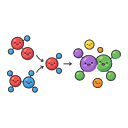
During a reaction, the reactants are used up in a fixed ratio. If one reactant runs short (the limiting reactant), some of the other is left over. Example: 2 slices of bread + 1 slice of cheese = 1 sandwich. If you have 5 slices of bread and 3 slices of cheese, how many sandwiches can you make, and what is left over? Adjust the amounts of reactants and watch how the products and leftovers change. Try it with real reactions too, like making water and ammonia!

Beer’s law
Measure how light is absorbed as it passes through a colored solution.
More details
Why are solutions colored? Shine a laser into a colored solution and use the detector to measure how much light is absorbed and how much passes through. Change the solute, the concentration, the cuvette width and the wavelength of the light, and watch how absorbance changes according to Beer’s law A = ε·l·c. The more concentrated the solution and the wider the cuvette, the more light is absorbed.
Molecule polarity
Show how electronegativity creates bond polarity.
Used in: Electronegativity, Halogen-containing hydrocarbon derivatives
More details
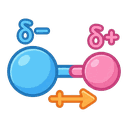
Atoms don’t attract electrons equally strongly. Change the electronegativity (EN) of the two atoms and watch the electrons shift toward the atom that pulls harder, making it δ− (negative) and the other δ+ (positive). The bond dipole arrow shows the EN difference: a small difference means a covalent bond, a large one an ionic bond. Turn on the electric field and the polar molecule turns to line up with the field.
Density
Explore how mass, volume and density are related by floating/sinking blocks in water.
Used in: Experiment: measuring mass and volume, Finding density
More details
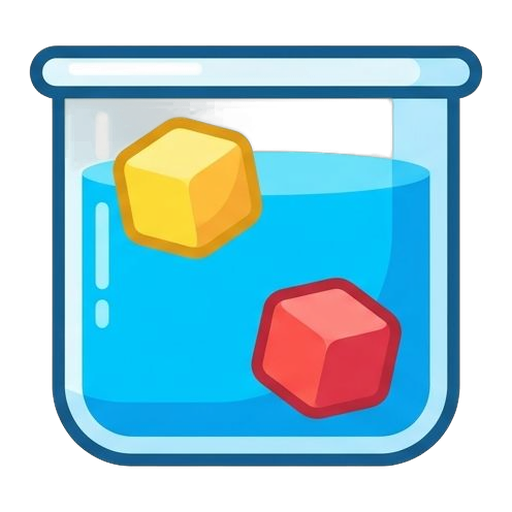
Why does wood float in water while iron sinks? Density = mass ÷ volume. Choose a material (wood, ice, glass, iron, copper, gold) and change its volume, or make your own block and set its mass and volume. If its density is less than the density of water, 1.0 kg/L, the block floats; if greater, it sinks. When a block floats, how much of it sits underwater depends on its density.
Diffusion
Mix two gases and watch until they spread out evenly.
Used in: Diffusion
More details
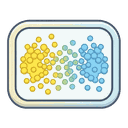
Why does a smell spread through a room? The container is split into two parts by a wall: blue gas particles on the left, red ones on the right. Set the number of particles and the temperature, then tap the “Remove wall” button. The particles keep moving and colliding, gradually mixing until they spread evenly throughout the container. The higher the temperature, the faster the particles move and the faster they spread.

Coulomb’s law
Explore the attractive/repulsive force between two charges.
More details
How do charges affect each other? Coulomb’s law: F = k·q₁·q₂ / r². Drag the two charges along the line to change the distance, and set their size and sign (+/−). Like charges repel, and opposite charges attract. The bigger the charges and the closer they are, the more sharply the force increases.
Build a nucleus
Add protons and neutrons to build a nucleus and explore its stability.
More details
What is an atomic nucleus made of? Add and remove protons and neutrons to build a nucleus. The number of protons determines which element it is, and protons+neutrons give the mass number. See on the nuclide chart whether the nucleus is stable (dark blue) or decays radioactively (β⁻, β⁺, emission). If there are too many or too few neutrons, the nucleus becomes unstable.
Molecules and light
Watch what happens when light hits a molecule.
Used in: Air pollution
More details
How does light interact with molecules? Choose a light source (microwave, infrared, visible light, ultraviolet) and shoot photons at a molecule. The molecule absorbs a photon with the right energy and responds: water rotates, carbon dioxide vibrates, nitrogen dioxide glows, and ozone breaks apart in ultraviolet light. Some molecules, such as N₂ and O₂, let the light pass straight through.

Rutherford scattering
Fire alpha particles at a nucleus and reveal the structure of the atom from how they are deflected.
More details
How did Rutherford discover the atomic nucleus? Fire positively charged alpha particles at a thin gold foil. Most pass straight through, but some that pass near a nucleus are sharply deflected by Coulomb repulsion, and those that hit it head-on bounce back. Change the number of protons in the nucleus or the energy and watch how the deflection changes — this experiment proved that an atom’s mass is concentrated in a tiny nucleus.
Molecule shapes
Predict a molecule’s 3D shape from its bonds and lone pairs.
Used in: Lewis structures, Cyclic hydrocarbons
More details
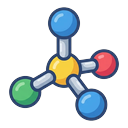
Why do molecules have particular shapes? Add bonds (single, double, triple) and lone pairs of electrons to the central atom. Electron pairs repel each other and spread out as far apart as possible (VSEPR theory). Depending on the number of domains, you get shapes such as linear, trigonal planar, tetrahedral, bent and pyramidal. Adding a lone pair changes the shape and makes the bond angle smaller.
States of matter
Heat and cool to observe the solid, liquid and gas states.
Used in: States of matter, Changes of state
More details
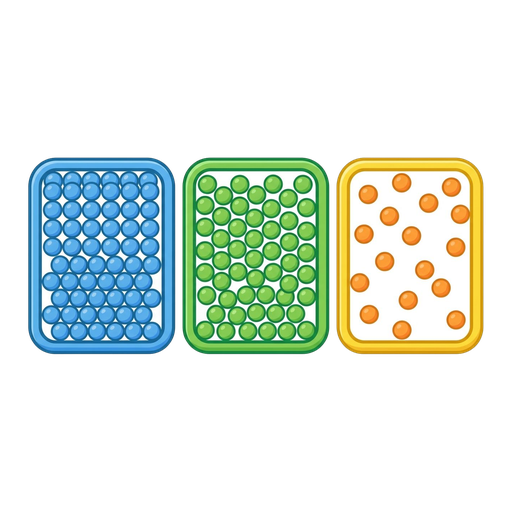
Why does ice melt and water evaporate? Choose a substance (neon, argon, oxygen, water) and change the temperature with the heater/cooler. When cold, the particles form a lattice and barely move (solid); when warm, they separate and flow (liquid); when hot, they fly around freely (gas). Watch the temperature and phase on the thermometer.

Properties of gases
Explore how pressure changes with particles, heat and volume.
Used in: Gas pressure, Properties of gases
More details
What does gas pressure depend on? Add particles with the pump, change the temperature with the heater/cooler, and move the piston to reduce the volume. The particles bounce elastically off the walls and create pressure. The more particles, the hotter the gas or the smaller the volume, the higher the pressure (PV = NkT). Watch the pressure on the gauge and the temperature on the thermometer.

Gas laws
Hold one quantity constant and observe the gas laws.
Used in: Experiments to identify water and gases
More details
How are a gas’s pressure, volume and temperature related? Add heavy (blue) and light (red) particles with the pump. Choose “Constant T” and the pressure rises when you reduce the volume (Boyle’s law, P·V=const). Choose “Constant V” and the pressure rises when you heat it (Gay-Lussac’s law, P/T=const). Watch the relationship curve on the mini-graph.

Molecule shapes: Basics
Add bonds and lone pairs and predict a molecule’s basic shape.
More details
Why do molecules have particular shapes? Add single bonds and lone pairs of electrons to the central atom. Electron domains repel each other and spread out as far apart as possible (VSEPR theory): 2 domains give a linear shape, 3 trigonal planar and 4 tetrahedral. Adding a lone pair changes the shape (water is bent, ammonia is pyramidal) and makes the bond angle smaller. Try it with CO₂, BF₃, H₂O, NH₃ and CH₄.

pH scale: Basics
Choose everyday liquids and see their pH and acid/base ratio.
More details
Coffee, milk, lemon, soap — how acidic or basic are they? When you choose a liquid, the pH meter shows a value from 0–14: 7 is neutral, lower is acidic (red), higher is basic (pink). Show the ratio of H₃O⁺ (acid) and OH⁻ (base) ions as bars. In acidic liquids H₃O⁺ dominates, while basic ones have lots of OH⁻.
States of matter — in detail
Heat and cool a substance to see its state change and where it sits on the phase diagram.
More details
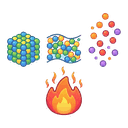
Why do substances change between the solid, liquid and gas states? Choose neon, argon, oxygen or water and change the temperature with the heater/cooler. When cold, the particles form a lattice and barely move (solid); when warm, they separate and flow (liquid); when hot, they fly around freely (gas). A dot shows where the substance sits on the phase diagram depending on temperature and pressure — more detailed than the Basics version!
Choose an element and see how electrons fill the orbitals.
Used in: Atomic structure and properties
More details
Choose an element with Z=1..20 and the energy diagram shows how electrons fill the orbitals by the Aufbau principle — starting from the lowest-energy orbital — and how, by Hund’s rule, they first occupy orbitals of equal energy one at a time. The full (1s²2s²…) and shorthand ([Ne]3s¹) notations of the electron configuration appear side by side.
Discover how periods and groups relate to atomic structure.
Used in: Periodic trends
More details
Tap any of the first 20 elements in the periodic table to draw the Bohr model of its atom. Move right and down, compare, and see for yourself that period = number of shells and group = number of electrons in the outer (valence) shell.
Explore radius, ionization energy, electronegativity and metallic character by color.
Used in: Periodic trends
More details
Shows the atomic radius, ionization energy, electronegativity and metallic character of the first 20 elements as a color map (heatmap). Choose a trend and tap elements to compare their values — the pattern of how they change across a period and down a group is visible at a glance.
Choose a cation and an anion, criss-cross the valences and build the compound’s formula.
Used in: Oxides, Bases, Acids, Salts
More details
Choose a cation (positive ion) and an anion (negative ion), and the subscripts are worked out by the criss-cross rule to build the compound’s formula: Al³⁺ + O²⁻ → Al₂O₃. The compound’s name, class (oxide, base, acid, salt) and charge balance are shown alongside — master formula writing right here!

Reaction lab
Mix 60 substances in pairs and observe color, gas, precipitate, heat and light.
Used in: What is a chemical reaction?, Word equations for chemical reactions, Types of chemical reactions, Law of conservation of mass, Chemical equations
More details
Metals, nonmetals, acids, bases, oxides, salts — mix any of the 60 substances however you like. If a reaction happens, you’ll see the color in the flask change, bubbles form, a precipitate settle, and heat released or absorbed. Best of all, every reaction is written in three forms at once: a word equation, chemical formulas and the balanced equation. With the “Heat 🔥” button you can also see a single substance decompose.

Virtual lab
Add reagents to a beaker, change the temperature, and track solubility and reactions.
Used in: Equipment for chemistry experiments
More details
A real lab bench: add water, acids, bases, salts, metals and indicators to a glass beaker and watch what happens. The table instantly shows each substance’s moles, solubility (g/L) and what percent of it has dissolved. Raising the temperature changes the solubility. Every reaction that takes place is recorded with its word equation and balanced equation. In “Burner” mode, put a substance on a watch glass, heat it in the flame and see the decomposition reaction.
Zoom in on everyday substances and see that they’re all made of tiny particles.
Used in: What is a substance?
🧊States of matter — particles
See how particles are arranged and move in the three states: solid, liquid and gas.
Used in: States of matter
Change the temperature and ice → water → steam. It melts at 0°C and boils at 100°C.
Used in: Changes of state, Assessing the purity of substances
💧Diffusion — a spreading drop
Watch a drop of dye spread through water on its own until it fills all the space.
Used in: Diffusion
Compare how fast ink spreads in cold and hot water.
Used in: Rate of diffusion, Rate of chemical reactions
Reduce the volume and the particles hit the walls more often, so the pressure rises.
Used in: Gas pressure
Choose the right way to collect a gas based on its density and solubility.
Used in: Collecting and purifying gases
Mix two substances and separate them again to see that no new substance forms.
Used in: Mixtures
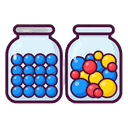
Pure substances and mixtures
A pure substance has one kind of particle; a mixture has several kinds.
Used in: Pure substances
See how to separate a mixture in three ways: filtration, evaporation and distillation.
Used in: Equipment for chemistry experiments, Techniques for obtaining substances, Preparing and purifying salts
🔄Physical and chemical phenomena
In a physical change the substance stays the same; in a chemical change a NEW substance forms.
Used in: Physical and chemical phenomena
🔬Testing material properties
Choose a material and measure its hardness, conductivity, flexibility and magnetism.
Used in: Safety rules for working in the chemistry lab, Properties of materials
Put materials into an electric circuit and check which ones conduct current.
Used in: Materials with metallic and nonmetallic properties
See that each element is made of only one kind of atom.
Used in: Chemical elements, Periodic trends
🕰️History of atomic models
Dalton → Thomson → Rutherford → Bohr: how did the model of the atom change?
Used in: Discovery of the elements, Discovery of the periodic table, How do researchers make discoveries?
🧴Acidic and basic properties
Place everyday substances on the pH scale to tell acids from bases.
Used in: Acidic and basic properties, Oxides, Acids
See what colors litmus, universal indicator and phenolphthalein show in solutions.
Used in: Chemical labeling, Indicators, Identifying ions and gases
⚖️Neutralization reaction
Slowly add alkali to acid: the pH shifts toward 7 and salt and water form.
Used in: Neutralization, Salts, Carbonates
Choose from 20 compounds and watch the metal give away its electrons and become an ion.
Used in: Ionic bonding
Free electrons flow between the positive ions and conduct current.
Used in: Metallic bonding, Metals and alloys
See four types of lattice — molecular, atomic, ionic and metallic — through 11 examples.
Used in: Crystal lattice structures
Drag atoms close together and build covalent, ionic and metallic bonds yourself.
Used in: Covalent bonding, Ionic bonding, Metallic bonding
Electrons move between a metal and a nonmetal, and the oxidation states change.
Used in: Oxidation state, Redox reactions
View 20 compounds as ball-and-stick and space-filling models.
Used in: Molecular models
See energy change from one form to another in a live system.
Used in: Chemical energy, Heat of chemical reactions, Chemical energy
Raise the temperature and concentration: more collisions make the reaction go faster.
Used in: Rate of chemical reactions, Chemical kinetics
See the reaction A ⇌ B go both ways at once until dynamic equilibrium is reached.
Used in: Chemical equilibrium
Watch zinc lose electrons that flow to the copper and light up the bulb.
Used in: Electrochemistry
Change the number of carbon atoms and the chain grows: methane, ethane, propane.
Used in: Hydrocarbons
Attach −OH, −COOH, −NH₂ or −Cl groups and see which class of compound forms.
Used in: Oxygen-containing hydrocarbon derivatives, Nitrogen-containing hydrocarbon derivatives
Mark an atom’s valence electrons with dots and build its Lewis structure.
Used in: Lewis structures
⚖️Equation balancing practice
Choose from 40 reactions and balance the equation yourself by placing coefficients.
Used in: Chemical equations
More details
Choose a reaction from five types — combination, combustion, single displacement, double displacement and decomposition — and adjust the coefficients with the +/− buttons. The table shows the number of atoms of each element on the left and right sides and turns green when they balance. If you get stuck, the “Answer” button shows the correct coefficients.
🪜Displacement reaction lab
Use the activity series to carry out displacement reactions with metals and halogens.
Used in: Types of chemical reactions
More details
The activity series of metals (K…Au, with H₂ marked) and the halogen series (F₂ > Cl₂ > Br₂ > I₂) are always on screen. Choose an element and put it into an acid, water or a salt solution — you’ll instantly see whether a reaction happens, why, and the balanced equation.
🎯Find the oxidation state
Work out the oxidation state of the marked element in 20 compounds yourself.
Used in: Redox reactions
More details
Choose from 20 compounds made of 3–4 elements, such as H₂SO₄, KMnO₄ and K₂Cr₂O₇, and use the known oxidation states (H +1, O −2 …) to find the oxidation state of the marked element with the +/− buttons. If you’re right, the full worked solution appears.
Balance 20 redox reactions using the number of electrons transferred.
Used in: Redox reactions
More details
20 redox reactions at 3 levels: easy, medium and advanced. For each reaction you see the oxidized and reduced elements, the number of electrons transferred and the reaction type (intermolecular, intramolecular, disproportionation), and you balance it with the atom-count table.
Pull trash out of the water, sort it by type and watch the water get clean.
Used in: Water pollution
More details
There are 12 kinds of trash floating in the lake. Sort them correctly into the plastic, glass, metal and organic bins, and the pollution level drops, the water gradually turns clear and the fish and other animals come back.
Remove the polluters and see how the natural cycle cleans up the acid rain.
Used in: Soil pollution
More details
Shows the cycle in which factory smoke — SO₂ and NO₂ gases — gets into the clouds and turns into acid rain. Remove the sources one by one and the rain’s pH rises from 3.5 to 5.6, the pH of clean rain, and the withered plants bloom again.
Replace polluters with helpful solutions and clean up the city’s air.
Used in: Air pollution
More details
Remove sources such as raw coal, old buses and unfiltered chimneys, and put improved fuel, electric transport and filters in their place. The AQI drops from 300 to 50 and the smoggy sky clears.
Remove polluters, add helpful facilities and restore the ecosystem.
Used in: Environmental pollution
More details
In a landscape of mountains, a river and forest, there are polluters such as sewage, garbage dumps and smoking chimneys. Remove them, then add treatment plants and sorting bins and plant trees — the river turns clear and the animals come back.
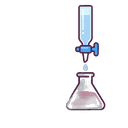
Titration lab
Drip substances from a burette and track moles and dissolving in real time.
Used in: Concentration of solutions
More details
Turn the burette’s stopcock to pour into the beaker drop by drop or in a stream. Choose substances from the categories water, acids, bases, salts, indicators and organics, and see the moles and percent dissolved in the contents table. Raising the temperature changes the solubility, and above 100°C it boils. The reactions tab shows the reactions in the beaker as balanced equations.

Flame test
FreeSee what color metal salts turn a flame and learn to identify the ions.
Used in: Identifying ions and gases
More details
Drip ethanol onto a metal dish and light it to get a blue flame. Add a metal salt and the flame turns the color of that ion: potassium violet, sodium yellow, copper blue-green, calcium orange. In test mode, guess which ion a hidden salt contains from its flame color — a real analytical chemistry method.
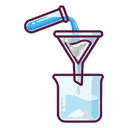
Precipitation lab
Mix two solutions in a beaker to form a precipitate, filter it through a funnel and filter paper, dry it and obtain a pure insoluble salt.
Used in: Identifying ions and gases
More details
Mix solutions of 8 cations (Ag⁺, Pb²⁺, Ba²⁺, Ca²⁺, Cu²⁺, Fe²⁺, Fe³⁺, Na⁺) and 7 anions (Cl⁻, I⁻, SO₄²⁻, CO₃²⁻, OH⁻, S²⁻, NO₃⁻) in pairs and instantly see from the solubility rules whether a precipitate forms. If one does, the beaker turns cloudy and a colored pile settles at the bottom, and both the complete and net ionic equations are written. Then use the “Filter” button to leave the precipitate on the paper and let the filtrate drain through, as in Figure 1.3.3, and use “Dry” to obtain the pure salt — how many of the 26 precipitates can you find?

Purity curve
Choose a substance and heat it: the temperature–time curve is drawn before your eyes, showing that a pure substance melts at one exact point, while a mixture melts gradually over a wide range.
Used in: Assessing the purity of substances
More details
Choose one of 8 substances (pure water, naphthalene, stearic acid, pure copper — salt water, ice with soil, candle wax, bronze alloy) and tap “Heat”: the clock starts and the temperature–time curve is drawn realistically from left to right in ~4 seconds. When a pure substance reaches its melting point, the curve goes FLAT — all the heat is used to break down the crystal structure; a mixture has no flat section, only a SLOPED range, and this is shown with bold markers, dashed lines and explanations. The “Compare” button plots two substances on the same axes at once (for example, pure water and salt water, or pure copper and bronze alloy) so you can compare the difference right away.
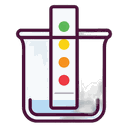
Chromatography lab
Separate 10 substances by paper chromatography, tell from the number of spots whether each is a pure substance or a mixture, and learn to measure Rf values.
Used in: Assessing the purity of substances
More details
Choose a substance from the list on the left, put a spot on the pencil start line and dip the paper into the solvent in the glass jar. As the solvent soaks up the paper, a spot that looked like one separates and moves up, and when the solvent front stops, each spot’s Rf value (distance traveled by the spot a ÷ distance traveled by the solvent b) is measured with arrows and dashed lines. One spot means PURE; two or more spots mean a MIXTURE — test all 10 substances (4 pure, 6 mixtures) to get the overall conclusion.

Industrial processes
Explore 8 industrial processes — sulfuric acid, ammonia, nitric acid, lime, cement, steel, zinc and sulfur — stage by stage in diagrams, and adjust the temperature, pressure and catalyst to see the yield.
Used in: Metals and alloys, Carbonates, Sulfur, Nitrogen and its compounds
More details
Choose a process on the left and step through each stage with the ◀ ▶ buttons — every piece of equipment, such as the roasting furnace, converter, absorption tower, blast furnace, flotation tank and Frasch well, appears as an animated diagram with its pipes, flows, flames and thermometers. On the right, the conditions for that stage (temperature, pressure, catalyst) are shown in bold above its equation, and the explanation uses the textbook’s wording. In “Adjust” mode, change the temperature, pressure and catalyst for the Contact process and the Haber process — the product yield and reaction rate change instantly and are compared with the optimal industrial conditions. In “Test” mode you get 6 questions: put the stages in order, choose the conditions and identify the reactions.

Organic nomenclature lab
Explore the structures, IUPAC names, isomers and boiling points of organic compounds, and build and name molecules yourself.
Used in: Basic concepts, Hydrocarbons, Oxygen-containing hydrocarbon derivatives, Cyclic hydrocarbons, Nitrogen-containing hydrocarbon derivatives, Halogen-containing hydrocarbon derivatives
More details
View the catalog’s 140 organic compounds in three representations (expanded, condensed and skeletal), along with their IUPAC name, general formula, properties, a boiling-point chart for the homologous series, and isomers. In “Build” mode, choose the chain, multiple bonds, functional groups and substituents to assemble a molecule and get its name. In “Test” mode there’s a set of 10 questions.