What is a purity curve?
A purity curve is a graph that shows how the temperature changes as you heat a solid steadily. The horizontal axis shows time, and the vertical axis shows temperature. The shape of the curve during melting tells you whether the substance is pure or a mixture.
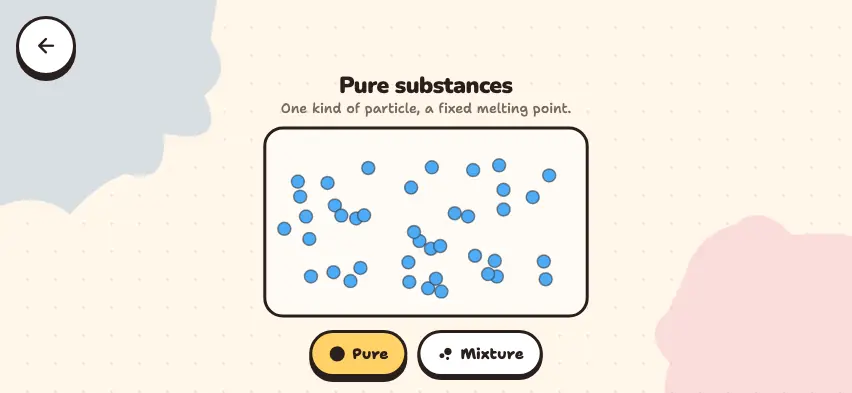
In chemistry, a pure substance is a substance made of only one element or one compound. "Pure orange juice" from a store is not pure in the chemical sense, because it contains many substances.
| Property | Pure substance | Mixture |
|---|---|---|
| Curve during melting | Flat | Sloped |
| Melting temperature | One exact point | Wide range |
| Examples in the simulator | Naphthalene 80°C, stearic acid 69°C, pure copper 1085°C | Candle wax 45–62°C, bronze alloy 890–1020°C |
Why does the curve go flat?
In a solid, particles are arranged in an orderly pattern and vibrate in place. As you add heat, the vibrations get stronger and the temperature rises. When the substance reaches its melting point, all the heat you add is used to break down the crystal structure. So the temperature does not rise until all of the substance has melted, and the curve goes flat.
In a mixture, particles of another substance disturb the orderly pattern of the crystal. Different parts melt at different temperatures, and the temperature keeps rising slowly without stopping. An impurity in a substance lowers the temperature at which melting starts: pure copper melts at 1085°C, while bronze, a copper alloy, starts to melt at 890°C in the simulator. Spreading salt on winter roads is related to this: salt lowers the melting point of ice below 0°C.
Draw melting curves in the Nalukh chem app
Heat eight substances and compare two curves side by side. This simulator is included with full access. The app is free to download, and 2 units and 5 simulators are open with no sign-up.
How do you use the simulator?
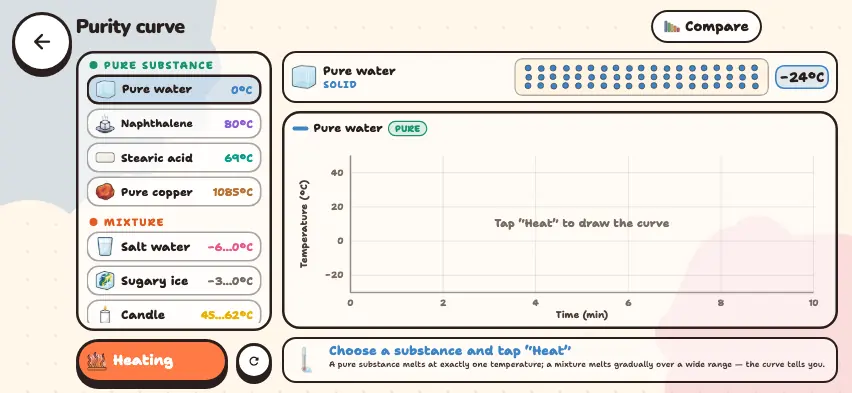
- Choose a substance from the list on the left. The PURE SUBSTANCE and MIXTURE sections have four substances each. Each row shows the melting point or range.
- Press the Heating button. The curve is drawn from left to right in about 4 seconds.
- In the top bar, read the state of the substance (SOLID, MELTING, LIQUID), see the motion of the particles, and read the temperature.
- When heating ends, the melting point or range and the shape of the curve are written on the graph. An explanation appears at the bottom.
- Press the Compare button to draw the curves of two substances on one graph. Only substances with the same scale can be compared: pure water, salt water, and sugary ice; naphthalene, stearic acid, and candle wax; pure copper and bronze alloy. If you tap a substance from a different group, its partner is selected automatically.
- Press the Reheat button to repeat. The circular arrow button next to it clears the graph.
Tasks to try in the simulator
- Use the Compare button to compare pure water and salt water. Answer: The curve of pure water is flat at 0°C. The curve of salt water starts below 0°C, at −6°C, and slopes upward.
- Find which one melts at a higher temperature, stearic acid or candle wax. Answer: Stearic acid melts at 69°C, and candle wax finishes melting at 62°C.
- Compare pure copper and bronze alloy, and calculate how many degrees earlier bronze starts to melt. Answer: 1085 − 890 = 195°C.
- Read from the time axis how many minutes the flat part for pure copper lasts. Answer: from 3 minutes to 6.4 minutes, about 3.4 minutes.
How is purity tested in a lab?
In a lab, you measure the melting point of a substance and compare it with the value in a reference book. A pure substance melts within a narrow range that matches the reference value. An impure sample starts to melt below the reference value and melts over a wide range.
Curves from real experiments are not as smooth as the simulator's. Stearic acid in a school lab is usually not completely pure, so its flat part can come out slightly sloped.