What is paper chromatography?
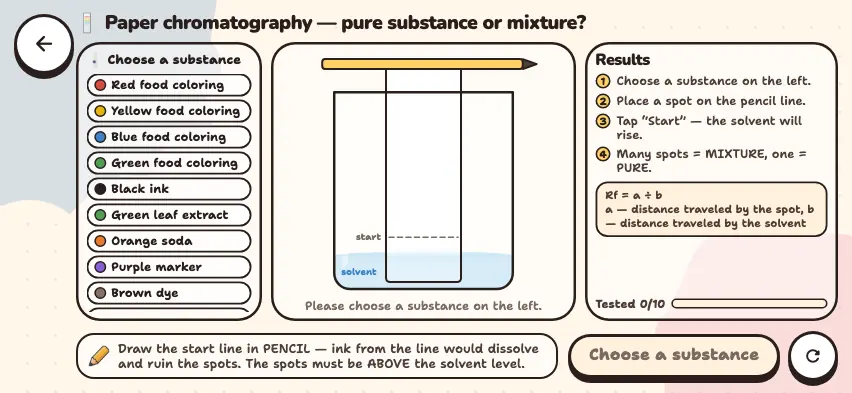
Paper chromatography is a method for separating mixtures of soluble colored substances. You draw a pencil line near the bottom of the paper, put a spot on it, and dip the end of the paper in a solvent. The solvent soaks up the paper and carries the substances in the spot with it.
Substances differ in how well they dissolve in the solvent and how strongly they are attracted to the paper. A substance that dissolves well in the solvent travels far up the paper. A substance that is strongly attracted to the paper stays low. This is why a spot that looks like one color can separate into several spots.
- One spot means a pure substance.
- Two or more spots mean a mixture.
How do you calculate the Rf value?
The Rf value shows how high a spot has traveled:
Rf = a ÷ b
Here a is the distance the spot moved, and b is the distance the solvent moved. Measure both distances from the start line.
Example: If the solvent moved 10 cm and a yellow spot moved 7.4 cm, then Rf = 7.4 ÷ 10 = 0.74.
A spot cannot move ahead of the solvent, so Rf is never greater than 1. In the same solvent under the same conditions, a substance gives the same Rf value. So you can identify an unknown spot by comparing it with a known substance.
Try chromatography in the Nalukh chem app
Analyze ten substances and measure the Rf value of each spot. This simulator is included with full access. The app is free to download, and 2 units and 5 simulators are open with no sign-up.
How do you use the simulator?
- Choose one of the 10 substances from the Choose a substance list on the left.
- Press the Place spot button. The spot lands on the pencil line.
- Press the Start button. The solvent rises, and the spot starts to separate.
- When the solvent front stops, the right panel shows the conclusion, PURE or MIXTURE, the number of spots, and the Rf value of each spot.
- Tap a spot's row to see the distances a and b shown with arrows on the paper.
- Press the New paper button to change the paper and test the next substance. A mark appears next to each substance you have tested.
Tasks to try in the simulator
- Test black ink. How many spots appear? Answer: four spots (brown 0.14, blue 0.30, pink 0.50, yellow 0.74).
- Test green leaf extract. What color appears besides green? Answer: a yellow spot, Rf 0.82. In the fall, the green pigment in leaves breaks down, and this yellow pigment becomes visible.
- Assume the solvent moved 10 cm, and calculate how far the three spots of brown dye moved. Answer: blue 2 cm, red 4.6 cm, yellow 7 cm.
- Test all 10 substances. Answer: 4 are pure and 6 are mixtures.
Common mistakes
- Drawing the line in ink. The ink of the line dissolves in the solvent and ruins the spot. Pencil does not dissolve.
- Placing the spot below the solvent level. The spot dissolves into the solvent in the jar instead of moving up the paper.
- Not marking the solvent front. After the paper dries, you cannot measure the distance b.
- Treating a single spot as complete proof. Two substances can rise to the same height in one solvent, so you repeat the test with a different solvent.