What did Rutherford's experiment show?
At that time, scientists pictured the atom using Thomson's plum pudding model: positive charge is spread throughout the atom, and electrons sit inside it. In such an atom, alpha particles were expected to deflect very little.
In 1909, Rutherford and his colleagues Geiger and Marsden fired alpha particles at a thin gold foil. An alpha particle is a positively charged particle made of 2 protons and 2 neutrons. It is a helium nucleus, He2+.
| Observation | Conclusion |
|---|---|
| Most particles passed straight through | Most of the atom is empty space |
| A few particles were deflected | The center of the atom has a positively charged part |
| A very few particles bounced back | Mass and positive charge are concentrated in a very small nucleus |
The radius of a nucleus is more than 10,000 times smaller than the radius of its atom. So most particles pass by without coming near a nucleus.
Why are the particles deflected?
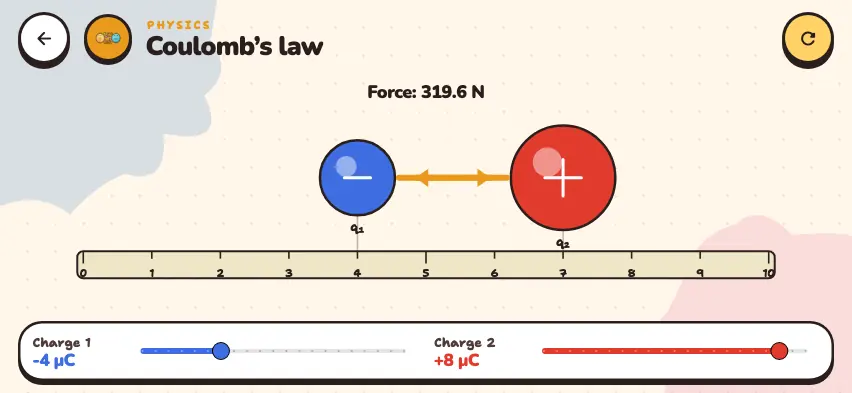
The positive nucleus repels the positive alpha particle according to Coulomb's law. The closer a particle passes to the nucleus, the stronger the repulsion and the larger the deflection. A particle heading straight for the nucleus stops and turns back. The more protons the nucleus has, the stronger the repulsion. The higher the energy of the particle, the smaller the deflection.
Run Rutherford's experiment in the Nalukh chem app
Watch how alpha particles are deflected near the nucleus. This simulator is included with full access. Downloading is free, and 2 units and 5 simulators are open without signing up.
How do you use the simulator?
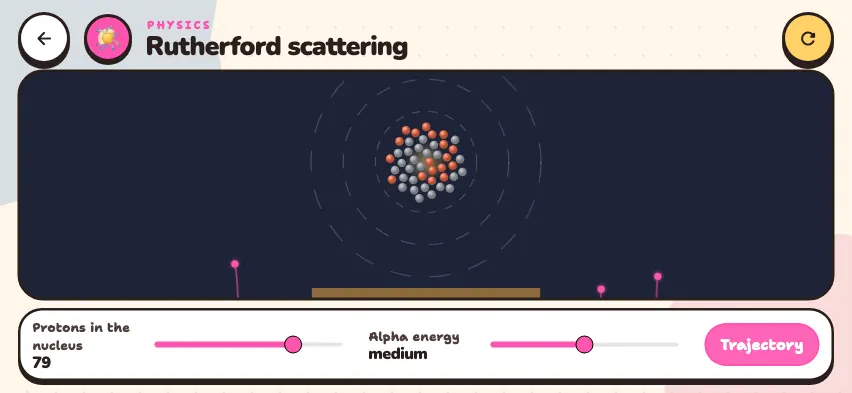
- Alpha particles fire upward nonstop from the brown source at the bottom. The nucleus is at the center, and the dashed circle around it is the electron shell.
- Use the Protons in the nucleus slider to change the number of protons from 20 to 100. The starting value, 79, is a gold nucleus.
- Use the Alpha energy slider to change the energy of the particles: low, medium, or high.
- The Trajectory button turns the paths of the particles on and off.
Tasks to try in the simulator
- With the starting settings, watch a particle heading straight for the nucleus. It stops before it reaches the nucleus and turns back. A particle passing to the side is deflected along a curved path.
- Set Protons in the nucleus to 20 and Alpha energy to high. The paths become nearly straight, and few particles turn back.
- Set Protons in the nucleus to 100 and Alpha energy to low. Most particles are strongly deflected and turn back the way they came.
- Keep the number of protons at 79 and drag the Alpha energy slider from left to right. The deflection gets smaller.
How did the model of the atom change?
| Year | Scientist | Discovery |
|---|---|---|
| 1897 | Thomson | Electron |
| 1909–1911 | Rutherford | Atomic nucleus |
| 1913 | Bohr | Electrons occupy specific shells |
| 1932 | Chadwick | Neutron |
Rutherford discovered the nucleus, but he did not explain how the electrons are arranged. Bohr continued to work on this question.