What does the circuit test show?
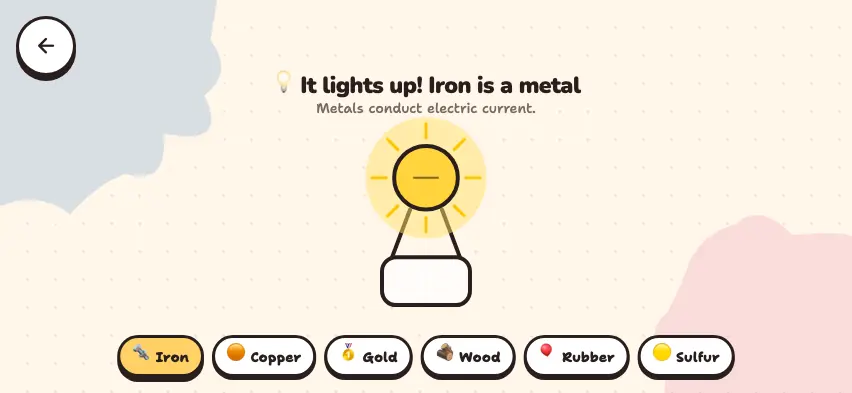
For a bulb to light, current must flow through the circuit. The material you are testing becomes part of the circuit. If the material conducts current, the bulb lights. If it does not, no current flows and the bulb stays off.
The test checks only one property: electrical conductivity. To see where metals and nonmetals are on the periodic table, see the article on metals and nonmetals.
Why do metals conduct electricity?
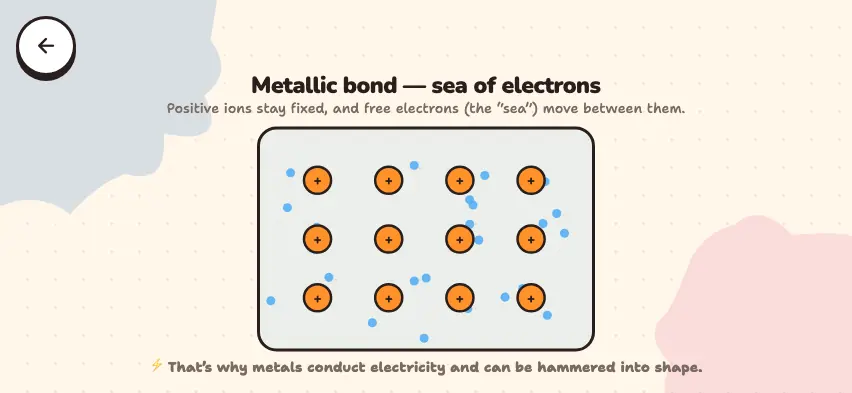
The outer electrons of metal atoms are not held to one atom. They move freely through the metal. When the metal is connected to a circuit, these free electrons flow in one direction and form a current. Wood, rubber, and sulfur have very few free electrons, so no current flows. You can watch free electrons move in the Electron sea in metals simulator.
Test six materials in the Nalukh chem app
Choose a material and see whether the bulb lights. This simulator unlocks with full access. The app is free to download, and 2 units and 5 simulators are open without signing up.
How do you use the simulator?
- There are six material buttons at the bottom of the screen: Iron, Copper, Gold, Wood, Rubber, and Sulfur. The simulator opens on iron.
- Press a material, and it appears in the box at the bottom of the circuit.
- Watch the bulb. If the material is a metal, the bulb lights up yellow and rays appear. If it is a nonmetal, the bulb stays pale.
- Read the result in the title. If the bulb lights, the word "metal" appears next to the name of the material. If it does not, the word "nonmetal" appears.
- Test all six materials and record your results.
Tasks to try in the simulator
- Predict the result for each material before you press it, then test it. How many materials light the bulb? Answer: Three: iron, copper, and gold.
- Gold and Sulfur are both yellowish. Can you tell them apart by color? Test them with the circuit. Answer: Color is not enough. The bulb lights for gold but not for sulfur.
- Which of wood, rubber, and sulfur is an element? Answer: Sulfur. Wood and rubber are materials made of many compounds.
What does the test not prove?
The rule works for the six materials in the simulator. But a lit bulb does not always mean the material is a metal.
- Graphite is a form of carbon. It is a nonmetal, but it conducts current well.
- Silicon is a metalloid. It sometimes conducts current and sometimes does not, so it is called a semiconductor.
- Salt solutions conduct current because they contain ions.
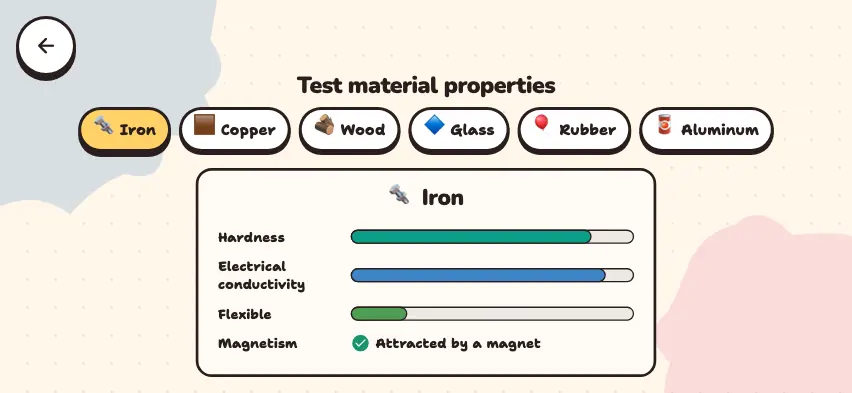
That is why you also check other properties to decide whether a material is a metal: whether it is shiny, conducts heat well, and flattens when hammered. You can compare properties other than conductivity in the Testing material properties simulator.