What does light do to a molecule?
Light is made of particles called photons. The shorter the wavelength, the higher the photon energy. A molecule absorbs only photons with the right energy, and other photons pass through.
| Light | Photon energy | What happens to the molecule | Molecules in the simulator |
|---|---|---|---|
| Microwave | Lowest | The molecule rotates | H2O |
| Infrared light | Low | Bonds vibrate | CO, CO2, CH4, H2O, NO2, O3 |
| Visible light | Medium | An electron is excited, and the molecule emits light | NO2 |
| Ultraviolet light | High | A bond breaks, and the molecule breaks apart | NO2, O3 |
A microwave oven works on this principle: microwaves make the water molecules in food rotate, and this heats the food.
Why do greenhouse gases trap heat?
Sunlight warms the ground. The warm ground radiates this heat back as infrared light. CO2, CH4, and H2O absorb this light and emit it again in all directions. Part of the heat comes back to the ground, so the atmosphere holds heat. This is called the greenhouse effect.
N2 and O2, which make up most of the air, do not absorb infrared light. They are nonpolar molecules made of two identical atoms, and their charge distribution does not change when they vibrate. CO2 is also nonpolar, but when it vibrates, its charge distribution becomes uneven for a moment, so it absorbs infrared light.
What does the ozone layer protect against?
Ozone, O3, absorbs ultraviolet light from the sun and breaks down into O2 and an oxygen atom. As a result, most of the sun's most harmful ultraviolet light does not reach the ground.
Try molecules and light in the Nalukh chem app
Choose a type of light and a molecule, and watch what happens. This simulator is included with full access. Downloading is free, and 2 units and 5 simulators are open without signing up.
How do you use the simulator?
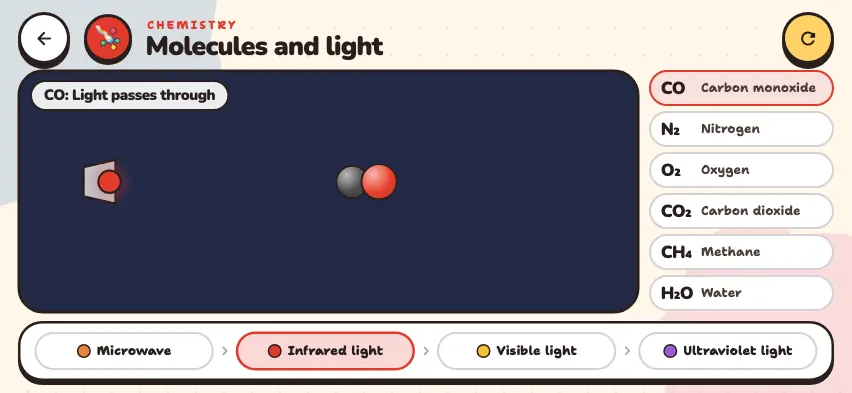
- Choose a type of light in the bottom row: Microwave, Infrared light, Visible light, or Ultraviolet light. Photon energy increases from left to right.
- Choose a molecule from the list on the right: CO, N2, O2, CO2, CH4, H2O, NO2, or O3.
- The light source fires photons on its own. Wait about 2 seconds for the first photon to reach the molecule.
- The state of the molecule appears in the upper-left corner: Light passes through, Rotating, Vibrating, Emitting, or It broke apart!.
Tasks to try in the simulator
- Select Infrared light and check the molecules one by one. N2 and O2 let the light pass through, and the other six vibrate.
- Select NO2 and switch the light from left to right. Microwaves pass through, and then the molecule vibrates, emits light, and breaks apart.
- Select O3 and turn on Ultraviolet light. The screen shows It broke apart!, and the molecule splits into O2 and O.
- Select Microwave and check all the molecules. Only H2O rotates.