How many types of chemical bonds are there?
Chemical bonds are classified by how the electrons are distributed. This simulator shows four types:
| Bond | Electrons | Between | Examples |
|---|---|---|---|
| Nonpolar covalent | Pair shared equally | Identical nonmetal atoms | H2, Cl2, O2, N2 |
| Polar covalent | Pair pulled toward one atom | Different nonmetal atoms | HCl, HF, H2O |
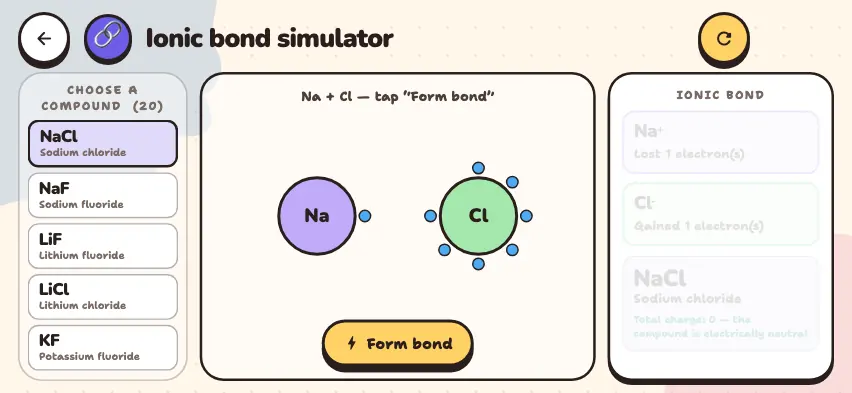
| Ionic | Transferred completely | A metal and a nonmetal | NaCl, MgO, KF |
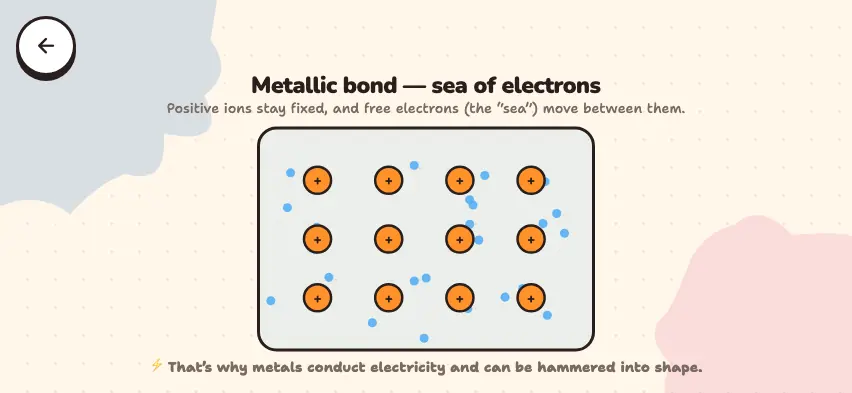
| Metallic | Released and shared by all the ions | Metal atoms | Cu |
The number of electrons missing from the outer shell tells you how many pairs a covalent bond shares. In Cl2, each chlorine atom is missing 1 electron, so a single bond forms. In O2, each atom is missing 2, so a double bond forms. In N2, each atom is missing 3, so a triple bond forms.
Telling bonds apart by electronegativity difference
Electronegativity (EN) is an atom's ability to pull a shared electron pair toward itself. You can determine the bond type from the EN difference between two atoms:
| Difference | Bond | Example |
|---|---|---|
| 0–0.4 | Nonpolar covalent | H–H: 2.1 − 2.1 = 0 |
| 0.4–2.0 | Polar covalent | H–Cl: 3.0 − 2.1 = 0.9 |
| Above 2.0 | Ionic | Na–Cl: 3.0 − 0.9 = 2.1 |
These cutoffs are a convention, and some books use 1.7. In a polar bond, the atom with the higher EN gets a slight negative charge (δ⁻), and the other atom gets a slight positive charge (δ⁺).
Build bonds yourself in the Nalukh chem app
Drag atoms close together to form covalent and ionic bonds, and build the electron sea of a metal. This simulator is part of full access. The app is free to download, and 2 chapters and 5 simulators are open without sign-up.
How do you use the simulator?
- Choose a bond type with the Nonpolar covalent, Polar covalent, Ionic, and Metallic buttons in the top row.
- Choose a formula from the row below. The Metallic section does not have this row.
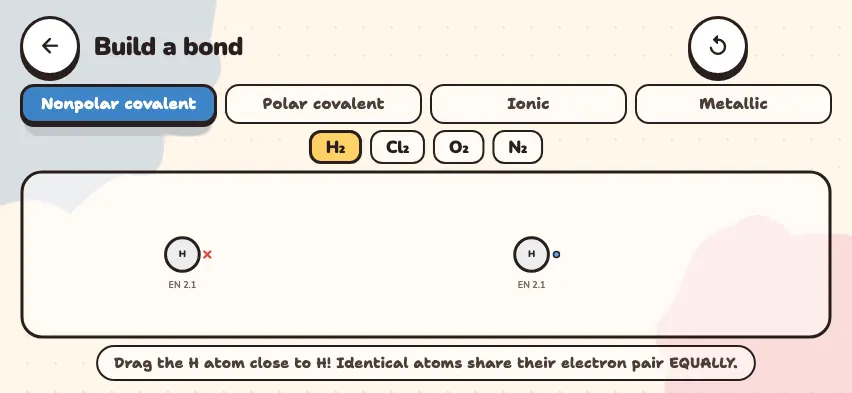
- Drag the left atom close to the right atom and release it. If it is close enough, a bond forms. If you release it too far away, drag it again. For H2O, drag each of the two hydrogen atoms separately.
- In the covalent sections, a blue dot is an electron of the right atom, and a red cross is an electron of the atom you dragged. Each atom has its EN value written below it.
- In the Metallic section, tap the 12 Cu atoms one by one. Each atom you tap becomes a Cu+ ion, and its electron moves freely.
- The bottom line shows instructions, and after the bond forms, it shows a conclusion. The round arrow button on the right side of the top bar restarts the current screen.
The simulator uses rounded EN values (fluorine 4.0, hydrogen 2.1). For more precise values, see the periodic trends guide.
Tasks to try in the simulator
- In the Polar covalent section, use the numbers below the atoms to calculate the difference for HCl and HF. Which bond is more polar? Answer: The differences are 0.9 and 1.9, so HF is more polar.
- In the Nonpolar covalent section, build H2, O2, and N2 and compare the number of shared electron pairs. Answer: 1, 2, and 3 pairs, which is 2, 4, and 6 electrons.
- In the Ionic section, how many electrons transfer in NaCl and in MgO? Answer: 1 and 2.
- In the Metallic section, tap the Cu atoms. When does the bottom line change? Answer: After you tap all 12 atoms.
Common mistakes
- Thinking HF has an ionic bond. The difference of 1.9 is large, but it is less than 2.0. The two nonmetal atoms share an electron pair, so the bond is polar covalent.
- Thinking electrons transfer in a polar bond. The electron pair moves closer to one atom, but it still belongs to both atoms. If it transferred completely, the bond would be ionic.
For more on each type, see the ionic bonding and metallic bonding guides.