What decides how you collect a gas?
First, check whether the gas dissolves in water. Then compare its molar mass with the average for air, 28.8 g/mol.
| Property of the gas | Method | Why |
|---|---|---|
| Barely dissolves in water | Water displacement (collecting over water) | The gas pushes the water out and fills the container |
| Molar mass below 28.8 g/mol | Mouth facing down | The gas rises and gathers at the top of the container |
| Molar mass above 28.8 g/mol | Mouth facing up | The gas sinks and gathers at the bottom of the container |
Chart of seven gases
| Gas | Molar mass, g/mol | Method in the simulator | Note |
|---|---|---|---|
| H2, hydrogen | 2 | Mouth down | Lighter than air |
| NH3, ammonia | 17 | Mouth down | Lighter than air, dissolves very well in water |
| N2, nitrogen | 28 | Water displacement | Barely dissolves in water, mass close to that of air |
| O2, oxygen | 32 | Water displacement | Barely dissolves in water, mass close to that of air |
| CO2, carbon dioxide | 44 | Mouth up | Heavier than air |
| SO2, sulfur dioxide | 64 | Mouth up | Heavier than air, dissolves well in water |
| Cl2, chlorine | 71 | Mouth up | Heavier than air, dissolves in water |
The simulator shows one method for each gas. In a real lab, H2 is also collected by water displacement, because it barely dissolves in water. CO2 dissolves only slightly in water, so it can also be collected by water displacement.
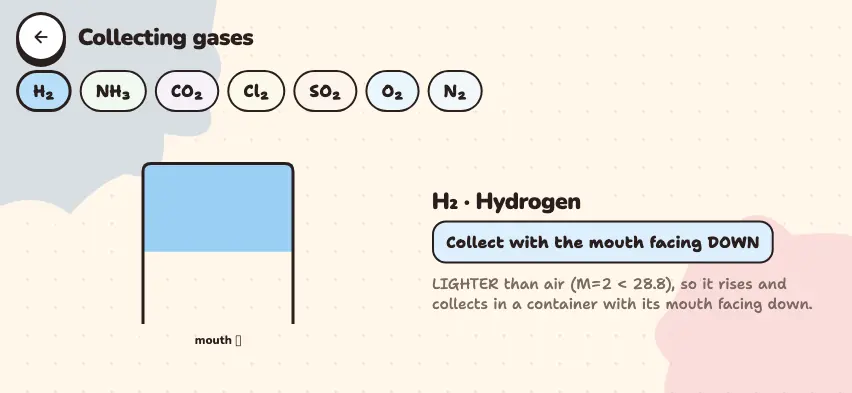
See how to collect each gas in the Nalukh chem app
Choose from seven gases and watch how the container fills. This simulator unlocks with full access. The app is free to download, and 2 units and 5 simulators are open without signing up.
How do you use the simulator?
- Press a gas formula in the top row to select it. There are seven gases: H2, NH3, CO2, Cl2, SO2, O2, N2.
- On the left, a container appears and shows how the gas fills it. The gas gathers at the closed end of the container.
- On the right, you see the name of the gas and the collection method: Collect with the mouth facing DOWN, Collect with the mouth facing UP, or Collect over water.
- The reason appears below. For gases chosen by comparing with air, the molar mass M also appears.
- Press the formula again to replay the animation from the start.
Tasks to try in the simulator
- Before you press anything, calculate the molar mass of SO2 and predict the method. Answer: 32 + 2 · 16 = 64, which is heavier than air, so the mouth faces up.
- Predict the method for NH3 too. Answer: 14 + 3 = 17, which is lighter than air, so the mouth faces down.
- Press O2 and N2, read the reasons, and compare them with the reason for CO2. Which property decided the method here? Answer: Not mass, but the fact that they barely dissolve in water.
- Predict the method for methane, CH4, which is not in the simulator. Answer: M = 16, which is lighter than air, so the mouth faces down. It barely dissolves in water, so water displacement also works.
To calculate molar mass, use the atomic mass table.
Why does water displacement give a pure gas?
You fill a container with water, turn it mouth down, and place it in a tub of water. No air stays inside. The gas comes in and pushes the water out, so it does not mix with air. When you collect a gas in air, on the other hand, some air may stay in the container.
Gas collected over water is moist. If you need dry gas, pass it through a drying agent.