What is an ionic bond?
An ionic bond is the electrical attraction between positive and negative ions. In a covalent bond, atoms share electrons. In an ionic bond, a metal atom gives its electrons completely to a nonmetal atom.
- Cation: a metal atom that has lost electrons. It has more protons than electrons, so it has a positive charge.
- Anion: a nonmetal atom that has gained electrons. It has more electrons than protons, so it has a negative charge.
After the transfer, the outer shells of both ions are full, and the ions are stable. For example, the Na+ and Cl− ions each have 8 electrons in their outer shell.
Finding the formula from electron transfer
The number of electrons the metal loses must equal the number of electrons the nonmetal gains. That is why the total charge of the compound is 0.
| Compound | Metal loses | Nonmetal gains | Ions |
|---|---|---|---|
| NaCl | 1 electron | 1 electron | Na+, Cl− |
| MgO | 2 electrons | 2 electrons | Mg2+, O2− |
| MgCl2 | 2 electrons | 1 electron for each chlorine | Mg2+, 2 Cl− |
| Na2O | 1 electron from each sodium | 2 electrons | 2 Na+, O2− |
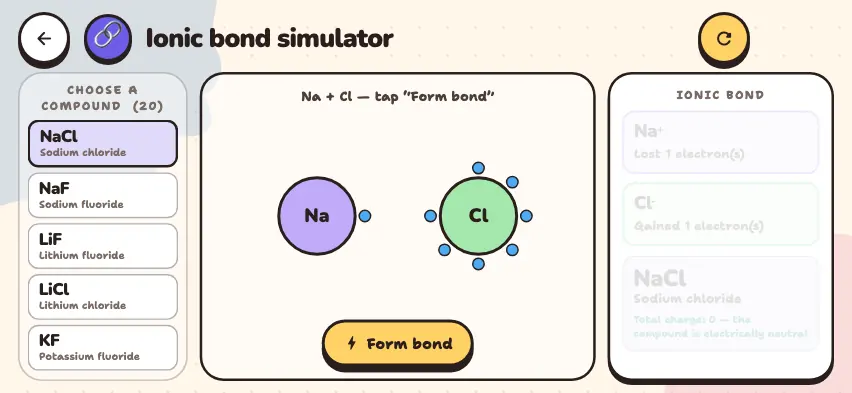
Form ionic bonds in the Nalukh chem app
Choose a compound and watch electrons transfer to form ions. This simulator is part of full access. The app is free to download, and 2 chapters and 5 simulators are open without sign-up.
How do you use the simulator?
- Choose one of the 20 compounds from the list on the left. Scroll down to see them all.
- Press the Form bond button in the middle section.
- Blue electrons move from the metal to the nonmetal. When the transfer ends, charges appear next to the atomic symbols, and the ions are pulled toward each other.
- When the animation ends, the IONIC BOND panel on the right becomes fully visible. It shows the charge of each ion, the electrons lost and gained, and the formula and name of the compound.
- The Restart button returns the current compound to the start. The yellow button in the top bar goes back to NaCl, the first compound on the list.
Tasks to try in the simulator
- Choose MgO and predict the charges of the ions before you press the button. Answer: Mg2+ and O2−, and 2 electrons transfer.
- Compare MgCl2 and Na2O. Answer: In MgCl2, one magnesium atom gives one electron to each of two chlorine atoms. In Na2O, two sodium atoms each give one electron to one oxygen atom.
- Find CaF2 on the list. Why are 2 fluorine atoms needed? Answer: Calcium loses 2 electrons, and each fluorine gains only 1.
Common mistakes
- Thinking NaCl is a molecule. The simulator shows only a few ions. In real salt, each ion is surrounded by many oppositely charged ions, forming a crystal lattice.
- Thinking solid salt conducts electricity. In solid salt, the ions are held in place in the lattice, so it does not conduct. In a melt or a solution, the ions move freely and carry charge.
- Thinking every metal-nonmetal compound is ionic. AlCl3 on the list is a handy example for working out charges. But real AlCl3 has strong covalent character: at about 180°C it turns directly into a gas and forms Al2Cl6 molecules.