What are periods and groups?
The position of an element in the periodic table tells you its atomic structure directly. A period is a horizontal row, and a group is a vertical column.
- The period number is the number of electron shells. Sodium is in period 3, so it has 3 shells.
- The group gives the number of outer electrons, also called valence electrons. In groups 1 and 2, this number equals the group number. In groups 13–18, subtract 10 from the group number: chlorine, in group 17, has 7 electrons in its outer shell.
Some books write groups 13–18 as IIIA–VIIIA. In this notation, the number equals the number of outer electrons.
| Group | Name | Outer electrons | Examples |
|---|---|---|---|
| 1 | Alkali metals | 1 | Li, Na, K |
| 2 | Alkaline earth metals | 2 | Be, Mg, Ca |
| 13–16 | Metals, metalloids, nonmetals | 3–6 | Al, Si, P, S |
| 17 | Halogens | 7 | F, Cl |
| 18 | Noble gases | 8, helium has 2 | He, Ne, Ar |
Elements in the same group have the same number of outer electrons, so their chemical properties are similar. Hydrogen is in group 1, but it is a nonmetal.
See atomic structure in the Nalukh chem app
Tap an element's cell and compare the atomic model, period, and group. The simulator is free and needs no sign-up.
How do you use the simulator?
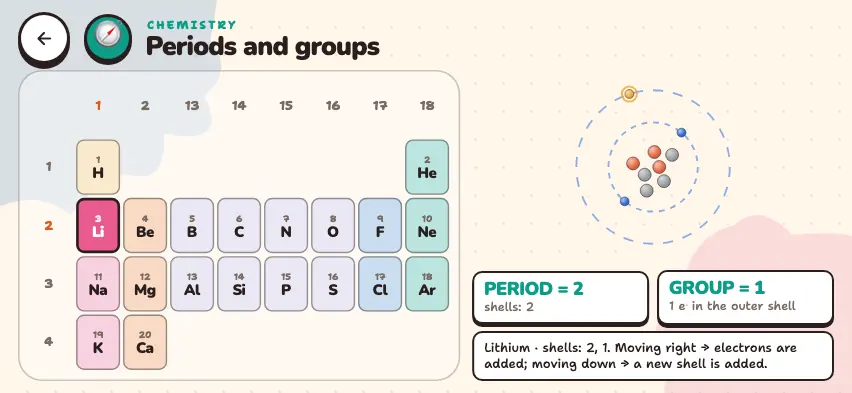
- The simulator opens on lithium. On the left is a table of the first 20 elements, with group numbers in the top row and period numbers in the left column.
- Tap an element's cell. The period and group numbers of that element are highlighted in the table, and a Bohr model of the atom is drawn on the right.
- The model shows the nucleus, shells, and electrons. The electrons in the outer shell are yellow.
- On the two cards under the model, read the period and number of shells, and the group and number of outer electrons.
- The bottom row lists the number of electrons in each shell. Lithium: 2, 1.
The table has no groups 3–12, because the elements in these groups start at element 21.
Tasks to try in the simulator
- Move down from the sodium cell to potassium. What happens to the number of shells and outer electrons? Answer: The shells go from 3 to 4, and the outer electrons stay at 1.
- Tap across period 3 to the right, from sodium to argon. Answer: The shells stay at 3, and the outer electrons increase from 1 to 8.
- Compare helium and neon. Both are in group 18, but their numbers of outer electrons are different. Answer: Helium has 2 and neon has 8. Both have a full outer shell, so they are in the same group.
Common mistakes
- Confusing the atomic number with the group. Magnesium is element 12, but it is in group 2.
- Reading the group number directly as the number of electrons. An element in group 17 has 7 outer electrons, not 17.
- Writing potassium as 2, 8, 9. When the 3rd shell has 8 electrons, the 19th electron goes into the 4th shell. So potassium has shells of 2, 8, 8, 1.
To see how electrons are arranged in subshells, read the electron configuration guide.