What is an isotope?
All atoms of an element have the same number of protons. But the number of neutrons can differ. Atoms with the same number of protons and different numbers of neutrons are called isotopes. An isotope is named with the element name and its mass number: carbon-12, carbon-13.
| Isotope | Protons | Neutrons | Natural abundance | Nucleus |
|---|---|---|---|---|
| Carbon-12 | 6 | 6 | 98.93% | Stable |
| Carbon-13 | 6 | 7 | 1.07% | Stable |
| Carbon-14 | 6 | 8 | Very small | Unstable |
Isotopes of an element have the same number of electrons, so their chemical properties are almost the same. They differ in mass and in the stability of the nucleus.
How do you calculate average atomic mass?
An element in nature is a mixture of several isotopes. That is why the periodic table lists the average mass. Multiply the mass of each isotope by its abundance, add the results, and divide by 100:
Average mass = (mass₁ × abundance₁ + mass₂ × abundance₂ + …) / 100
Example. In nature, boron is 19.9% boron-10 and 80.1% boron-11:
(10.013 × 19.9 + 11.009 × 80.1) / 100 = 10.811 amu
Boron-11 is more abundant, so the answer is close to 11. The average mass of chlorine is 35.5 for the same reason: chlorine is about 75% chlorine-35 and about 25% chlorine-37.
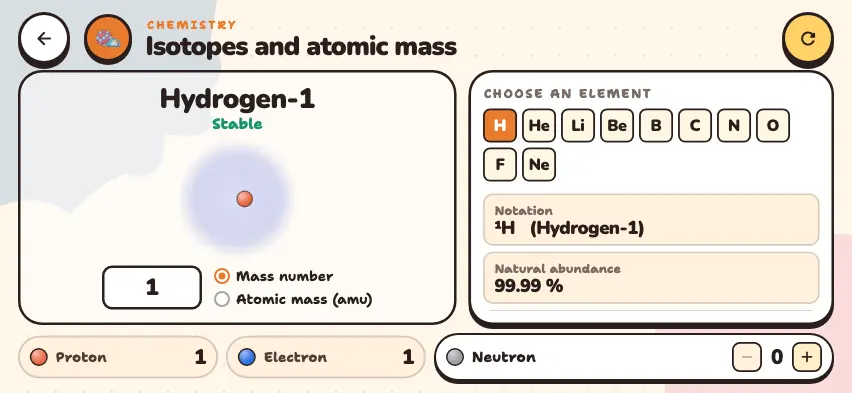
Build isotopes in the Nalukh chem app
Add and remove neutrons and see the isotope, abundance, and atomic mass. This simulator is included with full access. Downloading is free, and 2 units and 5 simulators are open without signing up.
How do you use the simulator?
- In the CHOOSE AN ELEMENT section, choose one of the 10 elements from hydrogen to neon. The most abundant isotope opens.
- Use the + and − buttons on the Neutron counter in the bottom row to add and remove neutrons. The numbers of protons and electrons do not change.
- Above the nucleus, look at the isotope's name and the word Stable or Unstable.
- Switch the display below the nucleus between Mass number and Atomic mass (amu) to compare them. Oxygen-16 has a mass number of 16 and an atomic mass of 15.995.
- Scroll the panel on the right and read the Notation, Natural abundance, and Average atomic mass of the element values.
Tasks to try in the simulator
- Choose boron and compare 5 and 6 neutrons. The abundances are 19.90% and 80.10%, and the average mass is 10.811. Compare this with the calculation above.
- Choose neon and check 10, 11, and 12 neutrons. The abundances add up to 100: 90.48 + 0.270 + 9.25. Calculate the average mass by hand and compare it with 20.180.
- How many stable isotopes does oxygen have? Three: with 8, 9, and 10 neutrons.
- Choose beryllium and fluorine. Each has only one stable isotope, so the average mass equals the mass of that isotope.
Common mistakes
- Confusing mass number with atomic mass. Mass number is the sum of protons and neutrons, so it is a whole number. Atomic mass is a measured value, so it is usually not a whole number.
- Calculating a simple average instead of a weighted average. The simple average of boron-10 and boron-11 is 10.5, but the correct answer is 10.811.