What is a reaction mechanism?
An equation shows the start and end of a reaction. A mechanism explains what happens in between: which bond breaks first, where the electrons move, and which intermediate forms. If you know the mechanism, you can predict the product without memorizing it.
Main types of organic reactions
| Type | What happens | Example in the simulator |
|---|---|---|
| Substitution | an atom or group is replaced by another atom | chlorination of methane |
| Addition | a double bond breaks and atoms add on | ethene adding bromine |
| Elimination | a small molecule splits off and a multiple bond forms | ethene from ethanol |
| Esterification | an acid and an alcohol form an ester and water | ethyl ethanoate |
| Hydrolysis | water breaks the ester bond | hydrolysis of propyl ethanoate |
| Oxidation | an alcohol becomes an aldehyde, then an acid | ethanol → ethanal |
| Polymerization | monomers form a long chain | ethylene → polyethylene |
| Isomerization | the formula stays the same and the structure changes | butane → 2-methylpropane |
| Nitrogen compounds | aniline salts, diazonium salts, and azo dyes form | aniline with hydrochloric acid |
Why does Markovnikov's rule work?
The rule: in an unsymmetrical alkene, hydrogen adds to the carbon that has more hydrogens. When propene reacts with HBr, the main product is 2-bromopropane.
- Electrons from the double bond move to the hydrogen of HBr.
- The hydrogen adds to the end carbon, and a secondary carbocation forms on the middle carbon.
- The bromide ion adds to the positively charged carbon.
If the hydrogen added to the middle carbon, a primary carbocation would form. This carbocation has low stability, so that path almost never happens. Carbocation stability: tertiary (3°) > secondary (2°) > primary (1°).
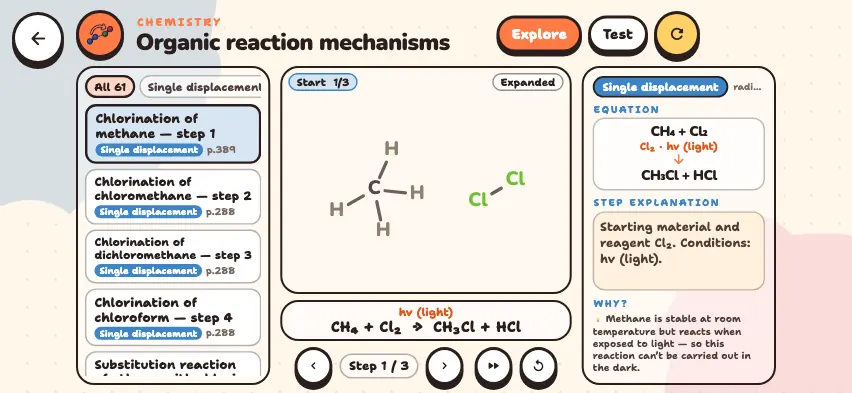
Step through mechanisms in the Nalukh chem app
This simulator is included with full access. Downloading is free, and 2 units and 5 simulators are open without signing up.
How do you use the simulator?
- In Explore mode, choose a reaction type from the top row on the left: Single displacement, Combination, Elimination, and others.
- Press a reaction in the list. The starting material appears in the center.
- Use the arrow buttons to move forward and back through the steps. The double-arrow button plays the steps automatically, one every 0.9 seconds, and the circular arrow button returns to the start.
- Watch the colors: a red bond breaks, a green dashed bond forms, a curved arrow shows electron movement, and ⊕ marks a carbocation.
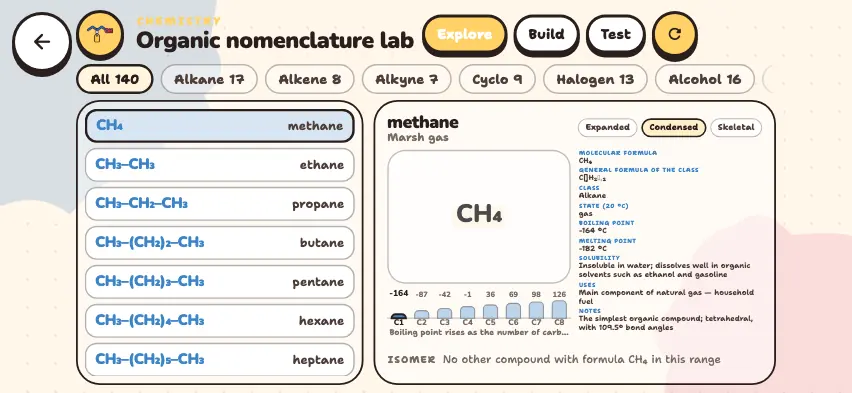
- Use the Expanded button to switch the molecule drawing to Condensed or Skeletal form.
- On the right, read the EQUATION, STEP EXPLANATION, and WHY? sections.
- Test mode gives you 10 questions on products, reaction types, Markovnikov's rule, and conditions.
Tasks to try in the simulator
- Step through the Propene with HBr — Markovnikov’s rule reaction and find which carbon the carbocation forms on. Answer: the middle carbon.
- Compare Ethanol at 170 °C — ethene and Ethanol at 140 °C — diethyl ether. Answer: The substance and the acid are the same, but ethene forms at 170 °C and diethyl ether at 140 °C.
- Compare the conditions of Substitution of iodomethane with an alkali and 2-Bromobutane with KOH — Zaitsev’s rule. Answer: KOH in water gives substitution, and KOH in alcohol gives elimination.
- Compare the products of Kucherov: acetylene with water — ethanal and Kucherov: propyne with water — acetone. Answer: Acetylene gives an aldehyde, and propyne gives a ketone.
Common mistakes
- Applying Markovnikov's rule to ethene. Ethene is symmetrical, so its two carbons are the same and only one product forms.
- Confusing substitution with addition. In substitution an atom is replaced; in addition new atoms join across a double bond.