What affects the rate of diffusion?
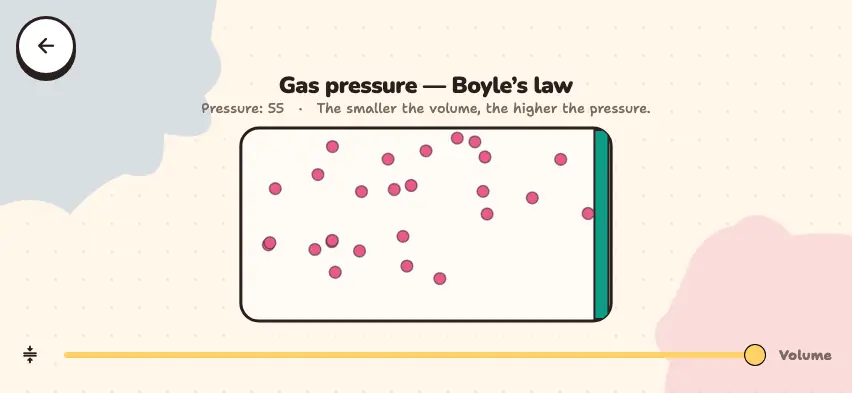
The rate of diffusion depends on how fast particles move and how freely they can spread.
| Factor | How the rate changes | Why |
|---|---|---|
| Temperature | The higher it is, the faster | Particles have more energy and move faster |
| State | Gas > liquid > solid | Particles move freely in a gas and vibrate in place in a solid |
| Particle mass | Lighter particles are faster | At the same temperature, light particles move faster than heavy ones |
| Concentration difference | The larger it is, the faster | Many particles move from the side with more of the substance to the side with less |
Why does temperature speed up diffusion?
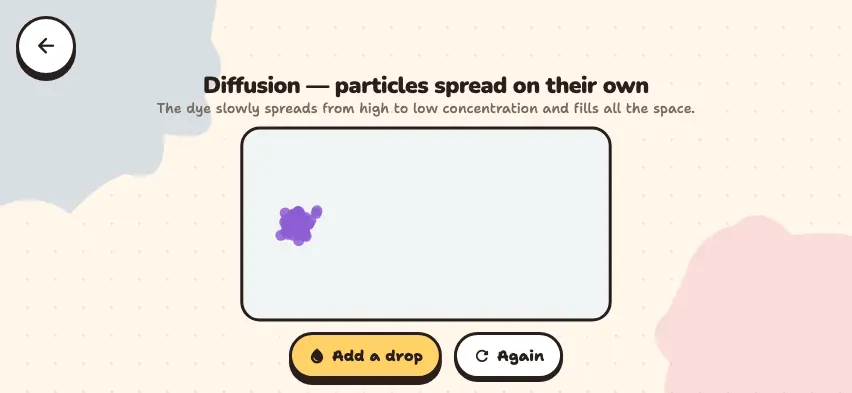
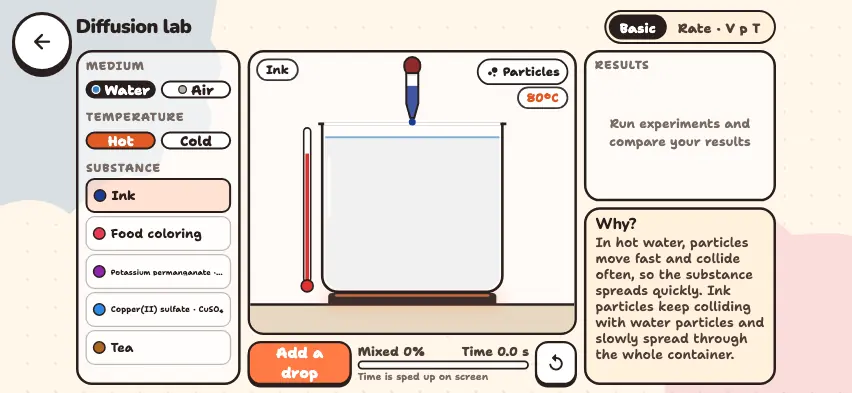
As water gets hotter, the water and ink particles move faster and collide with each other more often. So the ink particles spread farther in the same amount of time. In cold water, diffusion does not stop. It only happens slowly.
How particle mass matters: the ammonia experiment
In this experiment, a long glass tube has cotton soaked in ammonia solution at one end and cotton soaked in hydrochloric acid at the other. NH3 and HCl gases spread through the tube from the two ends, and a white ring of NH4Cl forms where they react. The ring usually appears closer to the hydrochloric acid end. The molar mass of NH3 is 17 g/mol and that of HCl is 36.5 g/mol, so ammonia spreads faster and travels farther.
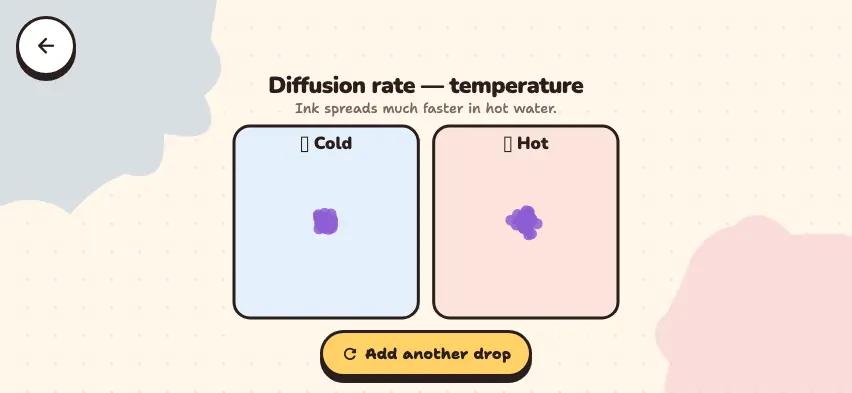
Compare hot and cold water in the Nalukh chem app
Watch the same ink spread side by side in two containers. This simulator unlocks with full access. The app is free to download, and 2 units and 5 simulators are open without signing up.
How do you use the simulator?
- Two containers appear side by side on the screen: Cold on the left and Hot on the right.
- The same number of purple ink particles appear at the center of both containers at the same time. The only difference between the containers is temperature.
- Watch both containers at once. In the hot container, the ink spreads fast. In the cold container, it stays near the center for a long time.
- Press the Add another drop button to put a new drop at the center of both containers and restart the experiment.
The simulator does not show temperature numbers, and the ratio of particle speeds in the two containers is a model. To compare many substances in water and air, use the Diffusion lab simulator.
Tasks to try in the simulator
- Press the Add another drop button and start a timer. Note the time it takes for a particle in the hot container to reach the wall. Where are the particles in the cold container at that moment? Answer: They have not moved far from the center.
- In which container does the ink fill the space first? Answer: The hot container.
- Why does it matter that both containers have the same amount of ink? Answer: You can only see the effect of one thing if you change only that thing. Here, the thing you changed is temperature.
How can you test this at home?
- Pour the same amount of hot water and cold water into two clear glasses. Ask an adult to pour the hot water.
- Wait a few seconds until the water is still. Do not stir.
- Add one drop of food coloring to each glass at the same time.
- Note which glass turns an even color first.