What is a functional group?
The chemical properties of an organic compound are determined mainly by its functional group. The app's lessons use the same term. Compounds with the same group belong to one class and show similar properties.
| Group | Class | Example | Property |
|---|---|---|---|
| −OH hydroxyl | Alcohol | ethanol C2H5OH | Ethanol mixes well with water |
| −COOH carboxyl | Carboxylic acid | acetic acid CH3COOH | Acidic, forms salts with bases |
| −NH2 amino | Amine | methylamine CH3NH2 | Basic |
| −Cl halogen | Haloalkane | chloromethane CH3Cl | Fluorine, bromine, or iodine can take the place of chlorine |
With the same chain but a different group, the class is different. Ethane C2H6 is an alkane, ethanol C2H5OH is an alcohol, and acetic acid CH3COOH is a carboxylic acid. All three have 2 carbons.
One molecule can have two groups. An amino acid contains both an −NH2 group and a −COOH group in one molecule.
Switch groups in the Nalukh chem app
This simulator is part of full access. The app is free to download, and 2 chapters and 5 simulators are open without sign-up.
How do you use the simulator?
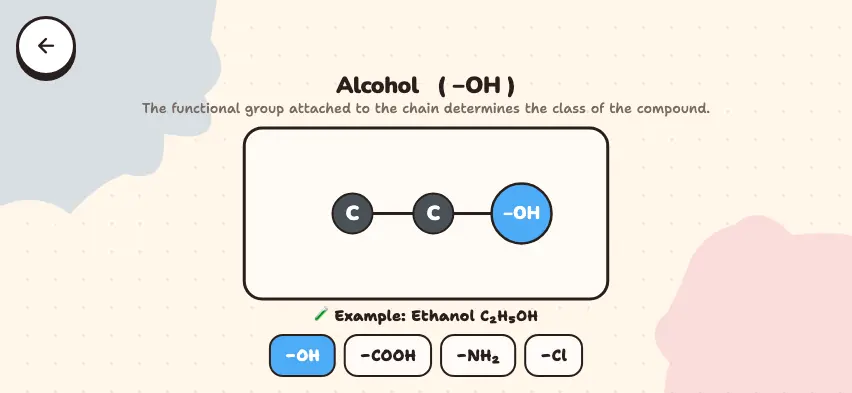
When the simulator opens, the −OH group is selected.
- The picture shows two carbons with a large colored circle attached. The colored circle is the functional group.
- Choose −OH, −COOH, −NH2, or −Cl from the four buttons below.
- The class of the compound appears in the top line: Alcohol, Carboxylic acid, Amine, or Haloalkane. Carboxylic acid is the class name used in textbooks.
- An example of that class appears below the picture, such as Ethanol C₂H₅OH.
The picture is a diagram that shows every group attached to the same chain. It is not the exact structure of the example substance: methylamine and chloromethane have one carbon.
Tasks to try in the simulator
- Choose each group and find it in the formula of the example substance. Answer: For example, the COOH at the end of CH3COOH and the NH₂ in CH3NH2.
- Before you press a button, guess the class: C3H7OH, C2H5COOH, C2H5NH2, C2H5Cl. Then check with the group buttons. Answer: Alcohol, carboxylic acid, amine, haloalkane.
- Of the four groups, which is acidic and which is basic? Answer: −COOH is acidic, and −NH2 is basic.
Common mistakes
- Thinking an alcohol is a base. The −OH group of an alcohol is covalently bonded to carbon and does not split off as an ion. A base, on the other hand, contains OH− ions.
- Thinking every hydrogen is acidic. Of the four hydrogens in the acetic acid formula CH3COOH, only the one in the −COOH group splits off as an ion.