What is diffusion?
The particles of liquids and gases are always moving and colliding with each other. Because of this motion, a substance spreads from an area of high concentration to an area of low concentration, until it is even throughout the container. Ink dropped into water spreads even without stirring. Perfume sprayed in one corner of a room can be smelled in the other corner.
In solids, particles only vibrate in place, so diffusion is very slow.
What affects the rate of diffusion?
| Factor | Effect | Example in the simulator |
|---|---|---|
| Temperature | When it rises, particles move faster and diffusion speeds up | Ink: 45 s in water at 5°C, about 8 s in water at 80°C |
| Particle mass | Light particles spread faster | Ammonia NH3 spreads 2.3 times faster than bromine Br2 |
| Pressure | When it rises in a gas, particles get closer and collide more often, so diffusion slows down. It has almost no effect in liquids | Bromine: 9 s at 1 atm, 18 s at 2 atm |
| Container size | In a large container, particles travel farther, so mixing takes longer | Bromine: 9 s in 1 L, about 14 s in 2 L |
Diffusion is much faster in gases than in liquids. The real difference is about 10,000 times, but the simulator speeds up the time to make this easier to see. Seconds on the screen are not real time, so compare the tests only with each other.
The white ring inside the tube
A classic experiment shows the effect of particle mass. Cotton soaked in ammonia solution is placed in one end of a long glass tube, and cotton soaked in hydrochloric acid is placed in the other end. The two gases spread through the tube and form a white ring of ammonium chloride NH4Cl where they meet. The ring appears closer to the hydrochloric acid end, because NH3 (17 g/mol) is lighter than HCl (36.5 g/mol) and spreads faster.
Measure diffusion in the Nalukh chem app
Spread 10 substances through water and air and compare the times. This simulator is included with full access. The app is free to download, and 2 units and 5 simulators are open with no sign-up.
How do you use the simulator?
- In the upper right corner, choose the basic mode or the “Rate · V p T” mode.
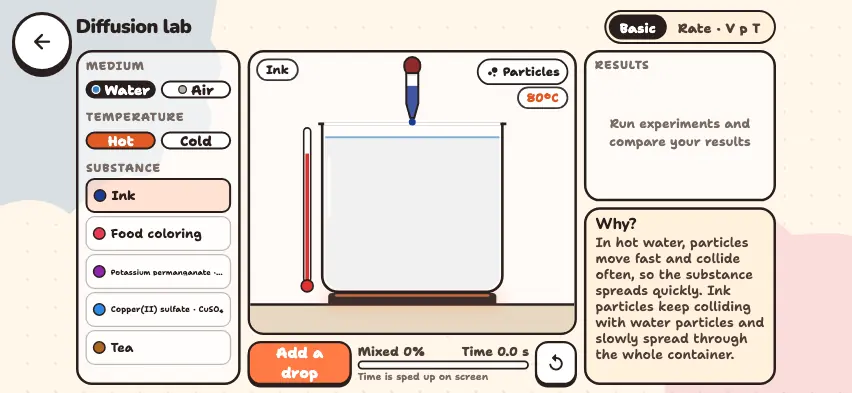
- In the left panel, choose the medium (water or air), the temperature (hot or cold), and a substance. Water has ink, food coloring, potassium permanganate, copper(II) sulfate, and tea. Air has perfume, ammonia, bromine, iodine, and chlorine.
- Press the large button under the container. Its name depends on the substance: add a drop, add a crystal, add a tea bag, remove the cap, or heat to vaporize.
- As the substance spreads, the percent mixed and the time go up. When it has spread evenly, the time is recorded and the result goes into the list on the right.
- Press the Particles button to see the motion of the particles.
- You detect substances you cannot see in other ways: a nose beside the container senses perfume, and damp red litmus turns blue in ammonia.
- In “Rate · V p T” mode, use the sliders to change the temperature (0–100°C), volume (0.5–2 L), and pressure (0.5–3 atm). The diffusion rate and the mixing time appear right away. The pressure slider does not work in water.
Tasks to try in the simulator
- Test ink in cold water and in hot water. Answer: 45 s in water at 5°C and about 8 s in water at 80°C, about 5 times faster.
- In air at the same temperature, test ammonia, chlorine, bromine, and iodine. Answer: They get slower in this order. Their molar masses rise: 17, 71, 160, and 254 g/mol.
- In “Rate · V p T” mode, choose air and bromine, and set the pressure to 2.0 atm. Answer: The rate goes from ×1.0 to ×0.5, and the mixing time goes from 9 s to 18 s.
- In the same mode, raise the temperature from 20°C to 100°C, and compare water and air. Answer: The rate becomes ×4.6 in water and ×1.5 in air.