What is a galvanic cell?
A galvanic cell, also called a voltaic cell, is a device that turns the chemical energy of a redox reaction into electrical energy. Schools usually study the zinc–copper cell. A zinc electrode is placed in a zinc salt solution, and a copper electrode is placed in a copper salt solution. A wire connects the two electrodes, and a salt bridge connects the two solutions.
| Part | What happens? | Reaction |
|---|---|---|
| Anode (zinc, −) | Zinc loses electrons and is oxidized | Zn → Zn2+ + 2e− |
| Cathode (copper, +) | Copper ions gain electrons and are reduced | Cu2+ + 2e− → Cu |
| Wire | Electrons flow from the anode to the cathode | — |
| Salt bridge | Ions move and keep the solutions neutral | — |
Overall reaction: Zn + Cu2+ → Zn2+ + Cu. Zinc is more reactive than copper, so it loses its electrons. When the ion concentrations are 1 mol/L, this cell has a voltage of 1.10 V.
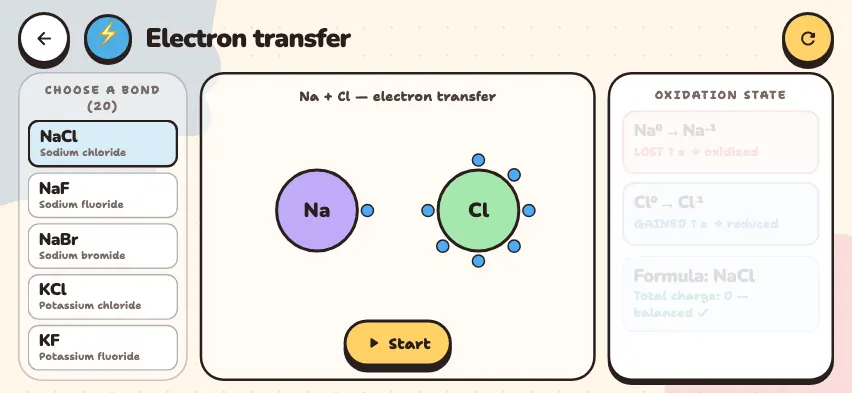
Without a salt bridge, the solutions cannot stay neutral, and almost no current flows. As the cell runs, the zinc electrode dissolves, and copper deposits on the copper electrode. Read about oxidation and reduction in the Electron transfer article.
Run a galvanic cell in the Nalukh chem app
This simulator is part of full access. The app is free to download, and 2 chapters and 5 simulators are open without sign-up.
How do you use the simulator?
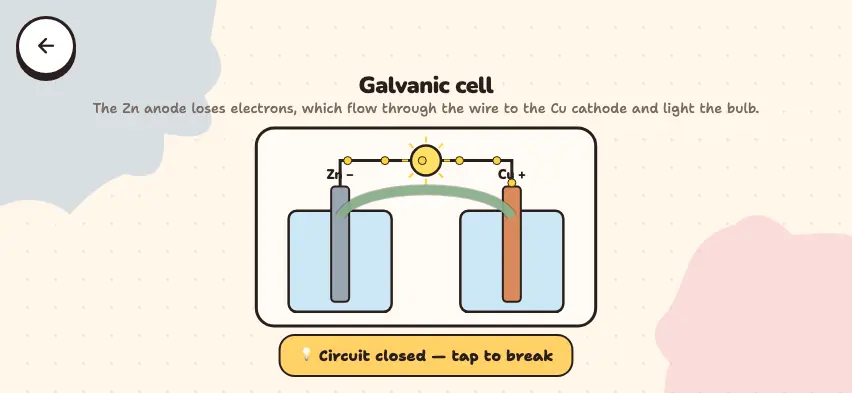
When the simulator opens, the circuit is closed, and the bulb is on.
- Find the electrode marked Zn − in the left beaker and the electrode marked Cu + in the right beaker. The green arc connecting the two beakers is the salt bridge.
- Watch the yellow dots, which are electrons, flow from the zinc through the wire and the bulb to the copper.
- Press the 💡 Circuit closed — tap to break button. The bulb goes out, and the electrons disappear.
- Press the 🔌 Circuit open — tap to connect button to close the circuit again.
The simulator animates only the electron flow. It does not show the ions moving or the electrodes changing.
Tasks to try in the simulator
- Break the circuit and close it again. Which way are the electrons going? Answer: From zinc to copper, from the anode to the cathode.
- Why does the bulb go out when the circuit is broken? Answer: The path for the electrons is cut.
- Explain why the zinc electrode has a − sign. Answer: Zinc loses electrons, and the extra electrons stay on the electrode.
- Calculate from the anode reaction: how many moles of electrons flow when 1 mole of zinc is oxidized? Answer: 2 moles.
Common mistakes
- Thinking the anode is always positive. In a galvanic cell, the anode is negative and the cathode is positive. In electrolysis it is the opposite: the anode is positive and the cathode is negative. But in both, oxidation happens at the anode and reduction at the cathode.
- Thinking electrons travel through the solution. Electrons travel only through the wire. Ions move through the solutions and the salt bridge.