Why do molecules have definite shapes?
The electron pairs around the central atom set the shape of a molecule. Each electron pair has a negative charge, so the pairs repel each other and stay as far apart as possible. The other atoms sit in the directions of these pairs.
To find the shape, count two things on the central atom:
- Bond: an electron pair that connects the central atom to another atom.
- Lone pair: an electron pair on the central atom that is not in a bond. It repels the other pairs, but it is not counted in the name of the shape, because shapes are named by the positions of the atoms.
Each bond or lone pair is called one domain. With 2 domains, they lie on one line. With 3 domains, they point to the corners of a triangle. With 4 domains, they point to the corners of a tetrahedron.
Chart: find the shape from bonds and lone pairs
| Bonds | Lone pairs | Molecular shape | Bond angle | Example |
|---|---|---|---|---|
| 2 | 0 | Linear | 180° | CO2 |
| 3 | 0 | Trigonal planar | 120° | BF3 |
| 2 | 1 | Bent | ≈118° | SO2 |
| 4 | 0 | Tetrahedral | 109.5° | CH4 |
| 3 | 1 | Trigonal pyramidal | ≈107° | NH3 |
| 2 | 2 | Bent | ≈104.5° | H2O |
CH4, NH3, and H2O all have 4 domains. But a lone pair repels more strongly than a bond, so the bond angle gets smaller as lone pairs are added. Some courses call the bent shape “angular.”
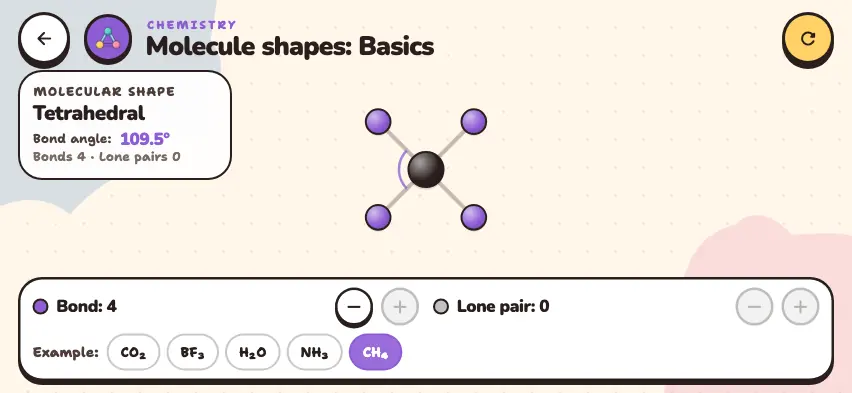
Try molecular shapes in the Nalukh chem app
Add and remove bonds and lone pairs, and see how the shape and angle change. This simulator is included with full access. Downloading is free, and 2 units and 5 simulators are open without signing up.
How do you use the simulator?
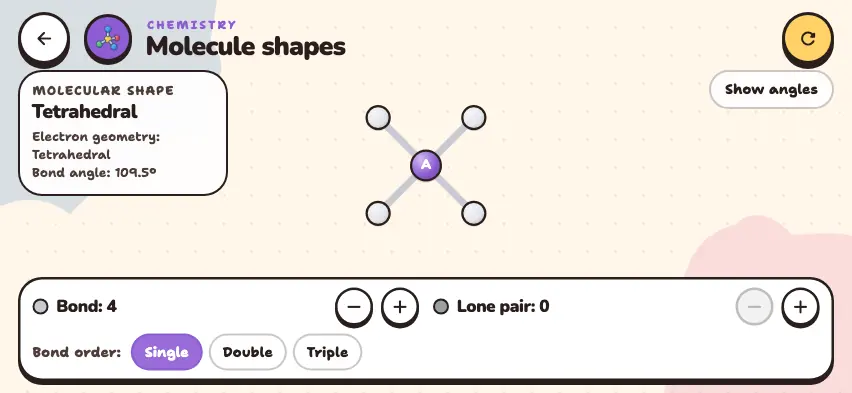
- The simulator opens with a molecule that has 4 bonds and no lone pairs. The upper-left card shows the name of the shape, the bond angle, and the numbers of bonds and lone pairs.
- In the bottom panel, use the − and + buttons in the Bond row to change the bonds from 2 to 4.
- In the Lone pair row, add or remove lone pairs from 0 to 2. As soon as the sum of bonds and lone pairs reaches 4, the + button stops working. So remove a bond before you add a lone pair.
- The CO2, BF3, H2O, NH3, and CH4 buttons in the Example: row take you to a ready-made molecule.
- The yellow button in the upper-right corner returns to the starting state.
Tasks to try in the simulator
- Go from the CH4 button to NH3, then to H2O. How do the shape and angle change? Answer: Tetrahedral 109.5°, trigonal pyramidal ≈107°, bent ≈104.5°.
- Set Bond to 2 and Lone pair to 0, then add lone pairs one at a time. Answer: Linear 180°, bent ≈118°, bent ≈104.5°.
- Compare BF3 and NH3. Both have 3 bonds, so why are their shapes different? Answer: Nitrogen has 1 lone pair, and boron has none.
Common mistakes
- Thinking water is linear. The formula is written on one line as H–O–H, but oxygen has 2 lone pairs, so the molecule is bent.
- Counting a lone pair as an atom. NH3 has 4 domains but 3 hydrogens. That is why it is called trigonal pyramidal, not tetrahedral.
What does shape affect?
A water molecule is bent, so its charge is distributed unevenly and it is a polar molecule. That is why water dissolves salt and sugar well. The bonds in CO2 are polar, but the molecule is straight, so the charge is distributed evenly on both sides and the molecule as a whole is nonpolar.
To learn about 5 and 6 domains and electron geometry, read the VSEPR theory guide.