What does "pure" mean in chemistry?
In everyday speech, "pure" means that nothing has been added and nothing is contaminated. A carton may say "pure orange juice," but the juice contains water, sugar, and many other substances. In chemistry, that is a mixture.
In chemistry, a pure substance is made of only one element or one compound. Iron, gold, and oxygen are elements. Water, H2O, and table salt, NaCl, are compounds.
| Property | Pure substance | Mixture |
|---|---|---|
| Kinds of particles | One | Two or more |
| Composition | Fixed | Can change |
| Melting and boiling points | Fixed | Not fixed |
| Examples | Gold, distilled water, table salt | Air, seawater, milk |
How can you test whether a substance is pure?
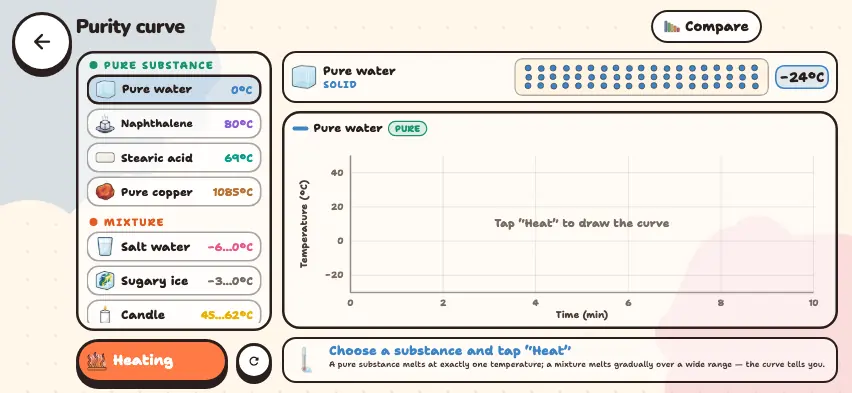
The main method is to measure the melting or boiling point. A pure substance melts at exactly one temperature, and the thermometer stops rising until all of it has melted. A mixture melts gradually over a range, not at one point.
At 1 atm, pure water freezes at 0°C and boils at 100°C. If you add salt to water, the freezing point drops below 0°C and the boiling point rises above 100°C. That is why you test whether a clear liquid is pure with a thermometer, not by looking at it.
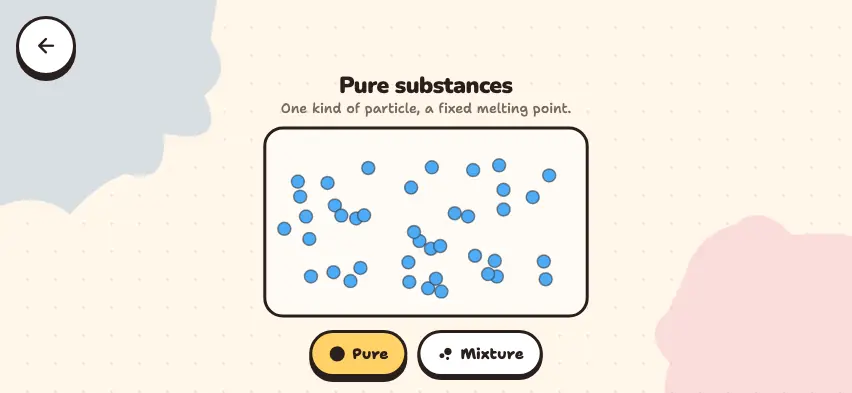
Compare pure substances and mixtures in the Nalukh chem app
Switch modes with two buttons and see how the particles differ. This simulator unlocks with full access. The app is free to download, and 2 units and 5 simulators are open without signing up.
How do you use the simulator?
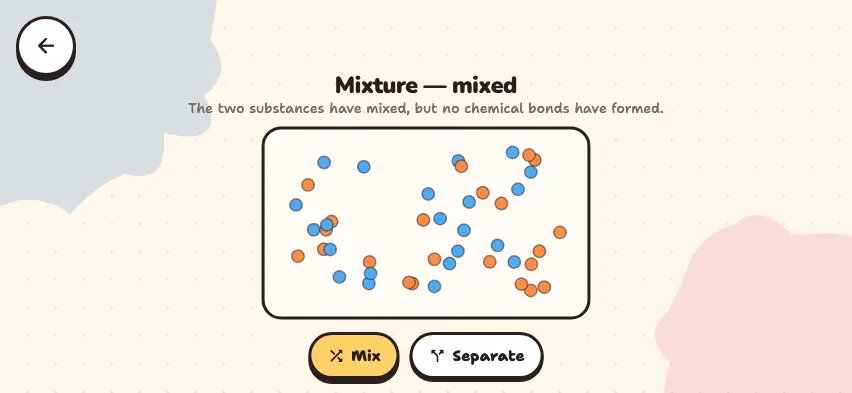
- The simulator opens in Pure mode. All the particles are one color, and the title reads Pure substances.
- Press the Mixture button. The particles turn three colors, blue, orange, and green, and the title changes to Mixtures.
- Read the description under the title. It says that a pure substance has a fixed melting point and that a mixture has no fixed melting point.
- Press the two buttons in turn and compare.
This simulator shows kinds of particles. It does not measure temperature. You can draw a melting curve in the Purity curve simulator. See the types of mixtures in the guide to mixtures.
Tasks to try in the simulator
- Count the colors of particles in Pure and Mixture modes. Answer: 1 and 3.
- Switch the buttons and watch how the particles move. Does their speed change? Answer: No, only the colors change. The difference between a pure substance and a mixture is in the kinds of particles, not in their motion.
- Imagine salt water as particles. Which mode does it match? Answer: Mixture. Salt water has three kinds of particles: H2O molecules and Na+ and Cl− ions.
Common mistakes
- "Water is made of two elements, so it is a mixture." Wrong. Every H2O molecule is the same, so water is a pure substance and a compound.
- "A clear liquid is pure." Wrong. Salt water and sugar water are clear, but they are mixtures. Even tap water contains dissolved substances.
- "Pure means good to drink." Wrong. In chemistry, pure is only about composition. Drinking water contains dissolved substances, but it is safe to drink.