What is a phase change?
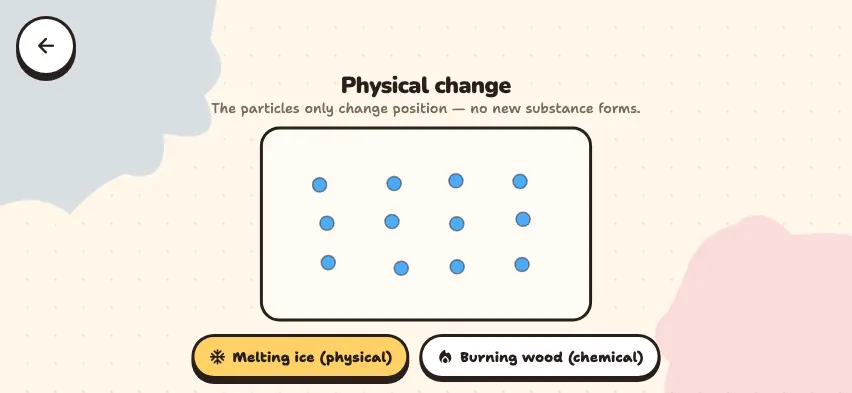
When you heat or cool a substance, its state changes. When ice melts into water, no new substance forms: ice, water, and steam are all made of H2O molecules. What changes is the distance between the molecules and the way they move. That is why a phase change is a physical change.
| Change | State | Heat | Example |
|---|---|---|---|
| Melting | Solid → liquid | Absorbed | Ice turning into water |
| Freezing | Liquid → solid | Released | A river freezing |
| Evaporation, boiling | Liquid → gas | Absorbed | Water in a kettle turning into steam |
| Condensation | Gas → liquid | Released | Drops forming on a cold glass |
| Sublimation | Solid → gas | Absorbed | Frozen laundry drying without thawing |
How do particles move in the three states?
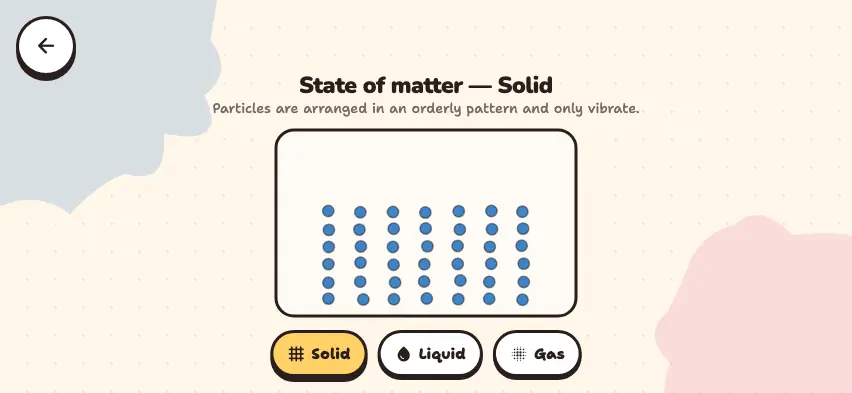
- Solid: particles sit close together in rows and vibrate in place.
- Liquid: particles stay close together, but they change places and move among each other.
- Gas: particles are far apart, move fast, and fill the whole container.
When you add heat, the particles move faster and the attractions between them weaken. When you remove heat, the opposite happens.
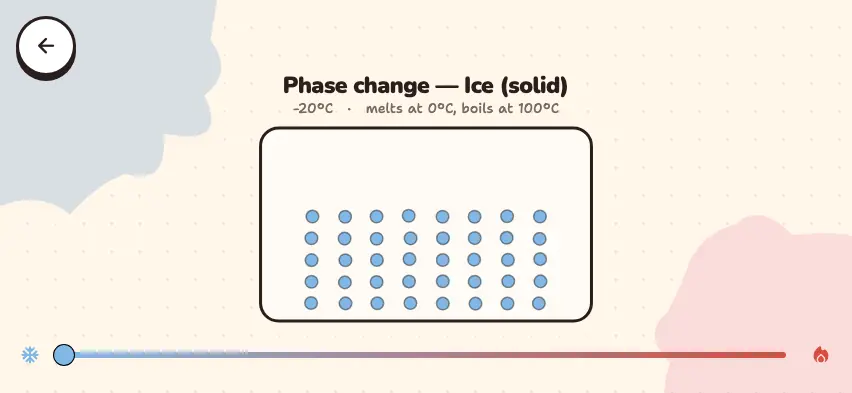
See the particles of ice, water, and steam in the Nalukh chem app
Change the temperature with a slider and compare how the particles move. This simulator unlocks with full access. The app is free to download, and 2 units and 5 simulators are open without signing up.
How do you use the simulator?
- The simulator starts at −20°C. The title reads Ice (solid), and the particles sit in rows at the bottom of the container.
- Slowly drag the slider under the container from left to right. There is a snowflake on the left and a flame on the right. The temperature appears as a number under the title.
- At 0°C, the title changes to Water (liquid). The particles lose their rows and move freely in the lower part of the container.
- At 100°C, the title changes to Steam (gas). The particles fill the whole container and move fast.
- Drag the slider back, and steam turns into water, water turns into ice, and the particles return to their rows.
Tasks to try in the simulator
- Move the slider back and forth across 0°C and watch how the particles are arranged. Answer: Below 0°C, the particles sit in rows and vibrate in place. As soon as the temperature reaches 0°C, the rows break apart.
- Compare which part of the container the particles fill at 99°C and at 101°C. Answer: At 99°C they fill the lower part, and at 101°C they fill the whole container.
- Move the slider up to 120°C and back to −20°C. Do any particles appear or disappear? Answer: No. The number of particles stays the same, and they all return to where they started. This shows that a phase change can be reversed.
Common mistakes
- The white "steam" from a kettle is not a gas. Water vapor is invisible. The white cloud is water that has cooled in the air and turned into droplets.
- Evaporation and boiling are not the same thing. Liquid water evaporates from its surface even when it is cold. During boiling, bubbles of vapor form inside the liquid.
- Water does not boil at 100°C everywhere. That number is for a pressure of 1 atm. In a high-altitude city like Ulaanbaatar, the air pressure is lower, so water boils before it reaches 100°C.