What are melting point and boiling point?
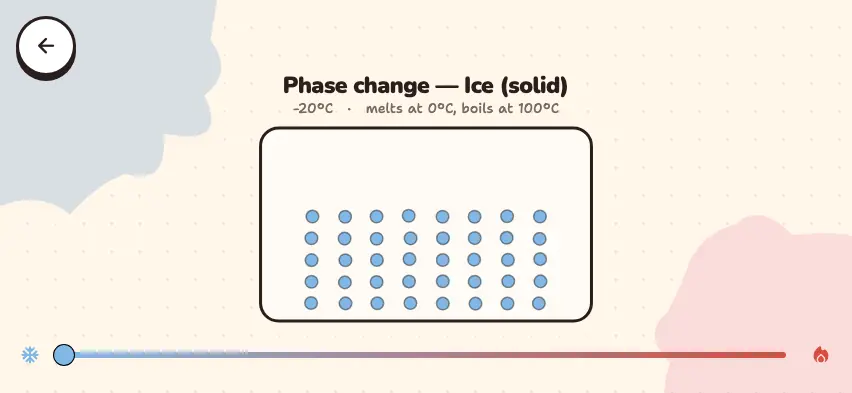
When you heat a solid, it becomes a liquid at a specific temperature. This temperature is called the melting point. When you keep heating the liquid, it boils and becomes a gas at a specific temperature. This is called the boiling point. Here are the values for the four substances in the simulator:
| Substance | Melting point | Boiling point | Liquid range |
|---|---|---|---|
| Neon | 24 K (−249 °C) | 27 K (−246 °C) | 3 K |
| Argon | 84 K (−189 °C) | 87 K (−186 °C) | 3 K |
| Oxygen | 54 K (−219 °C) | 90 K (−183 °C) | 36 K |
| Water | 273 K (0 °C) | 373 K (100 °C) | 100 K |
To convert kelvins to °C, subtract 273: 373 − 273 = 100 °C. The table values are for a pressure of 1 atm, rounded to whole numbers.
Why does each substance have different points?
When a substance melts or boils, its particles move away from each other. This takes energy to overcome the attraction between the particles. The stronger the attraction, the higher the melting and boiling points.
- Neon and argon atoms attract each other very weakly. So they become liquids only when they are very cold.
- An argon atom is larger than a neon atom, so its attraction is stronger, and its melting and boiling points are higher.
- Water molecules attract each other strongly through hydrogen bonds. That is why water is a liquid at room temperature.
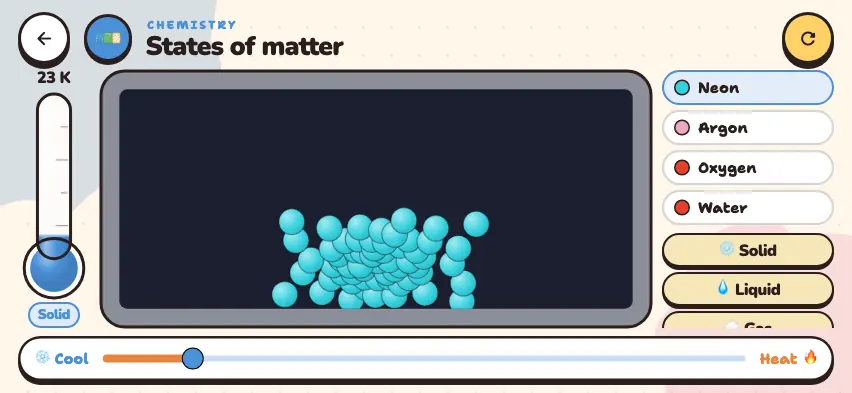
Heat a substance and watch its state change
Heat and cool four substances and find their melting and boiling points on the thermometer. This simulator is included with full access. Downloading is free, and 2 units and 5 simulators are open without signing up.
How do you use the simulator?
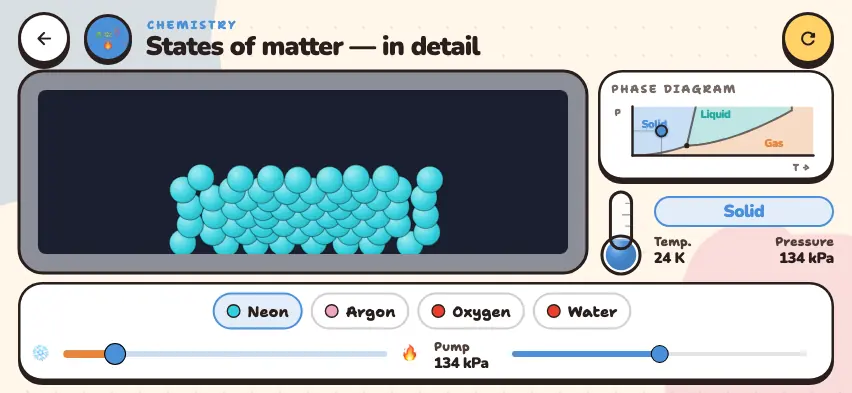
- Choose a substance on the right: Neon, Argon, Oxygen, or Water.
- Move the bottom slider toward Heat 🔥 to heat the substance or toward ❄ Cool to cool it.
- Read the temperature in K on the thermometer on the left, and the state of the substance below it.
- The ❄ Solid, 💧 Liquid, and ☁ Gas buttons move the slider directly to that state.
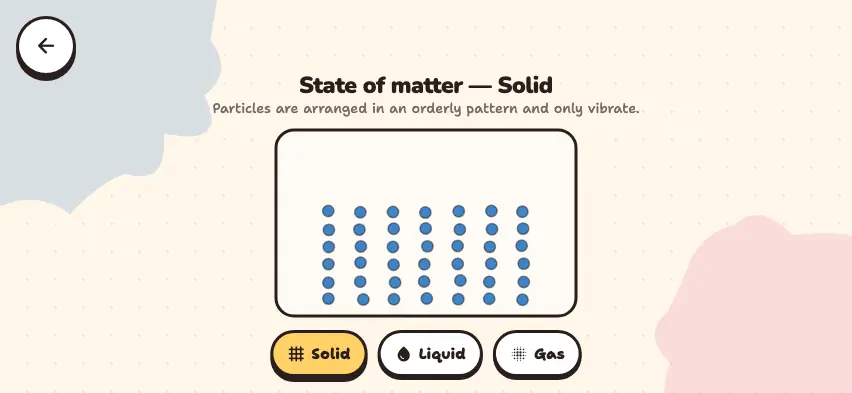
- Watch the particles in the container at the center: in a solid they vibrate in place, in a liquid they slide along the bottom, and in a gas they fill the container and move fast.
Tasks to try in the simulator
- Select Water and move the slider slowly. At what temperature in K does the state change? Answer: At 273 K, the solid becomes a liquid, and at 373 K, the liquid becomes a gas.
- Compare the liquid ranges of neon and water. Answer: Neon is 24–27 K, or 3 K. Water is 273–373 K, or 100 K.
- Find the states of argon and oxygen at 88 K. Answer: Argon is a gas, and oxygen is a liquid. At the same temperature, the two substances are in different states.
What the simulator does not show during melting and boiling
While a pure substance is melting or boiling, the heat you add goes into moving the particles apart, and the temperature stays constant. In the simulator, the temperature follows the slider directly, so you do not see this pause.
The boiling point depends on pressure. To see the effect of pressure, read the phase diagram guide.
Differences in boiling points are used in industry. Air is liquefied, and then argon and oxygen are separated by fractional distillation.