How do you name compounds?
| Category | Rule | Example |
|---|---|---|
| Oxide | element name + oxide | MgO magnesium oxide |
| Element with several oxides | write the oxidation state as a Roman numeral in parentheses | Fe2O3 iron(III) oxide |
| Acid without oxygen | hydrogen + anion name | HBr hydrogen bromide |
| Acid with oxygen | name of the main element + acid | H2SO4 sulfuric acid |
| Base | metal name + hydroxide | Ca(OH)2 calcium hydroxide |
| Salt | metal name + anion name | KNO3 potassium nitrate |
HCl has two names: hydrogen chloride and, in everyday use, hydrochloric acid.
How do you get a salt's name from its acid?
The second word of a salt's name comes from the acid's anion. An anion without oxygen ends in -ide. An anion with less oxygen ends in -ite, and one with more oxygen ends in -ate.
| Acid | Anion | Salt name | Example |
|---|---|---|---|
| HCl | Cl− | chloride | NaCl |
| H2S | S2− | sulfide | CaS |
| H2SO3 | SO32− | sulfite | Na2SO3 |
| H2SO4 | SO42− | sulfate | CaSO4 |
| HNO3 | NO3− | nitrate | KNO3 |
| H2CO3 | CO32− | carbonate | CaCO3 |
| H3PO4 | PO43− | phosphate | K3PO4 |
How do you read a formula aloud?
Read a formula from left to right. Say the symbols letter by letter and each subscript as a number. For a subscript after parentheses, add "twice" or "three times."
| Formula | Pronunciation |
|---|---|
| H2SO4 | H-two-S-O-four |
| CuO | C-u-O |
| Ca(OH)2 | C-a-O-H-twice |
| Al2(SO4)3 | A-l-two, S-O-four three times |
Common names
Some compounds have an everyday name as well as an official name. These appear in the simulator's notes.
| Formula | Official name | Common name |
|---|---|---|
| NaCl | sodium chloride | table salt |
| NaHCO3 | sodium hydrogen carbonate | baking soda |
| Na2CO3 | sodium carbonate | washing soda |
| NaOH | sodium hydroxide | caustic soda |
| CaO | calcium oxide | quicklime |
| Ca(OH)2 | calcium hydroxide | slaked lime |
Check your formulas and names in the Nalukh chem app
This simulator is included with full access. Downloading is free, and 2 units and 5 simulators are open without signing up.
How do you use the simulator?
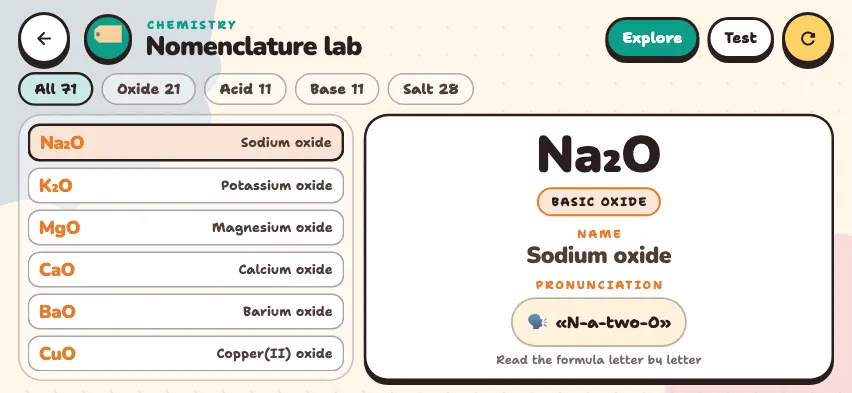
- In Explore mode, choose a category from the top row: all, oxides, acids, bases, or salts. Each button shows the number of compounds.
- Press a compound in the list on the left. The card shows the formula in large type, the subcategory, NAME, PRONUNCIATION, and for some compounds a note about their uses.
- In Test mode, press the correct answer out of four choices. There are three question types: Which NAME is correct?, Which FORMULA?, and How do you READ it?.
- The test asks questions from the category you selected. The top row shows your score, and if you press a wrong answer, the correct one appears in green.
- The circular arrow button resets the score to zero.
Tasks to try in the simulator
- Find the amphoteric oxides in the oxide list. Answer: ZnO, Al2O3.
- Compare the names of FeO and Fe2O3, and work out the oxidation state of iron. Answer: II, III.
- Find the acid salts in the salt list. Answer: NaHCO3, KHCO3.
- Take the test in the salt category only, and aim to get 8 of 10 questions right.
Common mistakes
- Confusing sulfide, sulfite, and sulfate: CaS has no oxygen, Na2SO3 has 3 oxygen atoms, and CaSO4 has 4.
- Leaving out the oxidation state. FeO and Fe2O3 are both iron oxides, so you cannot tell them apart without the Roman numeral.
- Reading a subscript of 1 aloud. Read MgO as "M-g-O."