What are strong and weak acids?
When an acid dissolves in water, it ionizes and forms H3O+ ions. In a strong acid, almost all the molecules ionize. In a weak acid, only a few molecules ionize, and most stay as molecules. Bases work the same way: a strong base breaks apart completely and gives OH− ions, and a weak base reacts only partly with water.
| Type | Example | Reaction in water |
|---|---|---|
| Strong acid | Hydrochloric acid | HCl + H2O → H3O+ + Cl− |
| Weak acid | Acetic acid | CH3COOH + H2O ⇌ H3O+ + CH3COO− |
| Strong base | Sodium hydroxide | NaOH → Na+ + OH− |
| Weak base | Ammonia | NH3 + H2O ⇌ NH4+ + OH− |
The one-way arrow → means the reaction goes to completion. The two-way arrow ⇌ means the forward and reverse reactions happen at the same time, so the starting substance remains in the solution.
Do not confuse strength with concentration
The words "strong" and "weak" tell you what percentage of the substance ionizes. The words "concentrated" and "dilute" tell you how much substance is in the solution. These are different ideas: you can have a dilute solution of a strong acid or a concentrated solution of a weak acid.
Compare acids at the same concentration. In the simulator, a 0.01 mol/L strong acid reads pH 2.00, and a weak acid reads pH 4.50.
Why does conductivity differ?
In a solution, ions carry the electric current. A strong acid has many ions, so the bulb glows brightly. A weak acid has few ions, so the bulb glows dimly. Pure water has very few ions, so the bulb barely glows.
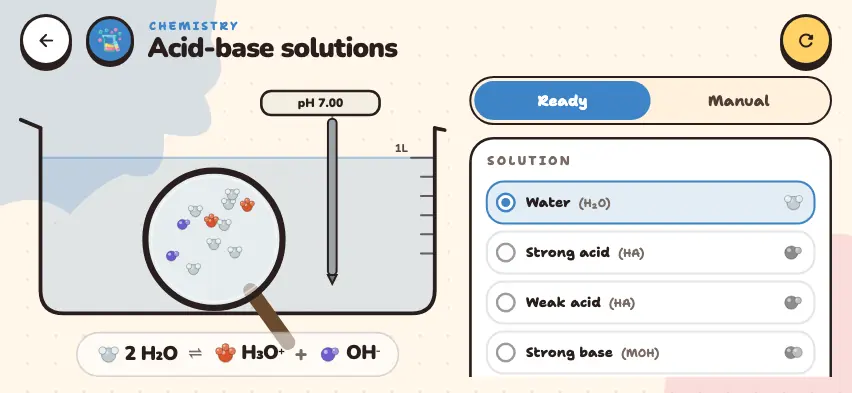
Compare acids and bases in the Nalukh chem app
Check the particles, pH, and conductivity of a solution yourself. This simulator is included with full access. Downloading is free, and 2 units and 5 simulators are open without signing up.
How do you use the simulator?
- In Ready mode, use the SOLUTION panel to choose water or one of four solutions: Strong acid, Weak acid, Strong base, or Weak base.
- Choose a view on the VIEW panel. Particles shows the particles in a magnifying glass, Graph shows the concentration of each particle as a bar, and Hide hides both.
- Choose a measuring tool on the EQUIPMENT panel. pH meter shows the pH as a number, pH paper shows it as a color, and Conductivity shows conductivity with a bulb. While Graph is open, the tool is not visible.
- Look at the equation under the beaker. For strong acids and bases, the arrow points one way. For weak acids and bases, it points both ways.
- In Manual mode, choose Acids or Bases, and use the Initial concentration slider to set a value from 0.001 to 1 mol/L. Then choose Weak or Strong. With Weak, the lower slider sets the strength.
- The circular arrow button in the top right corner returns all settings to the starting state.
Tasks to try in the simulator
- In Ready mode, measure the pH of the four solutions. Answer: strong acid 2.00, weak acid 4.50, strong base 12.00, weak base 9.50.
- Use the Conductivity tool to compare water, the weak acid, and the strong acid. Answer: The bulb barely glows in water, glows dimly in the weak acid, and glows brightly in the strong acid.
- In Manual mode, change the strong acid concentration from 0.01 to 0.1 mol/L. Answer: When the concentration becomes 10 times higher, the pH goes from 2.00 to 1.00, a drop of 1 unit.
- Can you get pH 2.00 with a weak acid? Set the concentration to 1 mol/L and move the strength slider. Answer: Yes. So you cannot judge an acid's strength from pH alone. Look at the concentration too.