How do you identify ions?
When a salt dissolves in water, it separates into cations (positive ions) and anions (negative ions). Each ion gives its own characteristic result with a given reagent: a precipitate color, a gas, or a flame color. Reactions like these are called qualitative reactions. One sample contains two ions, so you test for the cation and the anion separately.
Cation identification chart
| Cation | Flame color | Adding NaOH | Follow-up test |
|---|---|---|---|
| Cu2+ | blue-green | pale blue precipitate Cu(OH)2 | dissolves in excess ammonia to give a deep blue solution |
| Fe2+ | golden sparks | green precipitate Fe(OH)2 | oxidizes in air to red-brown Fe(OH)3 |
| Fe3+ | golden sparks | red-brown precipitate Fe(OH)3 | no change in excess alkali or ammonia |
| Al3+ | no color | white precipitate Al(OH)3 | dissolves in excess alkali, does not dissolve in excess ammonia |
| Zn2+ | no color | white precipitate Zn(OH)2 | dissolves in excess ammonia |
| NH4+ | no color | no precipitate | on heating, NH3 is released and damp red litmus turns blue |
| Na+ | yellow | no precipitate | identified by flame color |
| K+ | lilac | no precipitate | identified by flame color |
| Ba2+ | yellow-green | no precipitate | identified by flame color |
For an explanation of flame colors, see the flame test guide.
Anion identification chart
| Anion | Reagent | Precipitate | Follow-up test |
|---|---|---|---|
| SO42− | BaCl2 | white BaSO4 | does not dissolve in dilute HCl |
| CO32− | BaCl2 | white BaCO3 | dissolves vigorously in HCl and releases CO2, which turns limewater milky white |
| SO32− | BaCl2 | white BaSO3 | dissolves in HCl and releases sharp-smelling SO2 |
| Cl− | AgNO3 | white AgCl | dissolves completely in dilute ammonia |
| Br− | AgNO3 | pale yellow AgBr | dissolves only in concentrated ammonia |
| I− | AgNO3 | yellow AgI | does not dissolve in dilute or concentrated ammonia |
BaCl2 gives the same white precipitate with three anions, so you must add HCl to check. Before adding silver nitrate, you acidify the solution with nitric acid. Otherwise, the carbonate ion also gives a white precipitate, and you could mistake it for the chloride ion.
Analyze ten samples in the Nalukh chem app
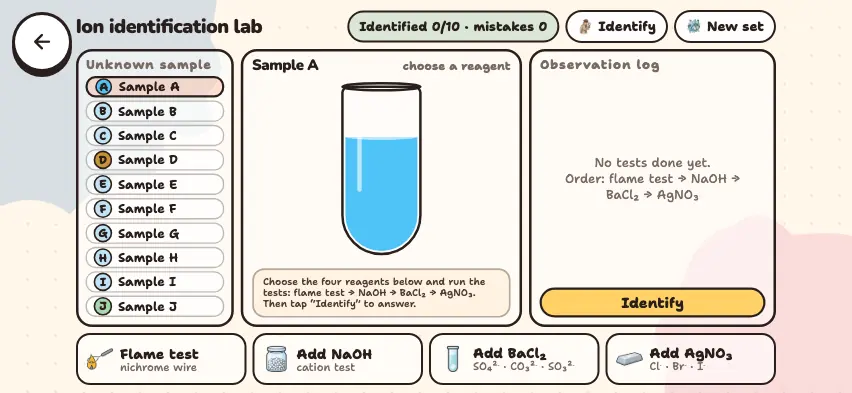
Use four reagents to identify the cation and anion in each sample. The simulator is free and needs no sign-up.
How do you use the simulator?
- Choose one of the samples A through J from the Unknown sample list.
- Press the reagents in the bottom row in order: Flame test, Add NaOH, Add BaCl₂, Add AgNO₃. The center area shows a test tube, an explanation, and the ionic equation.
- If a precipitate forms, a follow-up test button appears: Excess NaOH, Excess NH₃, Dilute HCl, or Ammonia solution. For the ammonium ion, the Heat + red litmus button appears.
- Each result is saved in the Observation log section.
- Press Identify, choose one option each under Cation and Anion, and press Confirm. If you are right, the sample's formula is revealed. If you are wrong, your error count goes up.
- The New set button reshuffles the samples and resets the score to zero.
Tasks to try in the simulator
- Before you run any tests, look at the color of each sample's round marker. Three samples are colored: blue CuSO4, pale green FeSO4, and yellow-brown FeCl3.
- Find the two samples that turn the flame yellow. Tell them apart with Add BaCl₂ and then Dilute HCl: Na2CO3 releases CO2, and Na2SO3 releases SO2.
- Tell apart the two samples that give a white hydroxide with Excess NH₃: the ZnBr2 precipitate dissolves, and the Al2(SO4)3 precipitate does not.
- Identify all ten samples without a mistake.