How does a precipitate form?
When a salt dissolves in water, it splits into ions. When you mix two solutions, a cation and an anion can form a new compound. If that compound does not dissolve in water, it becomes a solid and settles to the bottom.
AgNO3 + NaCl → AgCl↓ + NaNO3
The Na+ and NO3− ions stay in solution. So a net ionic equation includes only the ions that form the precipitate: Ag+ + Cl− → AgCl↓.
Solubility rules
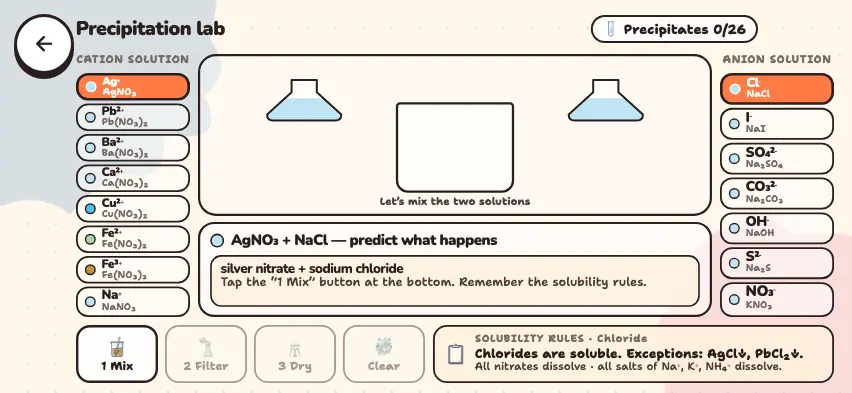
The rule for the selected anion is always visible in the bottom panel of the simulator.
| Anion | Rule | Exceptions |
|---|---|---|
| Cl−, I− | Soluble | Salts of Ag+ and Pb2+ form precipitates |
| SO42− | Soluble | Salts of Ba2+, Pb2+, Ca2+, and Ag+ form precipitates |
| CO32− | Insoluble | Salts of Na+, K+, and NH4+ dissolve |
| OH− | Insoluble | NaOH, KOH, and Ba(OH)2 dissolve |
| S2− | Insoluble | Salts of group 1 and 2 metals dissolve |
| NO3− | All soluble | None |
All salts of Na+, K+, and NH4+ dissolve, so these ions do not form precipitates.
Precipitate colors
| Color | Precipitate |
|---|---|
| white | AgCl, BaSO4, CaCO3, PbCl2, PbSO4 |
| yellow | AgI |
| bright yellow | PbI2 |
| pale blue | Cu(OH)2 |
| green | Fe(OH)2 |
| red-brown | Fe(OH)3 |
| blue-green | CuCO3 |
| black | Ag2S, PbS, CuS, FeS |
Make precipitates in the Nalukh chem app
Mix two solutions to form a precipitate, then filter and dry it. This simulator is included with full access. The app is free to download, and 2 units and 5 simulators are open with no sign-up.
How do you use the simulator?
- Choose one solution from the CATION SOLUTION column on the left and one from the ANION SOLUTION column on the right. Use the rules to predict what will happen.
- Press the 1 Mix button. If a precipitate forms, you see its formula, its color, and the full and net ionic equations. A precipitate you find for the first time gets a NEW mark.
- If no precipitate forms, read the reason.
- The 2 Filter button leaves the precipitate on the filter paper and lets the filtrate drain through.
- The 3 Dry button gives you the pure salt.
- Press the Clear button to clean the beaker, then choose the next pair. The top corner counts the precipitates you have found, up to 26.
Tasks to try in the simulator
- Mix Ag+ with each of the seven anions in turn, and find six precipitates. Which anion does not form a precipitate?
- Test Na+ with all the anions. No precipitate forms.
- Find the two precipitates of Ba2+. Use the note to find out which one dissolves in acid.
- Mix Fe2+ and Fe3+ with OH− and compare the colors.
- Mix Fe3+ with CO32−. Instead of a carbonate, Fe(OH)3 precipitates and CO2 gas is released.
How do you filter in a school lab?
- Put filter paper in a funnel and place a beaker under it.
- Pour the mixture onto the paper. The precipitate stays on the paper, and the filtrate drains through.
- Rinse the precipitate with distilled water and dry it.